5 min readfeature
The encore round: an agent that critiqued its own design work, then beat its own gates
The gallery's eighth app, built inside a measured design loop — every screenshot scored, every failure ledgered, every number traced to a receipt.
- #landing
- #demo
The first seven gallery apps asked whether the agent could carry a whole SDLC. This round asked the question that decides whether any of it scales: can the agent tell that its own work is not good enough yet — with numbers, not vibes — and then fix what the numbers say?
Short answer: the loop shipped. It found 23 font sizes and 32.7% off-grid spacing on a page six rounds of polish had produced, caught a 42px mobile overflow its own writing sessions had introduced, caught a contrast fix that broke the light theme one iteration after the fix landed, and drove its own flagship to every objective design gate green. The gallery now frames eight agent-built apps.
The instrument came first
The round began by building the thing the platform lacked: a critique
lane that produces receipts, not opinions.
scripts/design_critic.mjs
runs against any route of the production build — per-band and full-page
screenshots at desktop and mobile, an objective in-page audit (WCAG
contrast on every visible text node against its composited background, a
type-scale census, 4px-grid conformance, heading order, alts, overflow),
cold-load FCP/LCP/CLS/TBT, and a strict-JSON seven-axis VLM critique
through the Agnes lane — aggregated into one committed receipt per run.
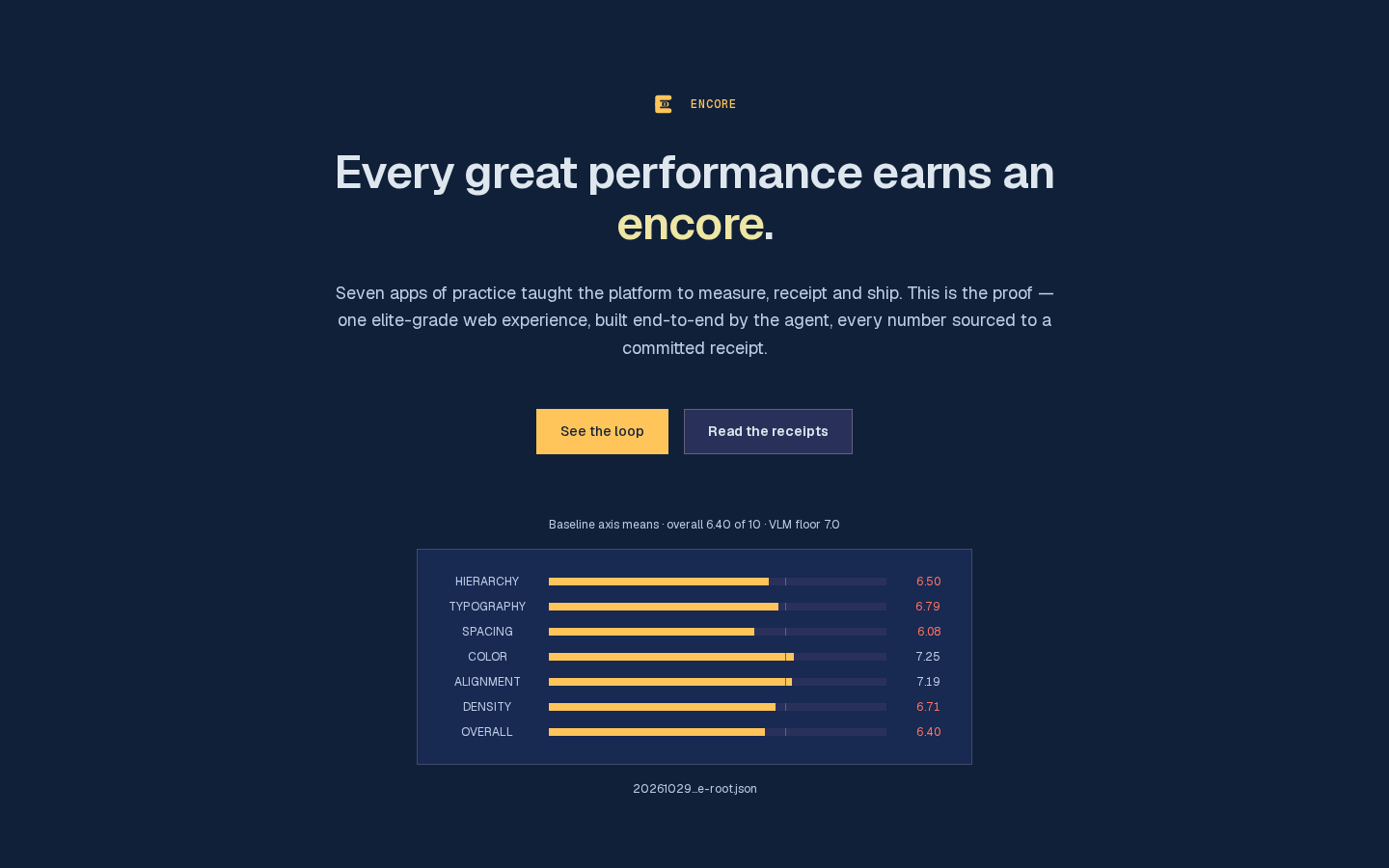
A judge that cannot discriminate is worthless, so the lane ships with a known-bad calibration fixture — eleven ad-hoc type sizes, arbitrary odd spacing, sub-AA greys, an h1→h4 skip. The fixture scores 1.5; the real landing page scores 6.4. The judge discriminates.
Then the first receipt landed, and it was uncomfortable: the landing page — six rounds of agent-built polish — resolves to 23 distinct font sizes (the elite baseline is about seven) and 32.7% off-grid spacing. The deliberately-chaotic calibration fixture uses ten sizes. Our real page was less disciplined than a page designed to be bad.
The flagship
Encore — the earned performance — is the gallery's eighth app, live
at /encore: a showcase, not a
SaaS domain, whose content is this round's own measured story. The
baseline receipt card (the honest 6.40/10 with its failing gates). The
critique loop as an interactive stepper. The tool cards. The failure
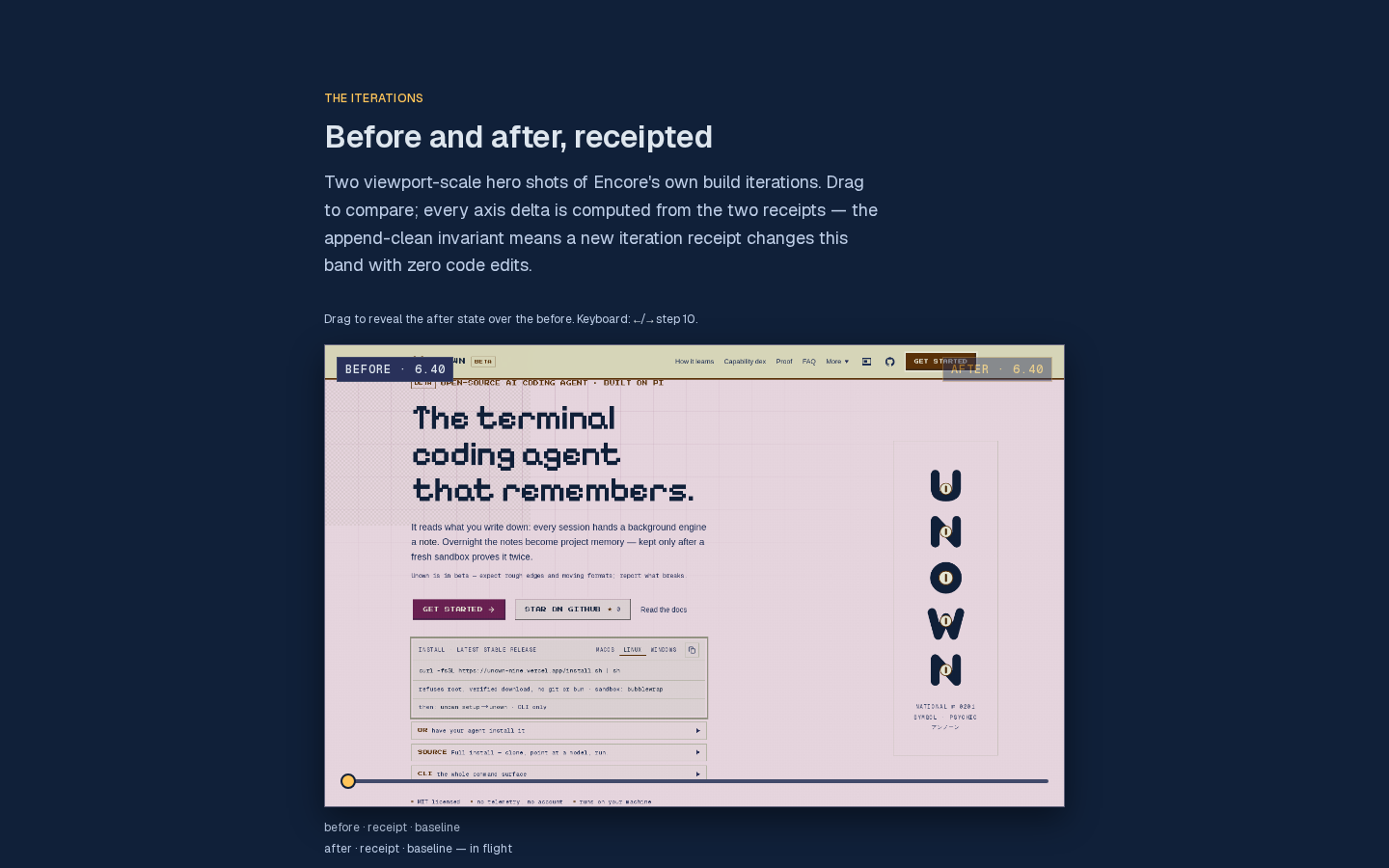
ledger. And the centerpiece: a before/after drag comparison between
the landing page's baseline hero and the flagship's final hero — the
program's success question rendered as a slider.
It was built by the agent across 17 ledgered sessions (459 turns,
513 tool calls, zero human edits to app code), phase by phase from its
own 192-line build contract — the design system pinned before a line of
UI existed: an eight-size type ramp, the 4/8px spacing grid, both
schemes WCAG-AA, the 390px covenant, motion 150/250/400ms behind
prefers-reduced-motion.
The loop, in receipts
Every iteration of the flagship was critiqued by the same instrument, and the receipts are committed:
| Run | VLM overall | Font sizes | Off-grid | Contrast (dark / light) | Overflow |
|---|---|---|---|---|---|
| the landing baseline | 6.40 | 23 | 32.7% | 0 / unaudited | 0px |
| iter0 — first build | 6.27 | 6 | 0% | 0 / 0 | 42px |
| iter1 | 6.00 | 6 | 0% | 0 / 0 | 42px |
| iter2 | 6.00 | 6 | 0% | 0 / 27 | 0px |
| iter3 — final | 6.22 | 6 | 0% | 0 / 0 | 0px |
The trajectory of the OBJECTIVE gates is the story: the discipline the
baseline lacked (type scale, spacing grid) held from the very first
build — because the plan enforced it — while the loop caught and fixed
what the writing sessions could not see: the 42px mobile overflow (an
sr-only data table whose layout box the scoped table CSS re-expanded
past the viewport), and the round's favorite failure — a contrast fix
that pinned its colors "under any scheme" and broke the light theme for
27 text pairings, caught by the both-scheme audit one iteration
later, fixed by inheriting the landing's own dual-declared tokens.
And the honest part, on the record: the VLM overall (6.22) did not clear the 7.0 floor, and sits within a single judge's variance band. The objective gates are laws and they pass; the aesthetic floor is a goal and it stays open. The showcase says exactly that — no number without its receipt, no spin on the ones that hurt.
What the platform keeps
The round's failures are ledgered (F14–F18 in the validation log), and each one left a permanent artifact behind:
- the critique lane with its both-scheme audit (the judge's own light-scheme blind spot was the fourteenth failure it caught — its first run photographed only the light theme and nobody noticed until the receipts described "off-white backgrounds" on a dark-first page);
- the calibration fixture — the judge's discrimination pinned by a receipt, not asserted;
- the seed drift gate — the showcase's every number tied to its committed receipt by a test that reads the JSON and compares field-by-field;
- the project memory AutoDream consolidated from the build's own session
notes — the sibling-inspection rule, the happy-dom origin quirk —
already rendered into
.unown/memory/project.mdfor the next round's sessions to inherit.
The primary success question — would a restarted project, using the improved platform, create a significantly better website than it could have at the beginning? — now has a measured answer. At the beginning: 23 font sizes, 32.7% off-grid, no instrument to see either. After: a first build that lands at 6 sizes and 0% off-grid because the contract and the critique loop exist, with every failure it introduces caught by a receipt, not a reviewer.
That is the encore: the performance after the performance. The next one starts from these receipts.
Spotted something wrong or worth adding? The record is the repo — open an issue.