5 min readfeature
The provider round: what nine competitors taught unown about connecting a model
Wire-aware probes, a rate-limit verdict that stops lying, masked key entry everywhere, and latency chips — the 2026-10-30 hardening of the provider path.
- #providers
- #hardening
The provider configuration path is the first ten minutes of every install: connect a model, trust it works, start coding. This round took that path apart against the field — Claude Code, Codex CLI, Gemini CLI, opencode, Cursor, Aider, Cline/Roo, Continue.dev and Cherry Studio, reverse-engineered from their docs, config schemas and error catalogs — and rebuilt every place unown was weaker. Five fixes landed (two of them P0s), three new indicator surfaces, and 16 new pinning tests; the full list is in the 0.0.43 changelog stop.
The two P0s
An update silently truncated your model list. upsertProvider — the one mutation path behind unown setup, unown providers add and the engine's registry merge — rebuilt a provider's models array from the incoming ids only. The comment above that line said "drop nothing"; the code dropped everything not named. The real-world damage: the bridge seeds its full 9-model allow-list on first run, and a later unown setup --provider bridge --model agnes-2.5-flash quietly deleted the other eight from /model and --model routing. Updates now take the union — incoming ids first, registered extras kept — with --force as the only reset, matching refresh's existing "removal is a deliberate act" rule.
providers key echoed your secret in clear text. The TTY prompt used a plain readline question while its label claimed "input hidden by your terminal's paste" — the typed key was on screen the whole time. Key rotation and the interactive providers add wizard now use the setup wizard's raw-mode masked reader (• echo, Ctrl+C cancels with nothing written), verified end-to-end in a real PTY with a pane-truth gate: bullets on screen, zero clear-text occurrences.
Wire-aware probes — Anthropic keys stopped lying
Every reachability check — session preflight, doctor, providers test, setup verification — probed with the OpenAI wire's Authorization: Bearer header. Anthropic's API authenticates with x-api-key, so a perfectly good Anthropic key read as "credentials rejected (HTTP 401)". The probe now speaks each provider's own wire: anthropic-messages providers are authenticated with x-api-key + anthropic-version against {root}/v1/models — the exact shape the Anthropic SDK's own models listing uses. A side effect worth the round by itself: the setup wizard's live model discovery now offers a numbered choice of what a real Anthropic endpoint actually serves, the same as the OpenAI wire always did.
A 429 is not "unreachable"
Claude Code's error catalog draws the line explicitly — the server is temporarily limiting requests, not your usage limit — and unown's probe now does the same. A 429 on a model-listing probe used to pass silently (with an empty model list, which read as "serves no listable models") or, on refresh, report the endpoint as down. It now classifies as rate-limit: the endpoint is up, the key passed auth, only the throttle is in the way. doctor rates it warn-class — the chat path answered — and every surface from preflight to the /providers manager says the same sentence: "rate-limited (HTTP 429) — the endpoint is up and throttling; retry in a moment."
Indicators: latency, health marks, time-to-first-token
The round's competitor sweep kept surfacing the same delighters — live latency badges, health states on screen, cost before you ask. Three landed:
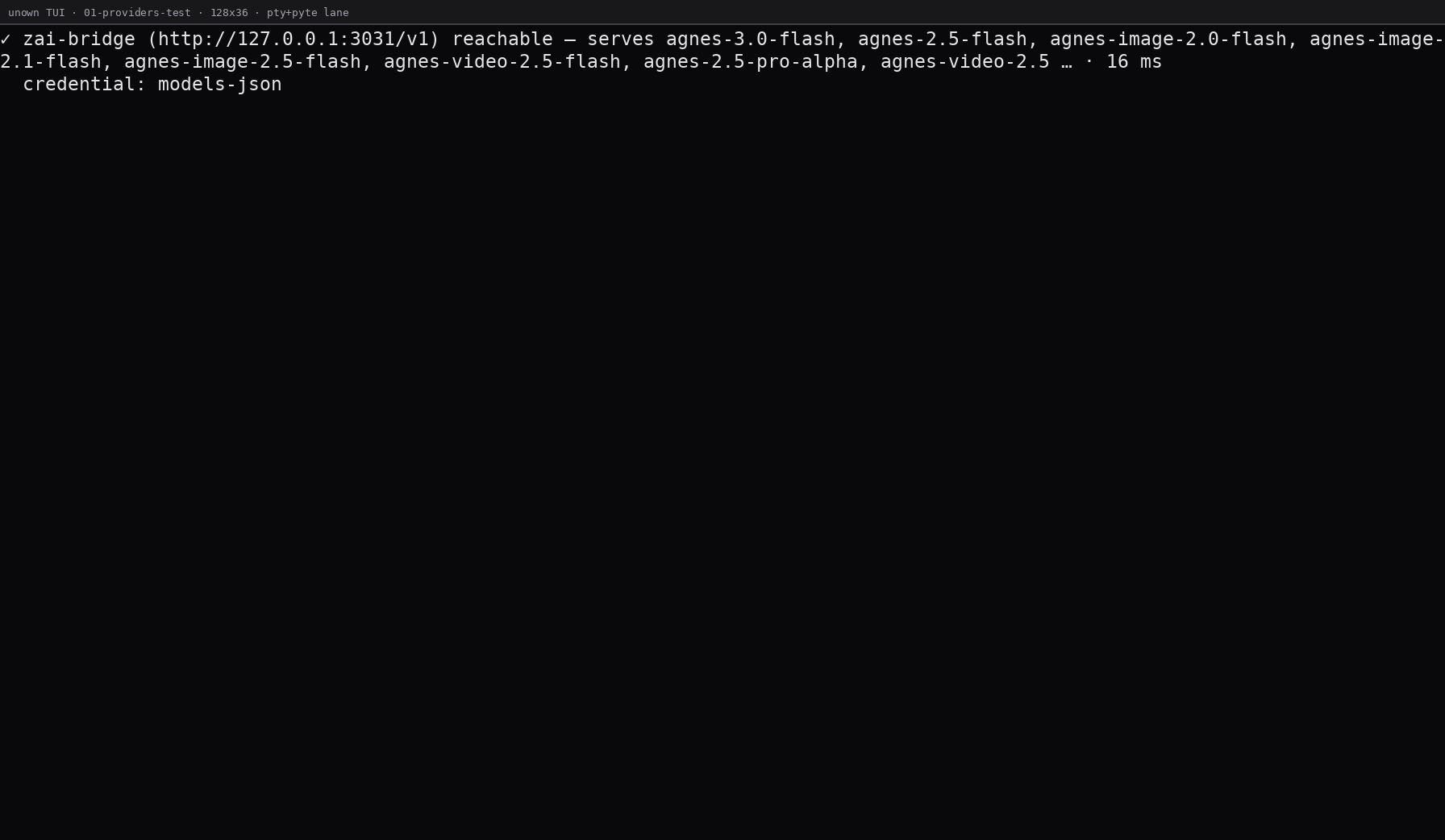
Every answered probe now carries its round-trip time — · 17 ms next to the reachability verdict on providers test, doctor's model-endpoint row, the unown models served-list header, and the in-session /providers test verdict.
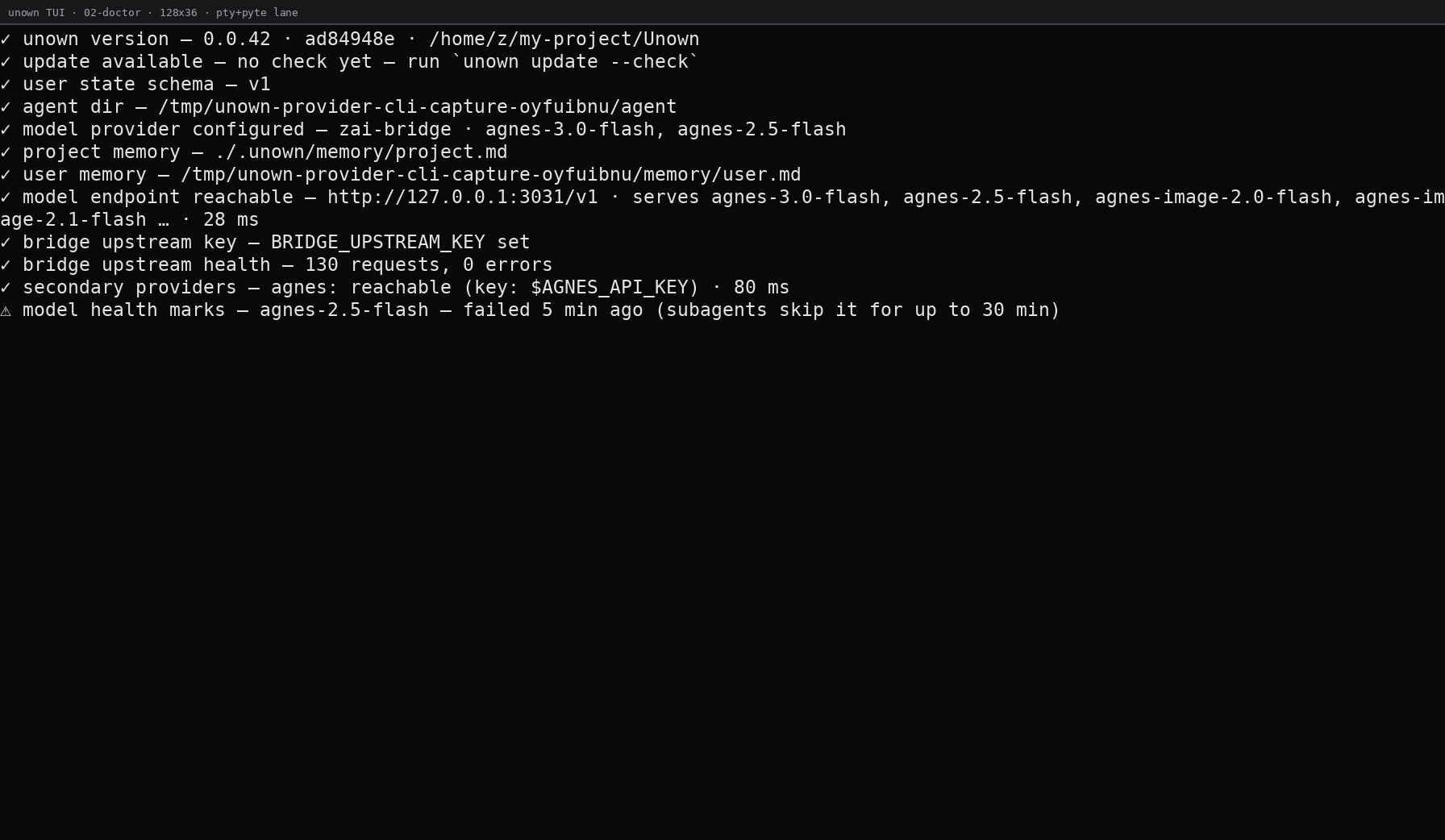
The model-health store — the cross-process marks subagents use to skip a provider-failed model for 30 minutes — was written everywhere and read nowhere user-facing. doctor now carries a model health marks warn row (agnes-2.5-flash — failed 5 min ago (subagents skip it for up to 30 min)), so a silent skip is never mysterious.
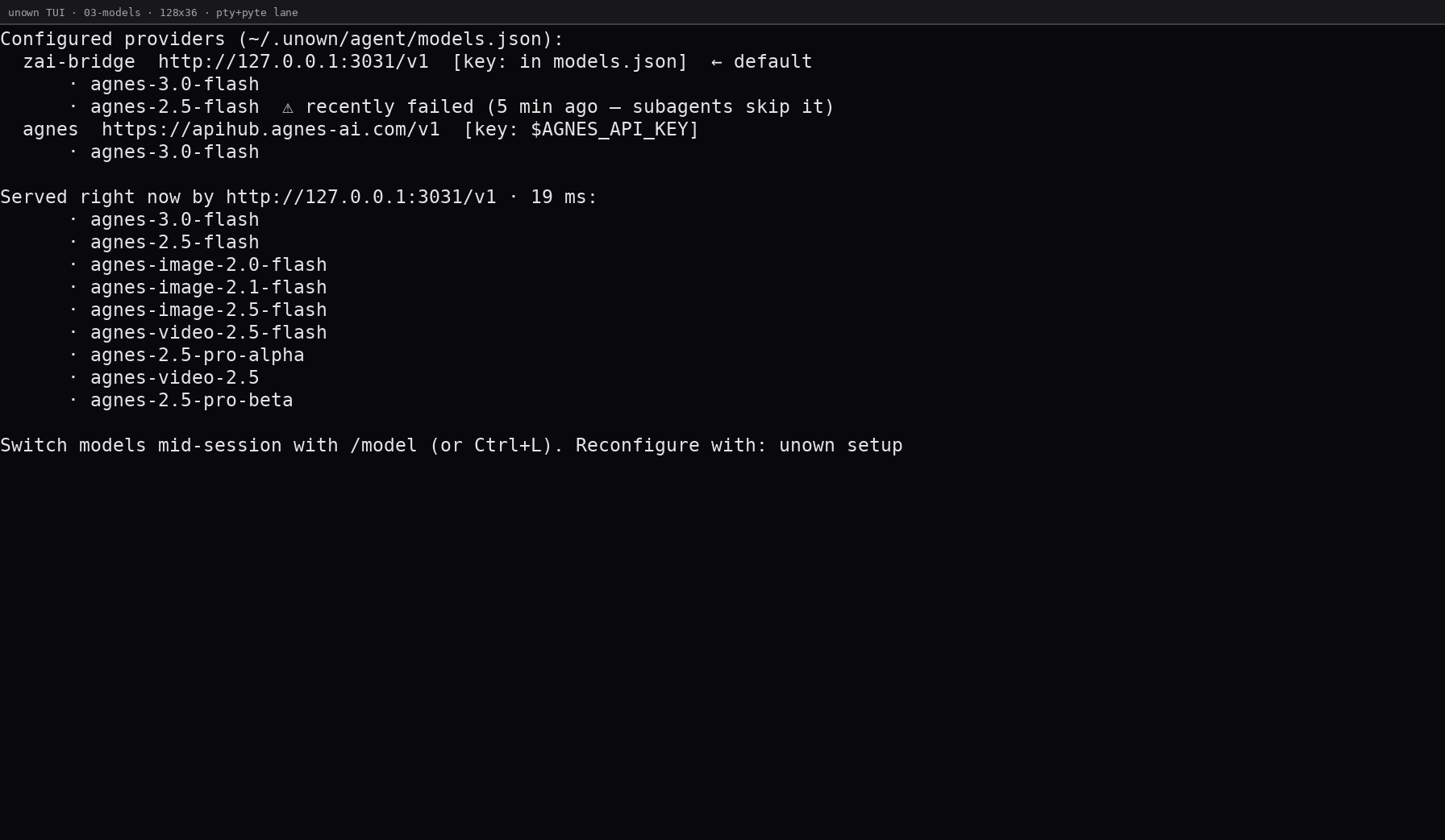
unown models annotates marked models inline (⚠ recently failed (5 min ago — subagents skip it)) and labels Anthropic-wire providers with · anthropic wire.
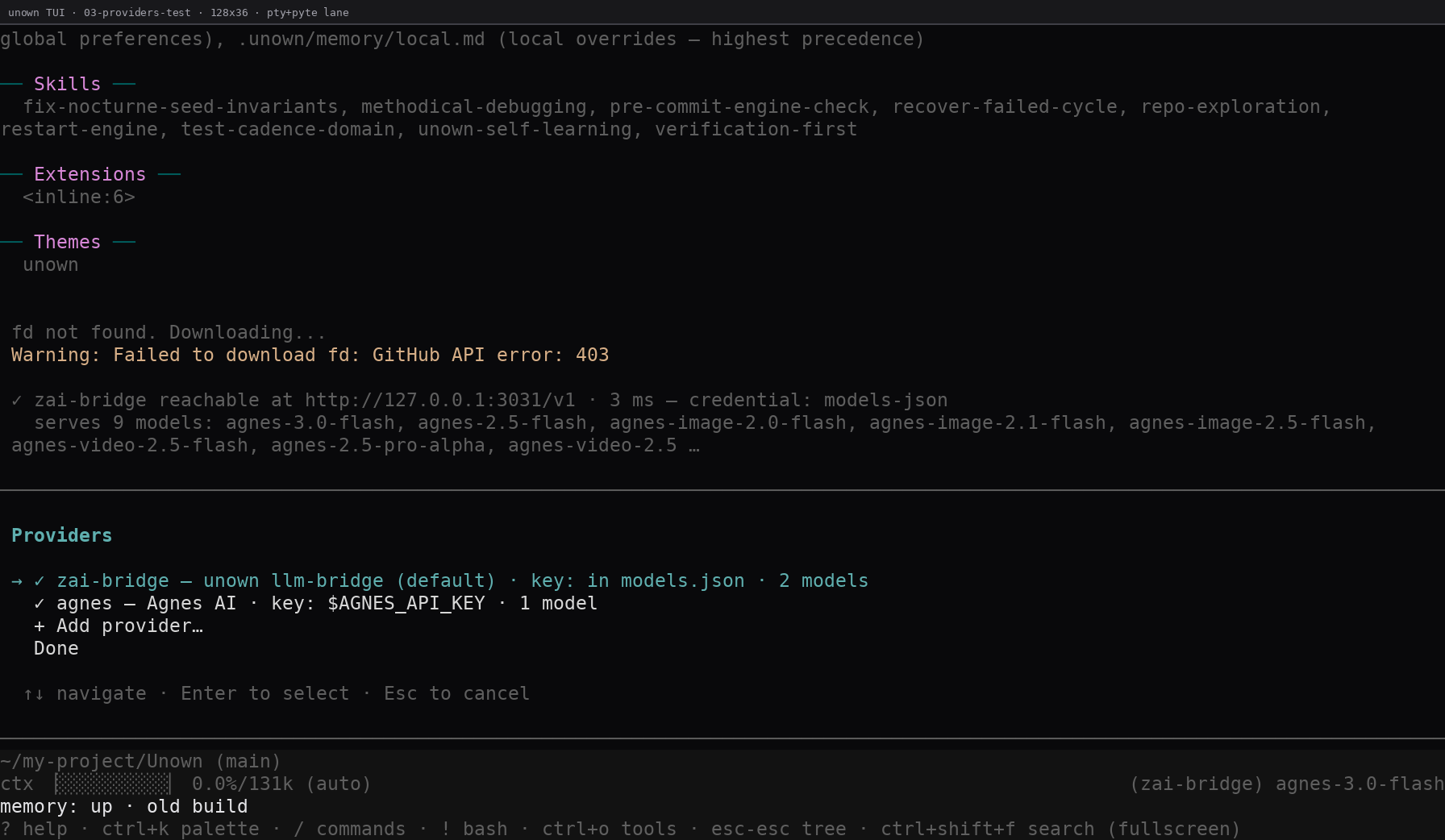
And the footer turn meter gains a time-to-first-token chip — turn 3.4s · ttft 0.8s · ctx 62% · … — captured from the first streamed assistant chunk (goose v1.42+ row parity; the chip is omitted when the host cannot observe it).
Paste hygiene, edge to edge
The classic provider-setup failures are paste failures: a trailing newline on a key that becomes a stored secret that 401s, a base URL with a trailing slash, whitespace inside a key. Every entry point — the wizard's masked prompt, --api-key flags, providers key, the /providers set-key action — now trims, strips CR/LF artifacts, and rejects keys that still contain whitespace or control characters with a Claude-Code-style diagnosis that names the character class and never echoes the value. Base URLs get the same normalization before anything is written or probed. And two smaller edges closed: the wizard's provider-choice step no longer silently selects preset 1 on a non-integer answer (the NaN || 1 hole — it goes through the dialog's validated numbered-list contract), and removeProvider can no longer write a bogus empty-string defaultModel when the surviving provider has no models.
Receipts
- The changelog stop: 0.0.43 in CHANGELOG.md
- The user-facing flow: docs/providers.md
- The pins:
providers-probe.test.ts(16 new — wire-aware headers, rate-limit class, latency,sanitizeApiKey, the empty-default guard, the TTFT chip) plus the union-merge regression inproviders.test.ts; full suite 4901 pass / 0 fail - The captures: the PTY lane's
pty_capture_provider_cli.pyandpty_capture_providers.py, every still written with its pane-truth dump and re-grepped on exit
Spotted something wrong or worth adding? The record is the repo — open an issue.