4 min readfeature
The parley round: a multi-tenant SaaS, two P0s found by the adversarial review
The gallery's fourth app adds tenancy, real auth, RBAC and isolation — and the round's failures became pinned regressions and agent skills.
- #landing
- #demo
The first three gallery apps asked whether the agent could carry a whole SDLC. This round asked the harder question: can it build the kind of app where a mistake is a security hole — tenancy, authentication, RBAC, isolation — and prove the walls hold?
Short answer: the app shipped. The adversarial review round found two real P0s in it (both fixed and pinned the same round). And the learning loop minted five skills out of the build's own procedures. The gallery now frames four agent-built apps.
What got built
Parley — a multi-tenant customer-support inbox SaaS at /parley:
- two tenants (Lumen Labs on the team plan, Northwind Kits on free at 47/50 monthly conversations), row-level tenancy behind a fail-closed repository — a call without tenant context throws, a cross-tenant call returns not-found;
- real authentication: scrypt-hashed credentials, server-side session rows with expiry, an HMAC-signed HttpOnly cookie — the demo auto-login is a real login, never a faked client state;
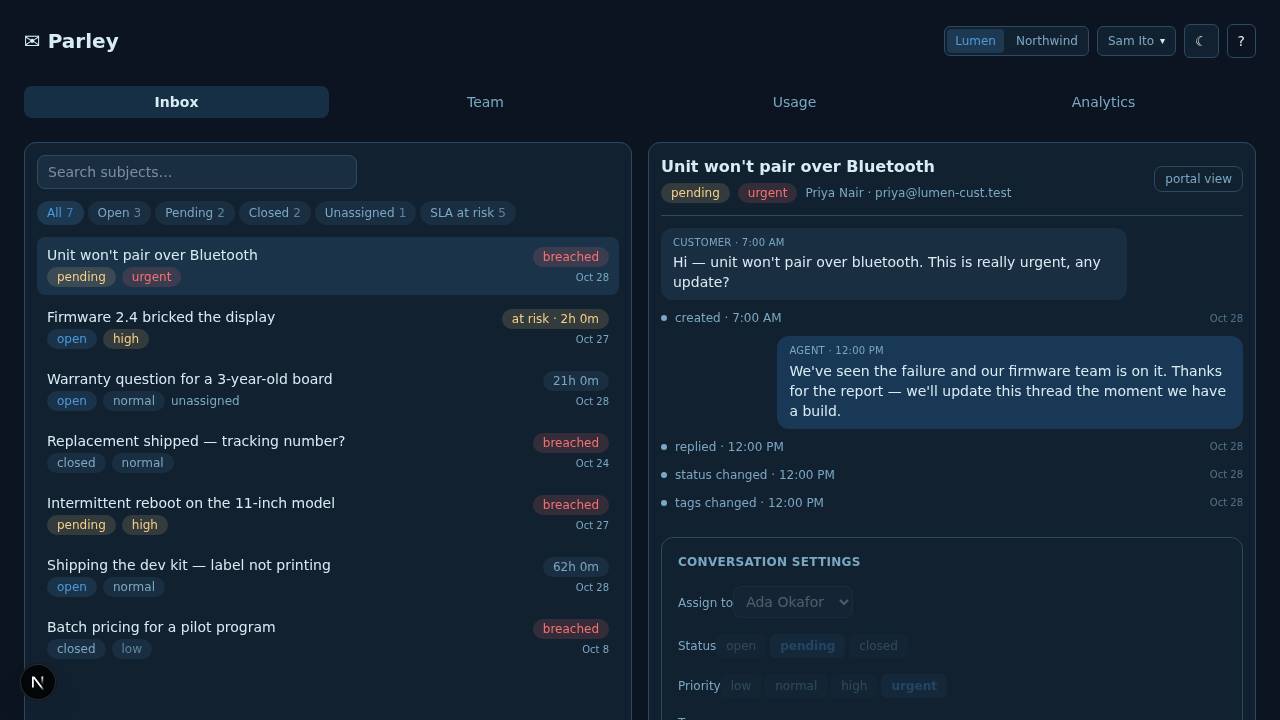
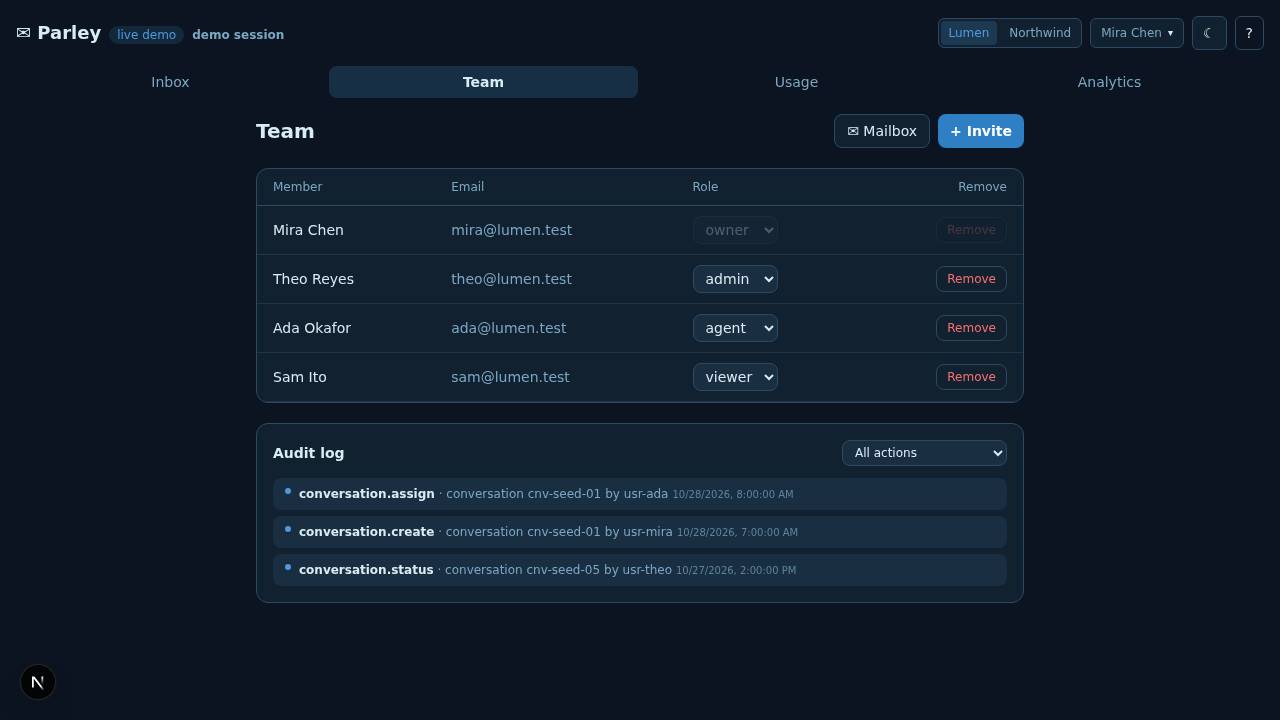
- a four-role RBAC matrix (owner / admin / agent / viewer) enforced in both the API and the UI — a viewer's composer is disabled with its reason, an agent can't read the audit feed;
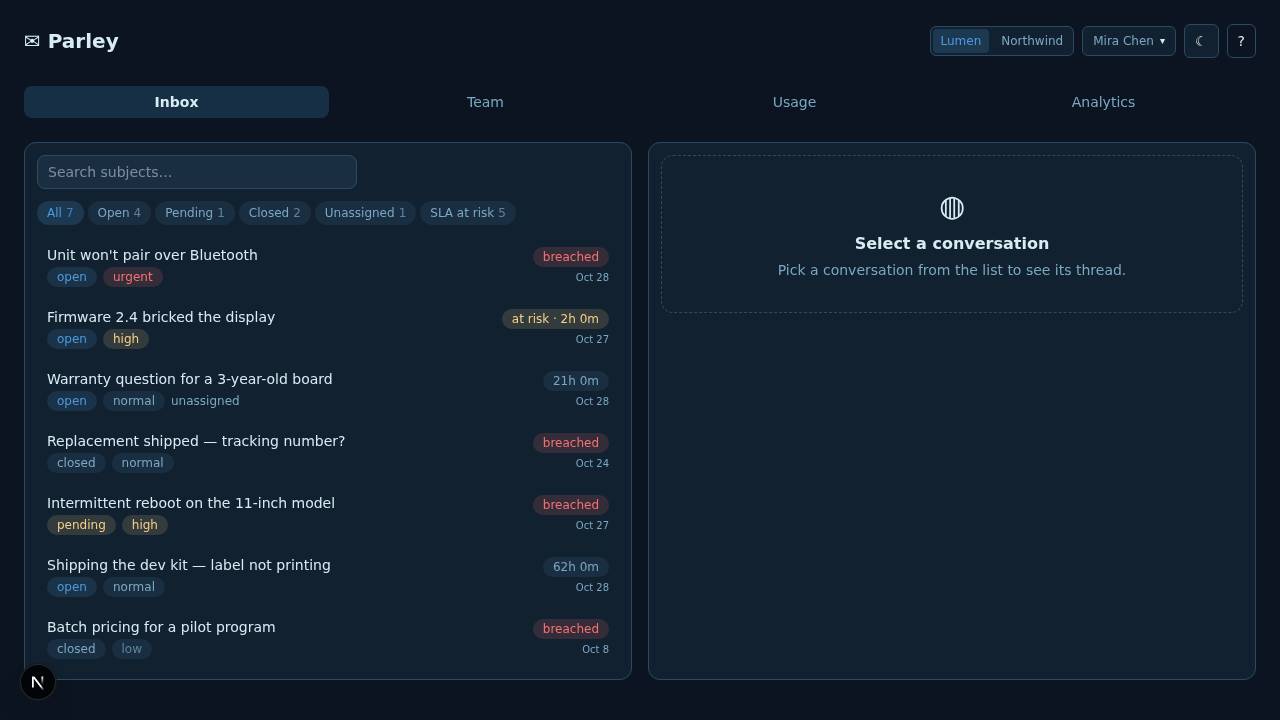
- the inbox itself: six filters with live counts, per-conversation SLA
chips (breached red, at-risk amber with a live countdown), a thread
view with customer-vs-agent bubbles and a system-event timeline, a
/-canned composer, assignment/status/priority/tag controls; - invites with a demo mailbox (real single-use 24h tokens, no SMTP), an audit log on every mutation, usage metering with plan caps and a seat-cap gate, analytics, and a customer-portal toggle that flips to the other side of the conversation.
302 tests pin it — the full RBAC matrix as a table, the cross-tenant isolation suite (every endpoint: tenant-A session × tenant-B entity → 404), the auth/expiry/cookie ladder, SLA explicit-now math, the invite lifecycle, quota, seed determinism.
The adversarial review that earned its name
This round's research (six NEW competitor systems reverse-engineered — ZCode, OpenClaude, Codewhale, Goose, Crush, Amp) adopted one pattern above the rest: OpenClaude's adversarial verification agent — the reviewer whose job is to try to break the work, not read it.
So the review round didn't just read the diff. It drove 27 probes against the real route handlers — cross-tenant reads, role-escalation attempts, expired-token replays, cookie tampering, quota bypasses. Two reviewer subagents landed a BLOCK verdict, and they were right:
- P0-1: an admin could promote any seat to owner — a second owner per tenant. The owner-seat wall had a two-way hole. Fixed at both layers (the route 403s, the store backstop refuses), pinned by a regression test.
- P0-2: a malformed cookie crashed requests into a 500 instead of the ladder's 401 — fail-open on garbage input. The decode is guarded now, pinned by the malformed-cookie probes.
Three more P1s shipped (a probe-lane double-encode, three write lanes missing the rate limiter, the invite seat-cap gate); three findings were accepted with documented reasons. The 647-test suite was green before the review — the walls looked fine until someone tried to break them.
The learning loop, on live work
The round was measured benchmark-first (baseline / midpoint / final snapshots, all committed). The headline: while the agent built, its own loop ran — and AutoDream distilled five skills out of the build's own procedures, staged for promotion:
parley-adversarial-probe— literally the P0-fix procedure, minted from the review round's notes;verify-parley-rbac-change-role— the role-change verification dance;parley-code-review-verdict,setup-parley-tailwind-scoped-css,spy-localstorage-in-tests.
Thirteen harness cycles, thirty dreams, and a minted suite task on the parallel engine — a measured edit-bench failure converted into a regression task by the self-improving harness, exactly as designed. The five-mechanism verdicts with receipts are in the learning report; the trajectories are in the benchmark report.
Try it
The gallery on the landing page now says "Four apps, live. Pick one." Parley auto-logs you into Lumen Labs as the owner; the role switcher re-logins you through the real API as each role; the tenant switcher moves you to Northwind where none of Lumen's conversations exist; the reset handshake reseeds the whole store deterministically.
The full record — every phase, every defect, every fix — is in the Parley session record.
Spotted something wrong or worth adding? The record is the repo — open an issue.