3 min readfeature
The live preview round: the landing page now runs what the agent built
Four sessions, ~200 tool calls, one fullstack app — and the landing page now runs it instead of showing a video. The category's first live agent-built demo.
- #landing
- #demo
The builder round filmed the agent building an app — one prompt in, a green test suite out, the whole thing on video. This round asks the harder question a video can't answer: does the artifact actually run? The landing page's new "Live demo" band answers it by running the app in your browser. Not a recording of the app. The app.
What got built
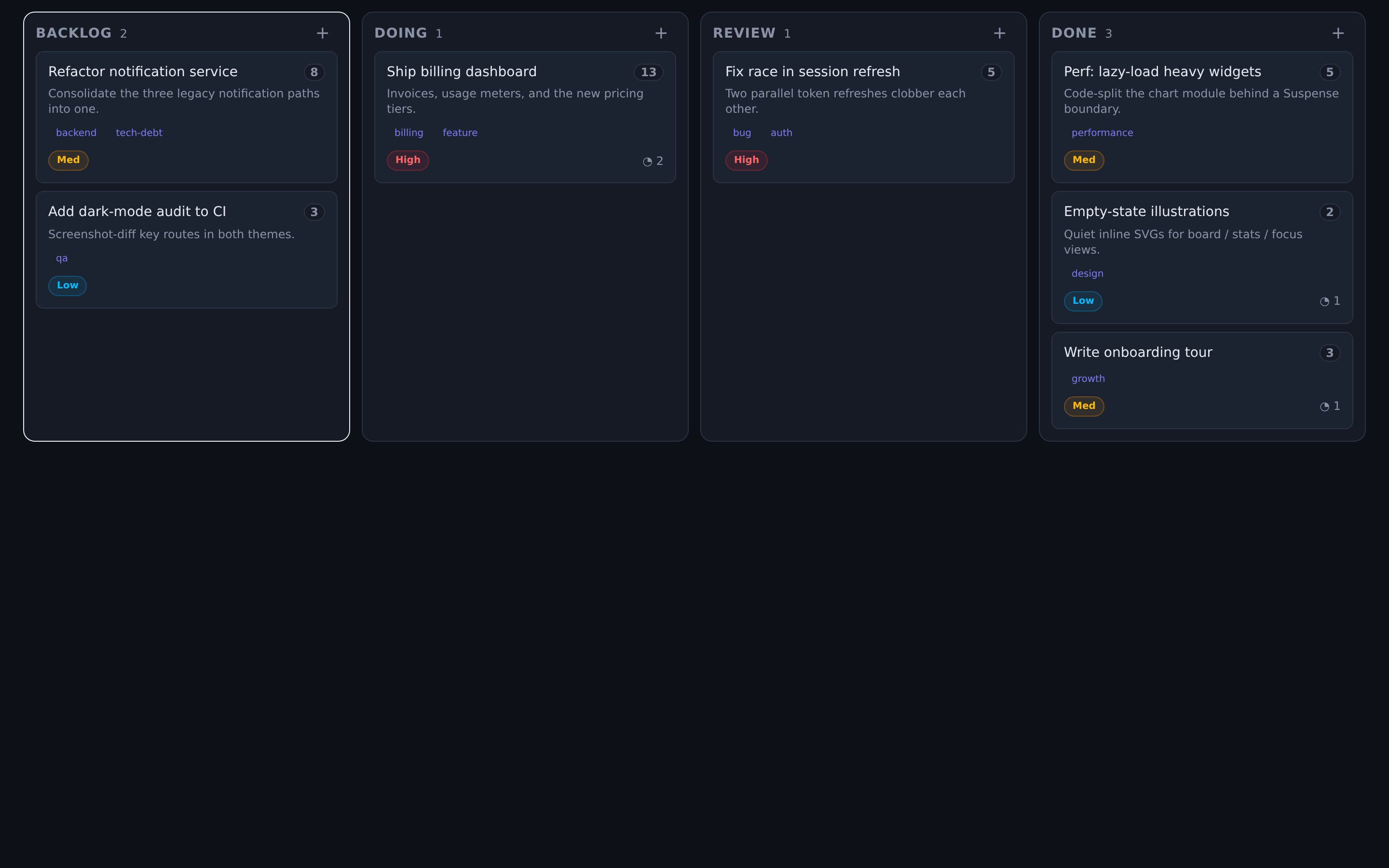
Sigil Focus — a fullstack productivity app:
- a four-column kanban board (Backlog, Doing, Review, Done) with drag-and-drop cards carrying priority, labels and story-point estimates;
- a configurable pomodoro focus timer that attaches to a task and logs completed sessions against it;
- a stats view — 14-day SVG bar charts of tasks completed and focus minutes, all-time totals, and a day-streak calculation;
- localStorage-first persistence with best-effort API sync (Next.js route handlers for tasks, stats and a starter-template library);
- dark/light themes, a mobile layout where columns collapse to tabs, and
keyboard shortcuts (
n,/,1–4,t).
How it was driven
Like a real user, not a demo script. Four sessions against the live stack
(agnes-3.0-flash through the bundled bridge):
- Build — one prompt, the full brief; the agent planned six todos, scaffolded, built, tested, committed three times.
- Review — a human testing pass found eight issues (a VLM design
critique found the rest: dead vertical space, confusing empty states,
chart cards that were mostly void); the agent fixed all eight and added
demo-data seeding plus an
?embed=1mode. - Finish — the review round hit its turn cap mid-work; a resume session verified everything and landed the commit.
- QA — the agent verified its own app in a real browser: board render, task creation with a 201 from the API, drag-and-drop, a ticking timer, rendered charts. Verdict: SHIP.
The receipts: ~200 tool calls, four commits, 27 unit tests green, zero human edits to the app's code — the full record, briefs and per-session ledgers, is docs/live-demo-session.md.
The honest engineering of embedding
An app that owns its document behaves differently from an app embedded in someone else's. The integration surfaced (and fixed) real defects the standalone app shipped with:
- A hydration bug: the embed flag was read from
window.location.searchinside auseStateinitializer — the server rendered one tree, the client another, and every?embed=1visit was a React #418 mismatch. The route now threads the flag fromsearchParamsserver-side. - A contrast defect: the landing page's axe gate scans into the iframe, and the app's "High" priority badge read 3.85:1 on its dark surface — below WCAG AA. The badges moved to the -400 shades and now pass.
Both fixes live in the embedded copy with code comments; the app as the agent wrote it is preserved untouched in the build record.
Try to break it
The band's frame is sandboxed, lazy-mounted (an idle visit never pays the demo's hydration cost — a poster still carries the first impression), and has a working reset button (a postMessage handshake the app listens for in embed mode) so every visitor is one click from the pristine seeded board. There's also an open full screen hatch — the route is a real deployment, and the full app (including its own header, theme toggle and API routes) is one click away.
No other terminal coding agent ships this. Their landing pages show videos of agents working; this one runs the working thing. Go drag a card.
Spotted something wrong or worth adding? The record is the repo — open an issue.