4 min readfeature
The commerce round: a storefront, a checkout, and a browser QA pass
Three SDLC rounds — planned, reviewed, browser-QA'd — and the landing page now frames two agent-built apps in a live gallery: 838 calls, one SHIP verdict.
- #landing
- #demo
The live-preview round asked whether the artifact runs. This round asks the harder one: can the agent carry a whole SDLC — plan, build, review, QA — on an app complex enough that each stage has real work to do? And can the landing page carry more than one proof at a time?
What got built
Sigil Bazaar — a fullstack e-commerce demo, an arcane marketplace of runes, sigils, relics and tomes:
- a storefront with 16 products, search, category chips, four sorts, and CSS-drawn glyph monograms (no binary image assets anywhere);
- a cart drawer with steppers, tax at 8%, and free shipping over $50;
- a three-step checkout wizard with real inline validation (Luhn on the card, expiry-not-in-the-past, 5-digit ZIP);
- an order history seeded with eight orders so the analytics have data;
- an owner dashboard: KPIs, a 14-day revenue chart, top-5 products, category mix, and an inventory table with restock actions;
- API routes with an in-memory store seeded identically to the client; localStorage-first persistence; 88 unit tests (the brief asked for 40).
How it was driven
Like a real user, across the three rounds — planned, reviewed, then browser-QA'd by the agent itself:
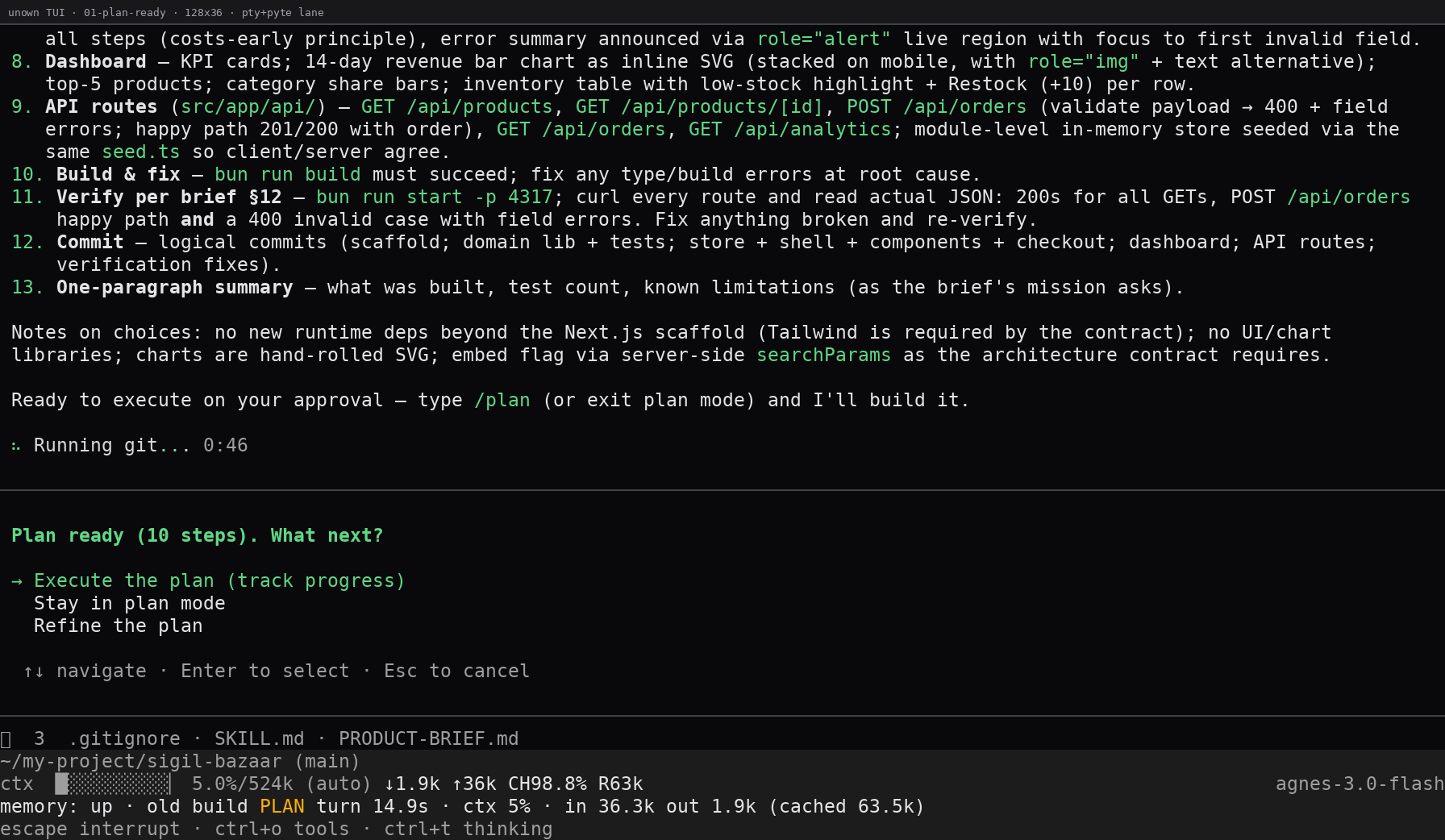
- Plan — plan mode, the 13-point plan, the approval overlay (a human in the loop before a line of code), then the build: scaffold, domain layer, components, API routes, tests, curl verification, commits.
- Review — my real-user pass found the API snapshotting order items
as
name=productId, price=0and re-posting every seeded order on each fresh load; a VLM design critique through the bridge found the rest. The agent verified all 56 findings claim-by-claim, fixed the real ones, and rejected the misreadings with reasons. - QA — the agent drove a real browser (a browser subagent) through every view, a failing-validation checkout, and the mobile layout. It found one real bug — the confirmation step closed too fast to read — fixed it, re-ran the pass, and shipped the verdict below.
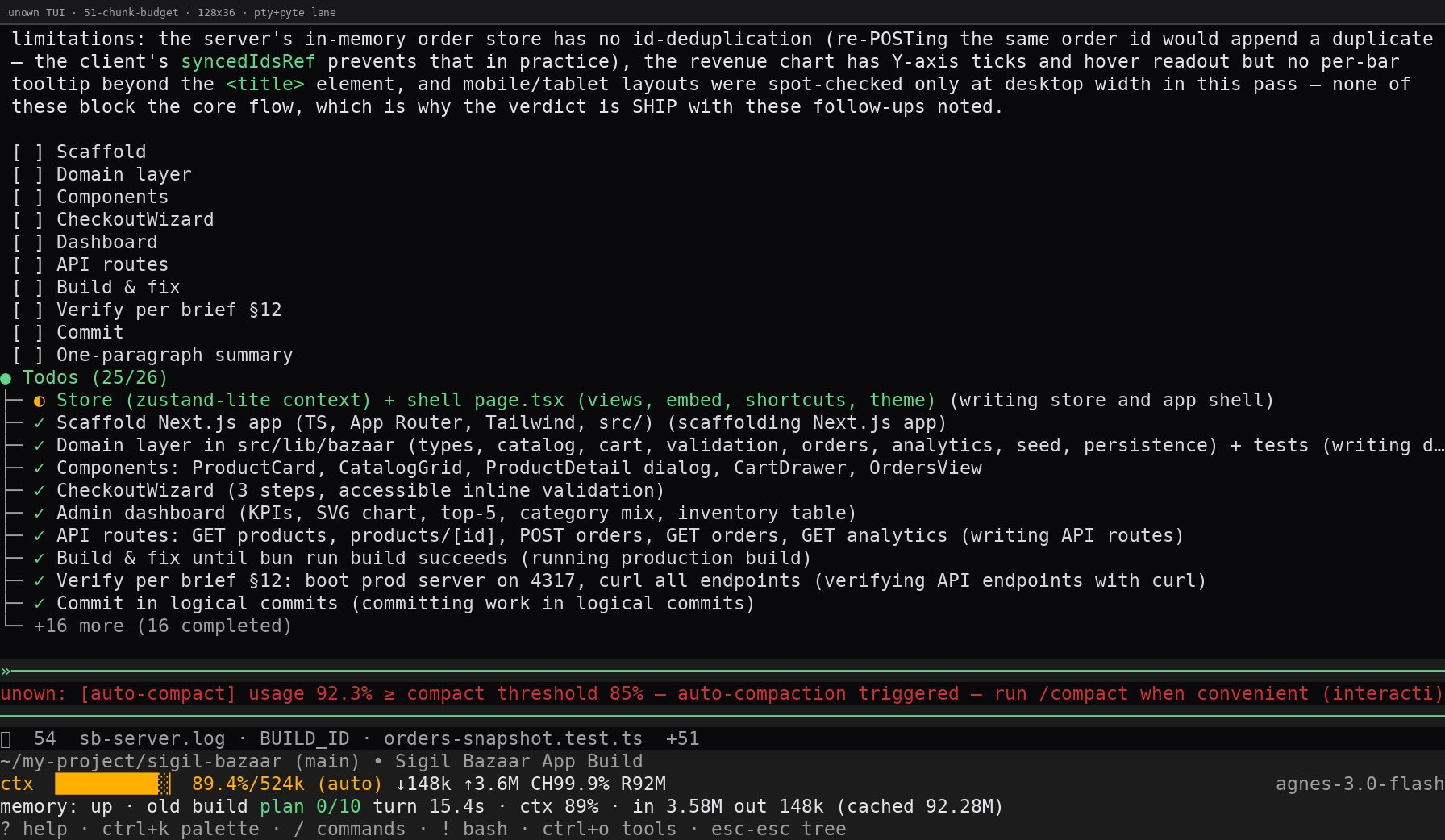
The receipts: 838 tool calls across the round (the ledger also counts 9 auto-checkpoints), 7 agent commits, 88 tests, zero human edits to the app's code. The full record — briefs, findings, patches — is docs/bazaar-demo-session.md.
The gallery
The landing page's live-demo band is now a gallery: two agent-built apps, each iframed from its own route in browser chrome, one switcher — the pattern v0's template gallery made the category default. Pick Sigil Focus and drag a card; pick Sigil Bazaar and buy something.
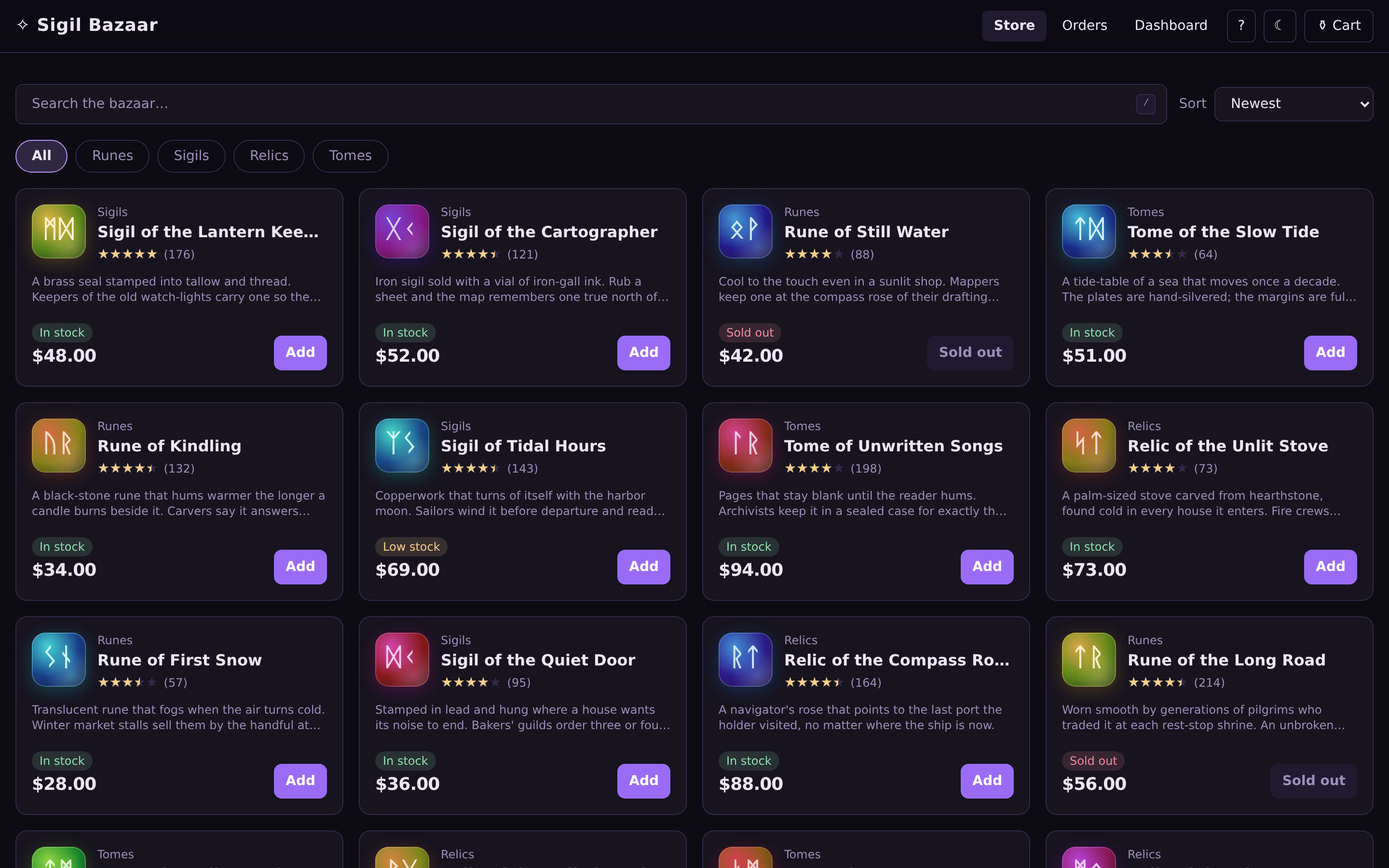
Switching apps is one same-origin navigation on a persistent frame; the receipt chips swap with the tab (each app's numbers come from its own build record, pinned by test — no hand-typed counts).
The honest engineering of embedding
The integration pass found real defects and fixed them at the right layer:
- A future-dated seed: the seed generates same-day orders at fixed times-of-day. At 00:04 UTC the integration test caught the seed dating orders into the future — future orders render ahead of "now" in the Orders view and the analytics count revenue that has not happened. A same-day time still ahead of now is now dated yesterday at the same time.
- AA contrast through alpha: the first cut of the gallery's selected tab used a translucent background over the chrome bar. Axe computes the effective contrast through an alpha background — 1.73:1. The tab is an opaque pill now, and the a11y gate is the reason.
- Both demos got the hardening round: CSP
frame-ancestors 'self'+X-Frame-Options: SAMEORIGINon the demo routes, the reset handshake pinned towindow.origin(never"*"), a per-IP rate limit on the public order POST, aseedVersiontag so new seeds reach returning visitors, and the sandbox attribute trimmed ofallow-modals.
Try to break it
The band keeps the same contract as the first demo: sandboxed frame,
lazy-mounted (an idle visit never pays the demo's hydration cost — the
poster carries the first impression), a working reset, and a full-screen
escape hatch per app. Below sm it is the poster and a tap-through, not a
390px iframe.
If the storefront sells you nothing else, the checkout wizard is worth one
pass: type an invalid card, watch the inline validation, then put
4242 4242 4242 4242 through and read your order number. It was built,
reviewed, browser-tested, and shipped by the agent — the receipts are one
click away.
Spotted something wrong or worth adding? The record is the repo — open an issue.