5 min readrelease
The validation round: cold-starting the learning loop, then pointing it at itself
A fresh clone, an empty engine DB, one tracked memory file — a validation programme that found drift, poisoning, and a dead-ended mint, then fixed all three.
- #memory
- #engine
- #release
Every validation we had published so far came from a warm install — an
engine that had been learning for weeks, with a database full of dreams
and a memory stack grown fat on real work. That is the favorable
condition. The deployment every new contributor actually experiences is
the opposite: a fresh clone, an empty engine database, and exactly one
artefact of accumulated learning — the tracked
.unown/memory/project.md.
So the validation round asked the uncomfortable version of the question: does the self-learning loop work from zero? And because a validation programme that only passes is a validation programme that wasn't trying, we armed it with probes designed to break things.
The setup
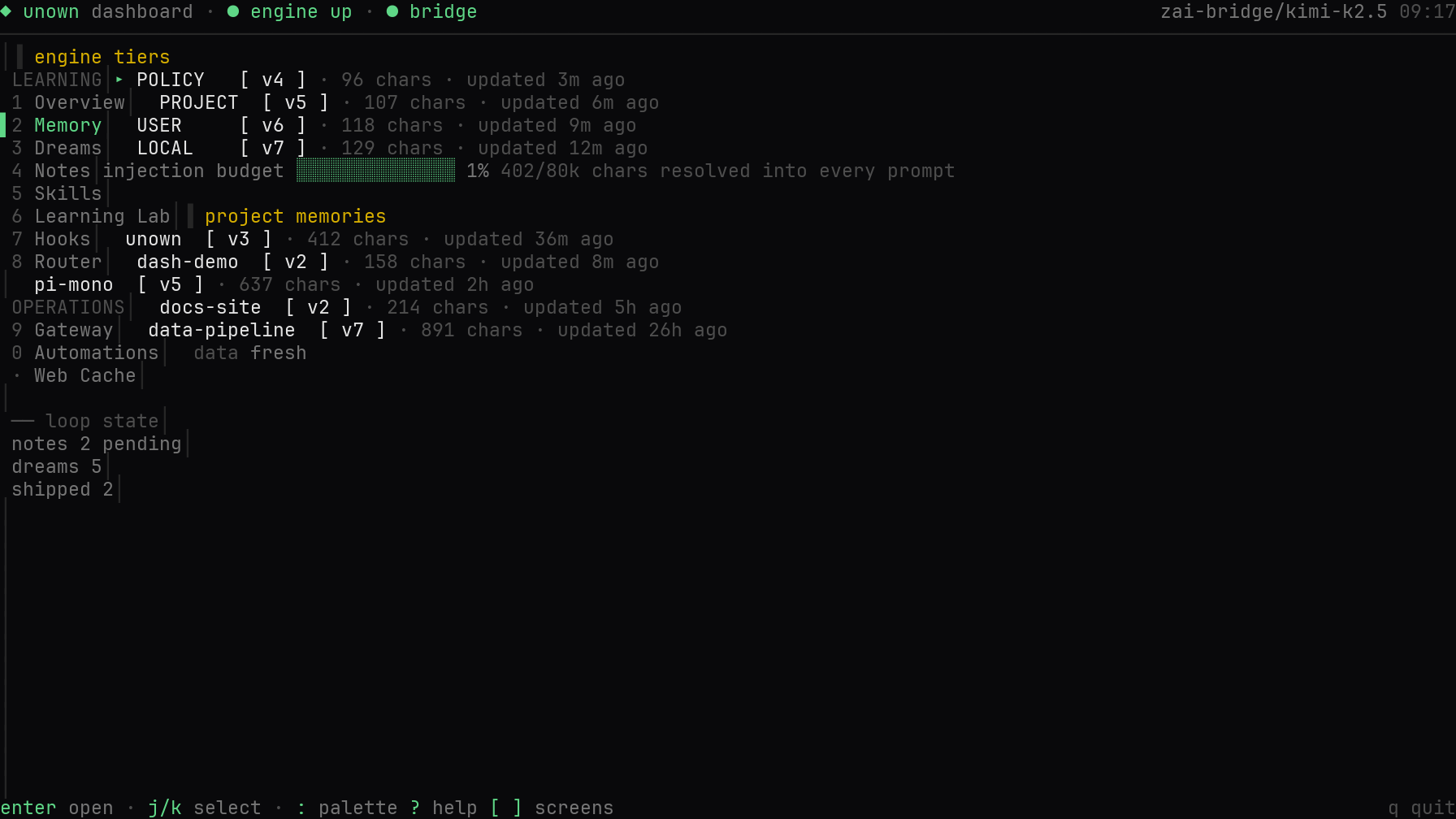
The repository itself was the controlled environment (a real developer tool, 39 release rounds of history, real repeated workflows). The engine booted with no operator input. The measurement lane — a snapshot driver over the engine's REST API, a retrieval-probe runner with a pinned query set, a per-session UX ledger — was built by the agent itself as the round's first cold task. Three drained snapshots (baseline / midpoint / final) and five real headless sessions provide every number below.
What worked immediately
Continuity. The tracked memory's very first test was a question only it could answer: "the harness cycles keep failing — should I restart the engine?" The fresh clone's first session answered in two turns and five seconds, quoting both the skill and the memory entry verbatim: no, failed cycles auto-recover. That entry was written on a previous install — the learning crossed a machine boundary.
Autonomy. Before any operator pressed anything, the engine's router
had run three harness cycles (all already-passing — the loop refuses
to mine junk from green runs) and two dreams. The learning loop runs
because it is scheduled, not because a button was pressed.
Regression prevention. The round's best single receipt: a dream
consolidated, its canary task ran under the new memory, and the canary's
final report claimed verification via bun while it had executed
python3 — a claim mismatch. The engine gated the dream and rolled the
memory back autonomously. No operator was involved. No broken task ever
reached a user.
The repeat-task lift. The cold build session (V3) hit its 30-turn cap with the core done but unfinished housekeeping. After one dream consolidated that session's notes, the warm repeat (V4) finished the same-shape extension in 9 turns — minus 70% turns, minus 70% wall time, minus 66% output tokens. That is retained learning, measured.
What broke — the round's real work
The probes found a three-link failure chain, and it is the most important thing the programme has measured.
F1 — recall drift. Asked what password hashing Parley uses, the
agent answered "bcrypt at cost 10, PARLEY_BCRYPT_COST override" —
confidently, in one turn. The tracked memory said scrypt N=16384. The
source said scrypt N=16384. The answer was wrong against both, and
the env var was invented. Nothing in the memory guide told the agent
that memory is evidence rather than authority, so it free-completed
over the topic instead of quoting it.
F2 — extraction poisoning. The wrong answer rode the session's auto-captured note into AutoDream, which extracted it as a fact. The recency-first reconcile then pruned the correct entry — and the rendered memory shipped the bcrypt claim in place of the scrypt one. Ground truth, erased from both the platform and the file by the system's own learning loop. (The same erosion had already happened upstream, we found — two independent instances of the class.)
F3 — the dead-ended mint. With the suite saturated, the task minter tried to author a harder variant and discarded its own draft for exceeding size caps the authoring prompt had never stated. The loop's expansion path was blind-broken exactly when it needed to work.
The fixes — measured before and after
The memory guide now carries an anti-drift contract: memory is evidence, not proof of current behavior; consequential facts get a source check before assertion; answers cite their memory source; a memory/source disagreement is a repair note, not a silent overwrite. The re-probe (V2b, same question, same model) answered correctly — scrypt, cited, with an explicit negation of the poisoned claim.
The extraction prompt now separates verified facts from the session's own assertions: an answer the agent gave is not evidence. We tested it live by delivering a deliberately poisoned note (wrong ports, explicitly unverified) through the real pipeline — the dream consolidated three notes and extracted zero of the poison.
The mint prompt states its caps, and a failed draft now gets exactly one bounded repair call. Post-fix mints travel the full validation depth — caps, shape, self-check — and discard honestly when the authored test file itself is broken. The gate working is not the lane failing.
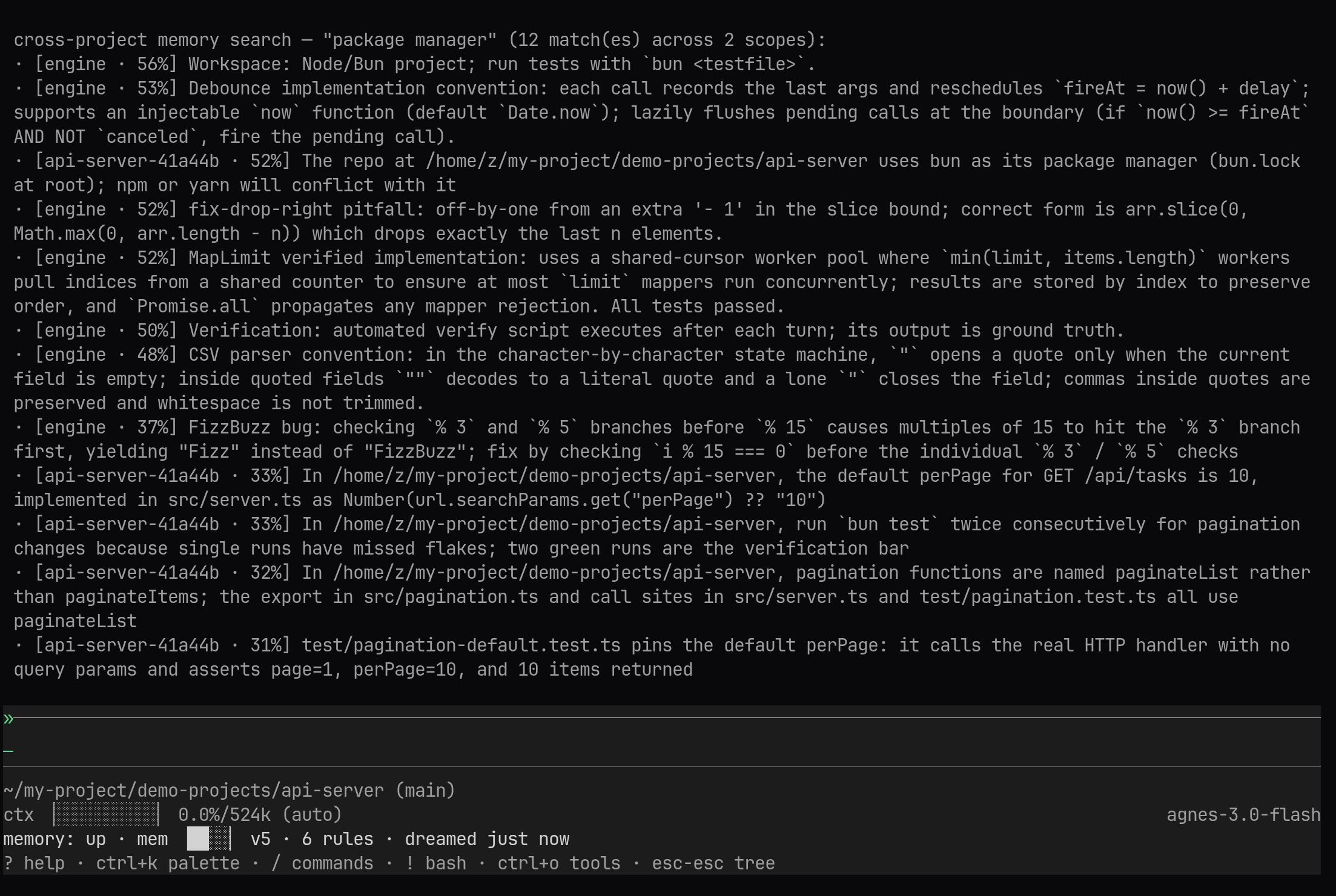
And the ground truth? Restored three-deep: the platform store, the
Facts section, and the ## Manual notes lane that survives every
re-render. The retrieval probe recovered from 0/6 to 6/6 hit@5 —
the before/after receipt for the whole arc.
What the numbers say
Across the round: 12 dreams consolidated 34 notes; the engine's project tier grew seven versions; 29 runs, 27 passing (both failures were defenses firing, not regressions); 145k tokens of autonomous learning spend on the metered free-tier upstream. Four defects found, fixed, and pinned by 20 new deterministic regression tests; the full engine suite green at 4,885 passing after the changes. One honest null: no staged skill was minted this round — the notes distilled into facts, not recurring procedures; the warm-install report carries that positive case and the cold start simply needs more horizon.
The mission asked whether Unown genuinely becomes a more capable agent over time through the operation of its memory and learning systems. The cold-start answer is: yes — measurably, within a single session pair — and the loop can actively destroy knowledge when its trust mechanics are wrong, which is exactly why the validation programme has to exist. The failures are now permanent pinned regressions instead of recurring surprises.
The full receipts: the four reports, the failure ledger, and the session record with every checkpoint's measured numbers.
Spotted something wrong or worth adding? The record is the repo — open an issue.