4 min readfeature
The cadence round: a habit tracker, a real bug in unown, and a three-app gallery
One round, every SDLC stage: planned, built, browser-QA'd, reviewed twice — and the review caught a TDZ crash in unown itself. Three apps live.
- #landing
- #demo
The commerce round asked whether the agent could carry a whole SDLC for one app. This round asked the full version: can it do that twice in a row — while the tools it needs hold up under a real user?
Short answer: the app shipped. A real bug in unown surfaced and got fixed along the way. The gallery now frames three agent-built apps.
What got built
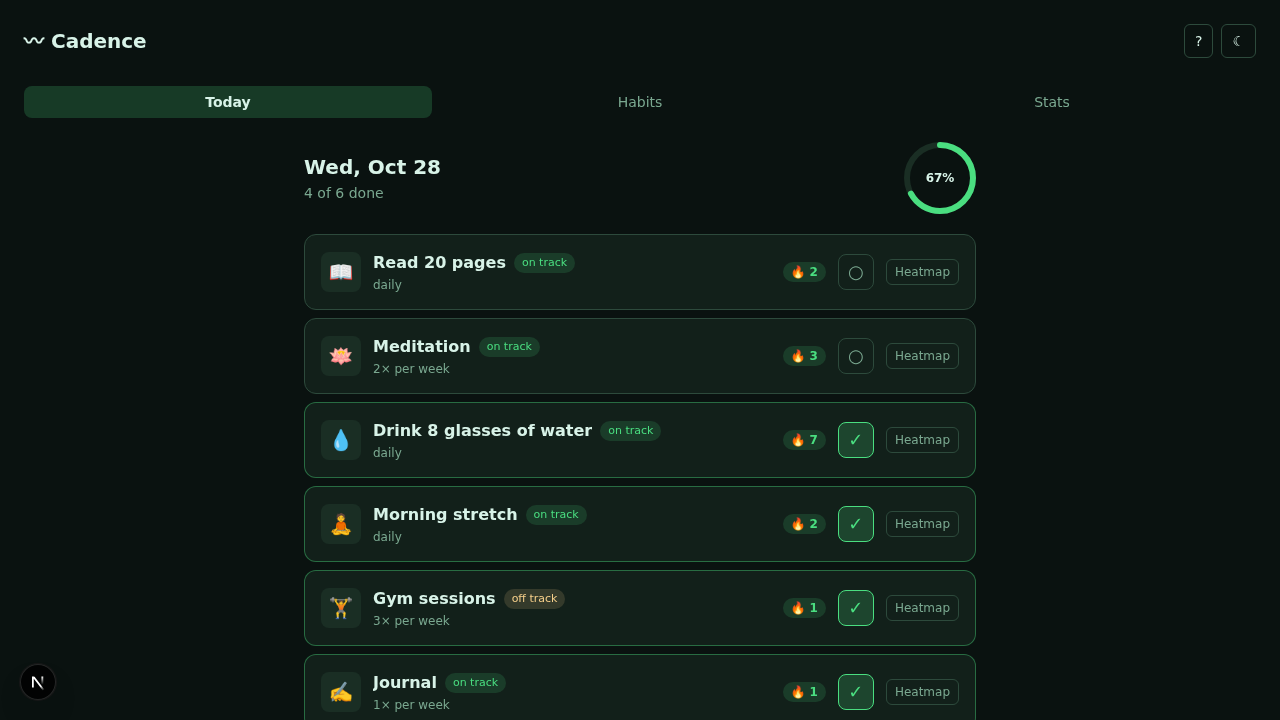
Cadence — a fullstack habit & streak tracker at /cadence:
- a today view of check-off rows: per-habit streak chips, on-track state, a completion ring, and a "N of M done" line that moves as you click;
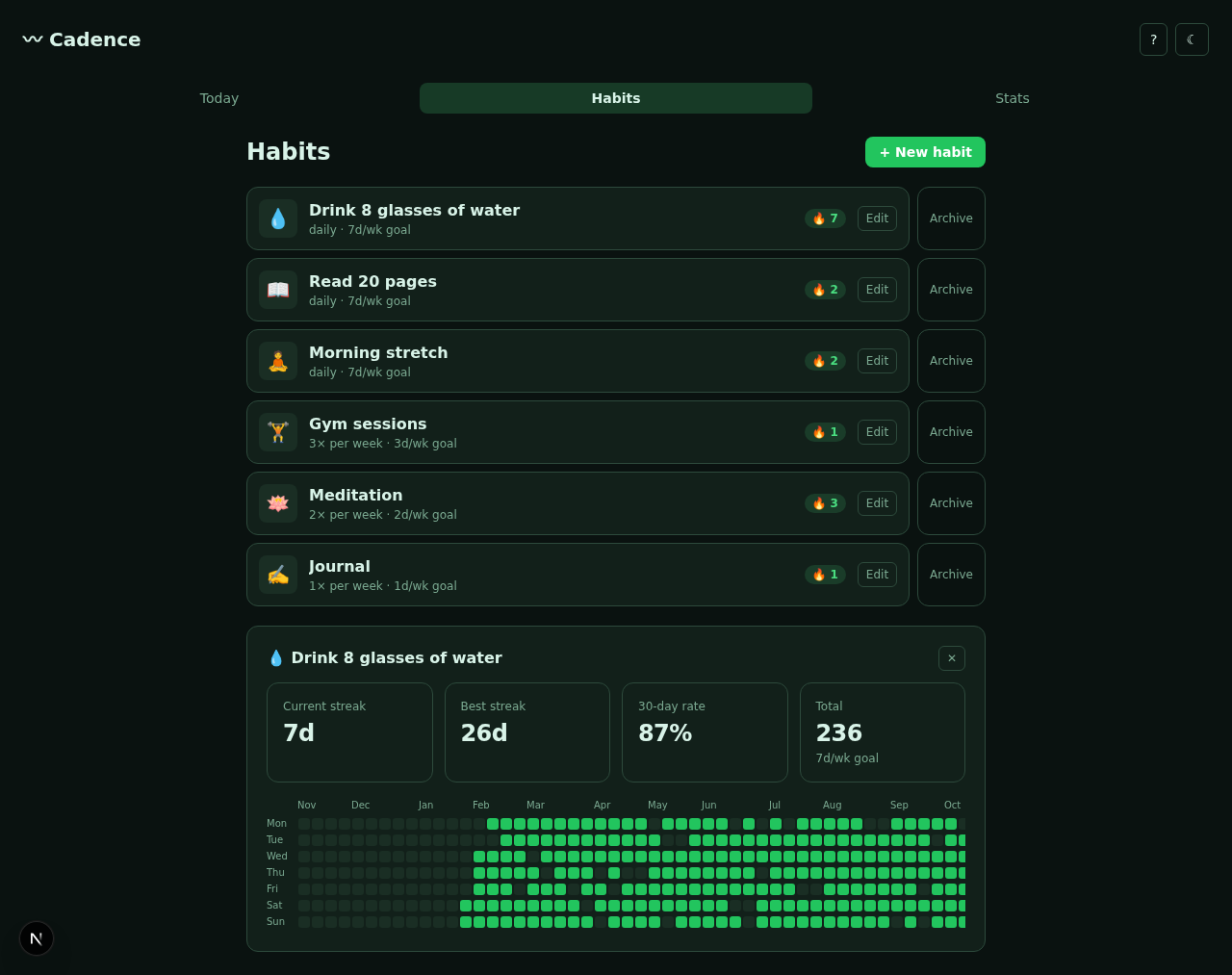
- a per-habit 52-week heatmap (364 cells, five intensity levels, dates on hover) with current/best streak, 30-day rate and total check-ins;
- habit CRUD with real inline validation (name bounds, 1–7 days-per-week, one-char glyph) — the server re-validates everything;
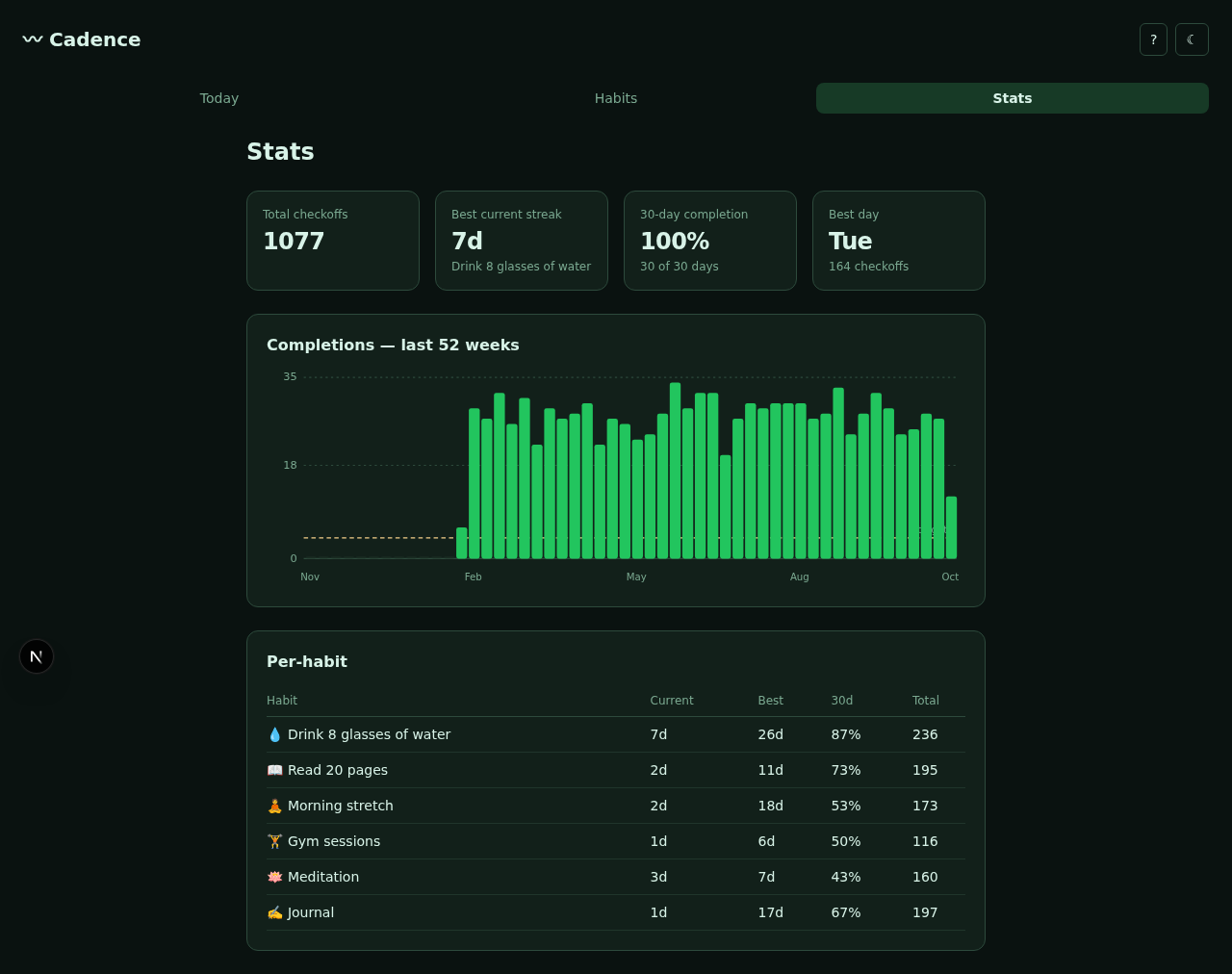
- a weekly stats view: KPIs, a hand-rolled SVG bar chart of 52 weeks, and a per-habit table;
- the same serverless-safe persistence as the other two apps: a
deterministic seed (mulberry32, fixed integer, explicit clock — client
and server agree byte-for-byte), a
SEED_VERSION-tagged localStorage override, and an embed-only reset channel.
96 tests across 8 files pin the domain math — streak edges at year boundaries, ISO-week alignment, seed determinism, validation tables, persistence corruption paths.
How it was driven
Like the bazaar round, but longer — eleven agent sessions, every stage a feature:
- Plan —
--planmode produced a 14 KB numbered plan (file-by-file, lib-first build order, a per-file test plan, and a risk table for the flash-tier model doing the writing — including "keep components under 250 lines" and "no_v2file variants"). The turn cap hit mid-plan honestly (error_during_execution, exit 1), the session resumed, the plan landed in one turn. - Build — domain lib first (62 tests), then store + API routes + route shell (87 tests), then the UI (96 tests). The todo tool tracked every phase; the verify lane typechecked after each file; the note tool fed the engine, and the engine dreamed memory between sessions.
- Browser QA — the agent drove the app it had just written through a
real Chromium over CDP: checked a habit off and watched the streak tick
2 → 3 and the header count 4 of 6 → 5 of 6, created "Evening walk"
through the real form, counted the heatmap's 364 cells and the chart's
52 bars by
eval, then flipped to?embed=1and fired the landing page's resetpostMessage— the created habit vanished, the six seeded habits returned. It found a real bug doing this: the habit detail panel was unreachable (a click handler never wired), fixed live with keyboard affordances added.
The part where unown itself broke
The round's /review — three parallel reviewer subagents over the whole
diff — completed, and then crashed: Cannot access 'labels' before initialization. A temporal-dead-zone bug in the merge step: labels[i]
was used inside results.map(...) three statements before const labels
was declared. Every review, on any repo, lost its verdict at the last
moment — the pure-function tests couldn't see it because they cover
review.ts, not the command wiring that shipped the bug.
Found live, fixed the same day: the computation now lives in two pure
functions (reviewerLabels, parseReviewerOutputs — labels exist
before any use, structurally), with regression tests pinning the label
order and the results-pairing. The re-review ran clean end-to-end.
The first review's verdict was an honest DO-NOT-SHIP — the frame headers and the gallery entry were missing (they were the next phase). The re-review after the fixes: no P0/P1 security issues. Its one substantive catch: a receipt-number drift in the session record — the reviewer checked the receipts against the prose, found the test-file breakdown wrong, and the recount you are reading is the result. That is the loop working.
The gallery
The live-demo band now frames three apps — Sigil Focus (/demo),
Sigil Bazaar (/bazaar) and Cadence (/cadence) — one persistent
iframe, src swapped on the switcher, receipt chips that swap with the
tab, a per-app reset, and a poster-first lazy mount so an idle visit
never pays the hydration cost. The new entry's chips are the round's own
receipts: 11 sessions, 1,381 tool calls, 30 files, 96 tests, 8 commits,
10 embedding adaptations — every number with its source in
the session record.
The frame-hardening headers ship with the route (frame-ancestors 'self'
X-Frame-Options: SAMEORIGIN), the API routes areforce-dynamic(a production build would otherwise freeze the first GET forever — the review caught that too), and the review's other findings are all fixed: the rate-limit map is capped, the checkoff writes are copy-on-write with a 400-date bound, a tautology test got a real pin.
Try to break it
Visit the landing page, pick the Cadence tab, check a habit off twice (unchecking is the point), create a habit with a 300-character name (the form and the server both say no), open a heatmap, then hit reset — the world you broke goes away, the seed comes back. No other terminal coding agent ships one live agent-built app on its landing page. This one ships three.
Spotted something wrong or worth adding? The record is the repo — open an issue.