6 min readfeature
The builder round: one prompt, a whole app, filmed end to end
One prompt into an empty directory; 47 tool calls later a full-stack app with a green 39-test suite and a live-verified API. The whole build, on film.
- #landing
- #media
Every lane in the capture catalog compresses a story into seconds — a bugfix, a rename, a wiki. The lane nobody had filmed was the whole point of the product: give the agent one prompt in an empty project and let it build the entire app. The builder round filmed exactly that, start to finish, and the cut is now the landing page's capability dex № 023 — "The builder round."
The fixture
The world the camera boots into is an empty directory holding exactly one
file: PRODUCT-BRIEF.md. The brief describes Glyph Quests — a small
full-stack quest tracker with an architecture contract, not a TODO list:
- a JSON file store with validation, seeding, atomic persist and corrupt-file
recovery (
store.ts); - a REST API layer over it (
api.ts) and a Bun HTTP server (server.ts) on a fixed port; - a dependency-free vanilla frontend (
public/index.html,styles.css,app.js) that must also work standalone — opened from disk, with no server, on localStorage; - a test suite (
quest.test.ts) covering store CRUD, validation, atomic persist, reload and end-to-end API tests over a realBun.serveon an ephemeral port; - and a mission section: run the tests until they all pass, verify every endpoint with curl, fix what is broken, and end with a one-paragraph summary.
The only keystroke a human sends is the mission prompt itself. Everything after it — every read, write, edit, test run, server boot and curl — is the agent's own work, at 30 characters per second, the speed a person types.
The session
The filmed run (against the live stack: bridge + engine, agnes-3.0-flash
through the Agnes AI upstream) is a 12-minute session the receipt records
event by event: 97 events, 47 tool calls, 13:16:11 to 13:28:12. The agent
read the brief, planned four todos — backend, frontend, tests, verify —
and then worked the list:
- wrote
store.ts,api.ts,server.tsand the three frontend files, plusREADME.mdand a.gitignorethat keepsdata/out of git — eleven files by the closing inventory,+2211 −47lines on the session footer; - wrote
quest.test.ts(39 tests) and ran the suite — green on the first completed run, then kept hardening it: cleaned a stale field and an unused import out ofstore.ts, rewrote theserver.tsfetch handler to pass the raw body string into the API layer so JSON validation errors surface as 400s, converted flakyit.eachblocks to plainitblocks, and made theupdatedAtassertion millisecond-safe — each fix followed by another suite run, five and then seven times in a row to prove stability; - booted the server on :8787 with a clean data dir and ran the live curl
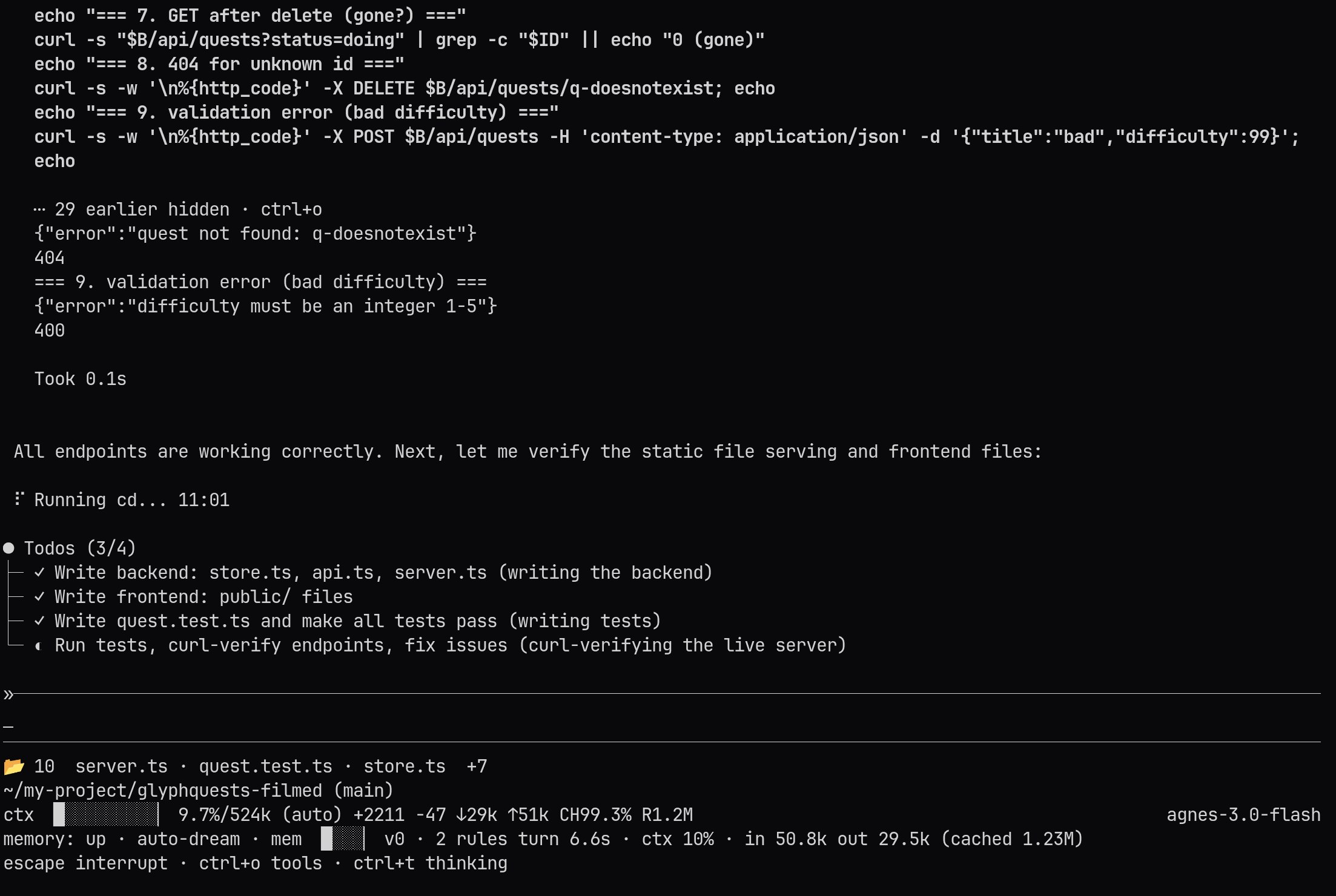
round-trip: seeded list, stats, a 201 create → PATCH → delete round-trip
with the id confirmed gone afterward, a 404 on an unknown id, a 400 on a
validation error, and the statics (
/,styles.css,app.js) checked for content-type — unknown paths falling back to the index; - then killed the server and verified the kill — a two-second curl probe for "STILL UP" before calling it dead — and closed with the one-paragraph summary the brief asks for, all four todos checked.
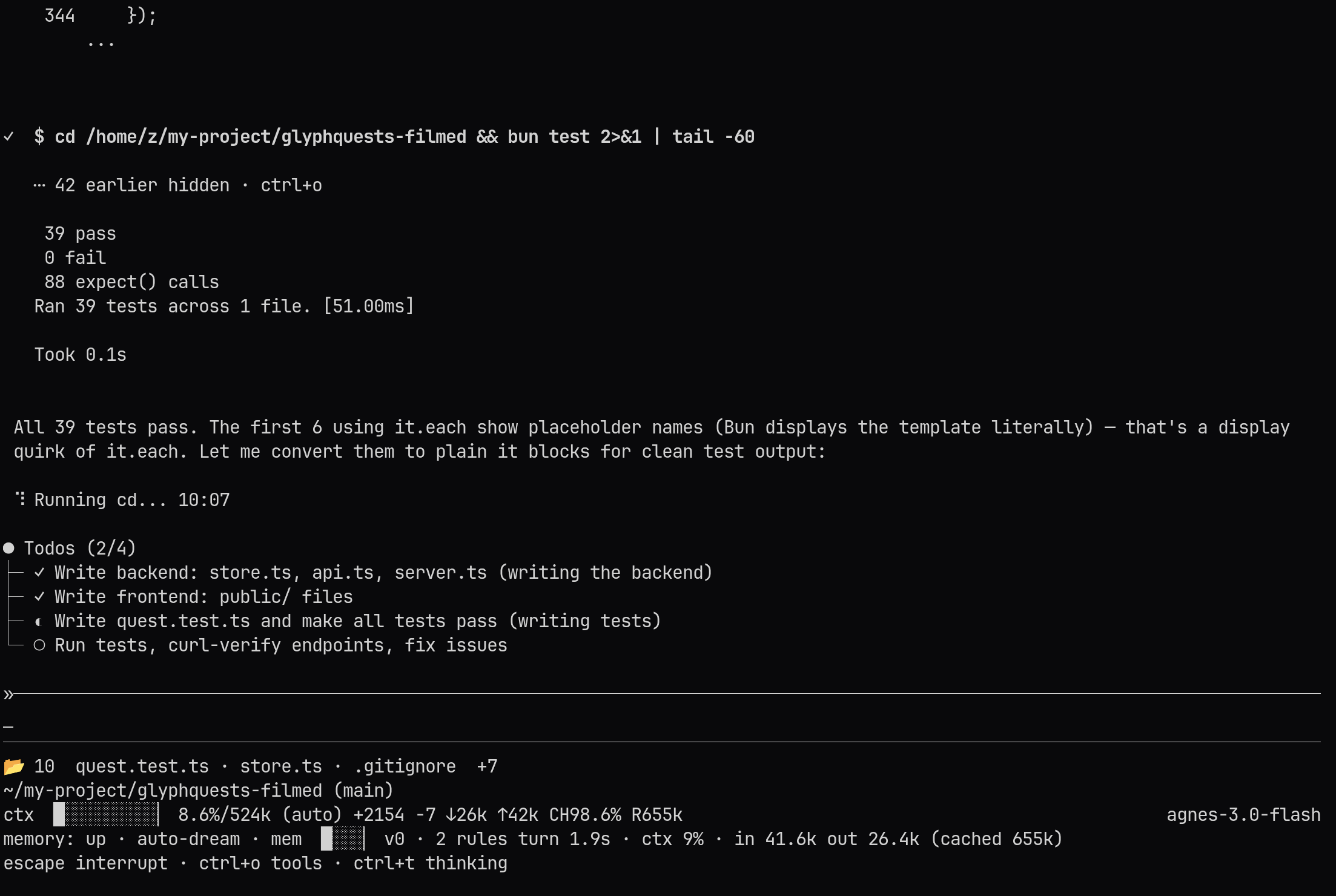
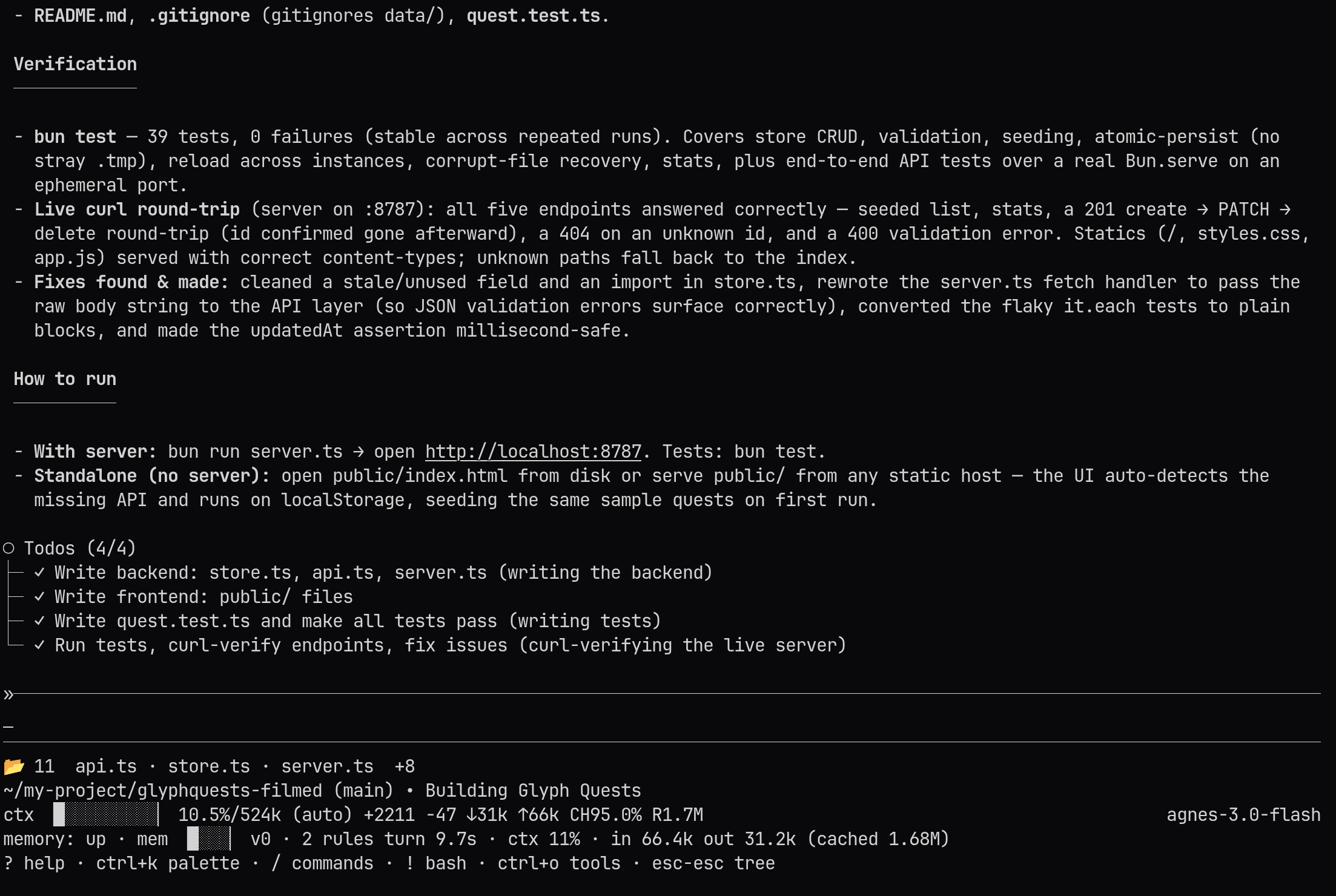
An earlier session the same morning (run 3 of the round) built the same brief with a different plan — eight todos, 68 tool calls — and also finished green with the same curl verification. Two independent sessions, two different plans, one outcome; the shipped cut is the second one.
What the camera saw — and what it took to film it
The lane is honest, and so is this section: filming a 12-minute build tested
the capture harness harder than anything before it. The four cuts it took are
now lessons in the workflow contract (docs/tui-capture-workflow.md):
- Cut one anchored stills on bare filenames and fired on the model's
plan text minutes before any work happened. Cut two anchored on the
todo panel header and died — the header scrolls off the 36-row fold while
the panel's rows stay. Cut three made every wait soft (a miss logs and
captures the pane as-is — a long real session is worth more than a perfect
anchor) but its green-suite anchor excluded
" fail"… and cut four shipped that exclude: bun renders a0 failrow on a green piped run, so the wait excluded its own match for ten full minutes. The stills for "verifying the server" and "app built" came out byte-identical — both the same idle summary, captured twice after the session had already ended. - The fix for the shipped cut was not an image edit: still 06 was re-curated
from the frame record — frame 568 of 1514, timestamped mid-round-trip by
the session receipt and verified by the vision lane (the curl script, its
404/400 answers, the live spinner, the todo panel). The substitution and
its evidence are documented in the capture root's
CURATION.md; the superseded still is preserved, not deleted. - The assembler learned the same lesson: the frames after the session ends
are harness time, not story, and the video now trims that trailing idle to
one final dwell (rule 2b in
assemble.py). The shipped cut is 651 frames at 8fps — 81 seconds paced from 1514 captured frames. - And the launch itself: this sandbox reaps the launching shell's process
tree, which killed two silent
nohup/setsidattempts eight seconds in. The round's driver runs detached inside tmux, which survives.
Every shipped still passed the three-layer audit (pane truth, pixel verification, vision check) and the video passed frame-sampled vision audit 5/5 — the same gates as every other lane; the curated still carries its receipt-timeline evidence alongside.
What ships
- The lane:
public/landing/tui/build-session/— seven audited stills plus the mp4/webm pair, catalogued in the tui README. - The dex entry: capability № 023, "The builder round," on the landing page — the reel plays the whole build, muted, from the writing-app poster.
- The harness fixes: the fifth-cut anchors (the green wait anchors on the
green-unique
0 failrow with no exclude; the verify wait reads the session receipt — the agent's own record — instead of screen text), the assembler's trailing-idle rule, and the workflow contract's new failure playbook rows. The next builder round films on the first cut that matters.
Receipts
- The lane and its audits:
public/landing/tui/build-session/+public/landing/tui/README.md(capture workflow:docs/tui-capture-workflow.md). - The scenario spec (fifth cut):
scripts/tui-capture/scenarios/index.js. - The session receipt: 97 events, 47 tool calls — the curation note quotes
the timeline (
CURATION.mdin the capture root, outside the repo). - The changelog: the round ships in the 0.0.33 release entry (folded with the live-preview round).
What ships next
The catalog's next lane candidates are the ones the dex still marks pending — each gets the same treatment: one real session, one honest cut.
Spotted something wrong or worth adding? The record is the repo — open an issue.