4 min readrelease
The SOTA memory-eval round: four suites, one real fix, and a bill paid
How our memory system earned its numbers: gold-op ledgers, dual-embedder retrieval, a calibrated judge, twelve failure modes — and the bug they caught.
- #memory
- #benchmarks
- #release
Unown's four-tier memory stack — policy, project, user, local — claims it remembers. The honest question is whether the claim survives contact with the state of the art in evaluation — so before shipping v0.0.22, we surveyed what the field actually measures (LoCoMo, LongMemEval, MemoryAgentBench, MEME, MemBench, plus the 2026 audit literature on judge reliability), and then built the four suites the survey said were missing. All four ran live against the production dream pipeline. One of them found a real bug, and this post is the record of both.
| Suite | What it measures | Result |
|---|---|---|
| ops-accuracy | gold-op ledger: ADD/UPDATE/DELETE/NOOP + MEME's Cascade/Deletion | 11/11 cases, opsF1 0.992 |
| retrieval-rank | platform search: recall@k, MRR, conflict preference, scope isolation | lexical r@5 0.864 → onnx 1.000 |
| judge-calib | the binary QA judge vs 24 gold-labeled items | agreement 20/20, FPR 0, flips 0/72 |
| failure-modes | the twelve documented cross-industry failure modes, pinned | 12/12 pass, 4 recorded findings |
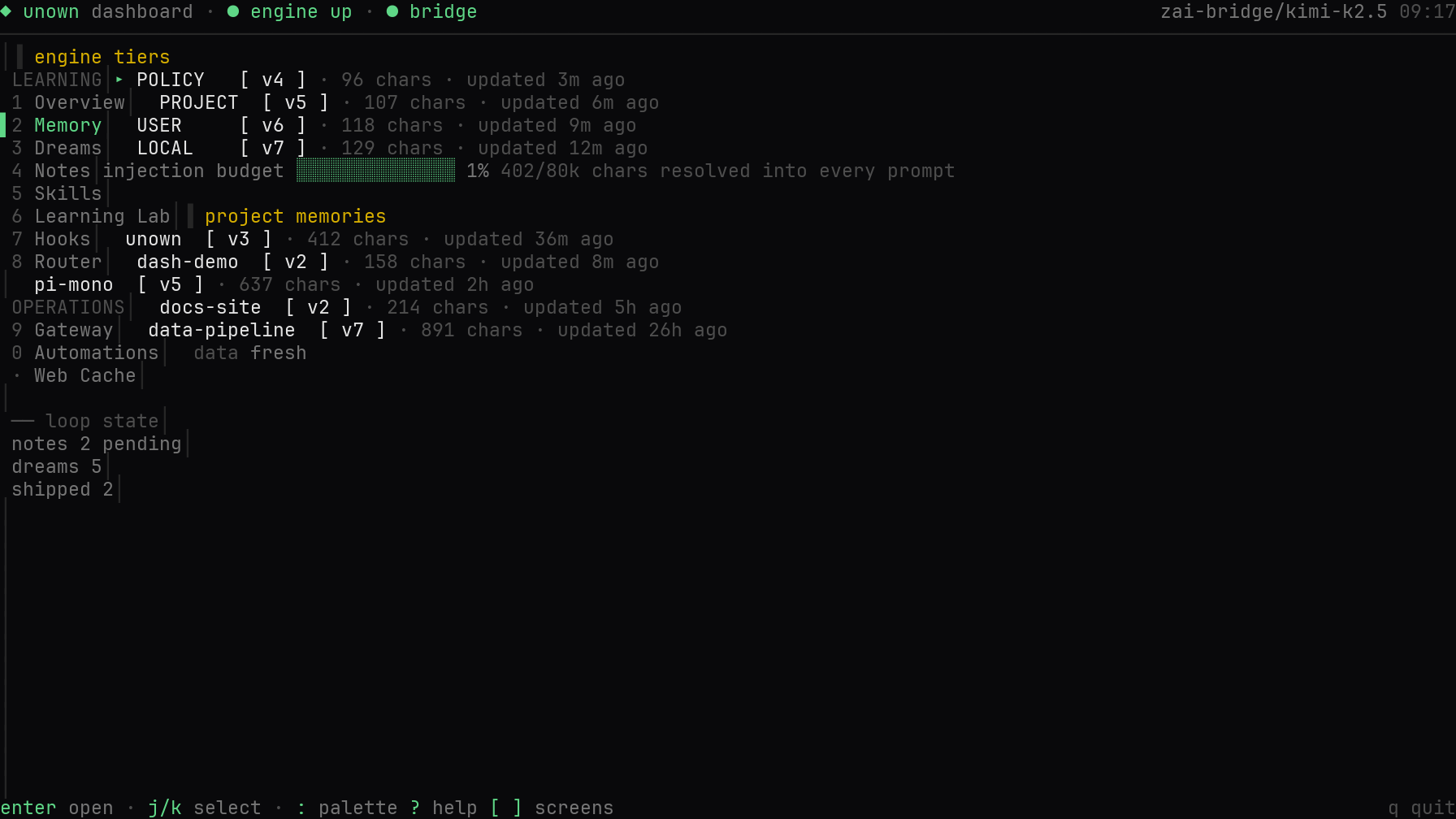
The memory screen these suites keep honest — every tier versioned, every write attributable, rollback one key away:
The suites
ops-accuracy scores the memory system the way the Mem0 paper scores memory operations: a gold-op ledger of expected ADD / UPDATE / DELETE / NOOP decisions per fact, plus the hard cases MEME showed collapse most systems (cascade dependencies, post-deletion state). Eleven isolated cases, one confusion matrix: 11/11 passed, opsF1 0.992 — including the bi-temporal case, where a note about Monday's state arrives after Wednesday's and the reconciler must resolve by event time, not delivery order (results).
retrieval-rank is the suite recall-qa couldn't be: it scores the search layer itself (facts seeded verbatim, no extraction in the loop). The headline is the embedder A/B the docs had never measured — the deterministic lexical fallback finds 86.4% of gold facts at rank 5 where the ONNX lane (bge-small) finds 100% — and the finding both arms share: asked to choose between an old fact and its replacement, the search layer prefers the old one five times out of six. Recency is guarded by the reconciler alone; that's now a measured gap, not a vibe (results).
judge-calib answers the item our own testing strategy had left open longest: "judge calibration for every graded number." The binary CORRECT/WRONG judge — the same protocol Mem0 and Letta's leaderboard use — was measured against 24 gold-labeled items in eight classes (wrong-number, wrong-entity, paraphrase, partial, both abstention directions): agreement 20/20, false positives 0/8, false negatives 0/8, run-to-run flips 0/72 at temperature 0, order sensitivity 0/6 (results). The audit papers' judge instability simply does not reproduce on the served tier — which unblocks a judged lane for the QA suites.
failure-modes pays the competitor-research sweep's explicit debt: the twelve failure modes we documented across eleven shipped memory products (each with the issue that proved it ships in the wild — Mem0's dedup races, Letta's stale index, Codex's silent truncation, the bi-temporal recency trap) are now twelve pinned regression cases. Six run deterministically without an LLM; four drive the live dream pipeline; two boot a real scratch engine — the TOCTOU case fires two dream triggers concurrently and asserts the busy-mutex serializes them, the ingestion-loss case kills the bridge and asserts the failed dream is visible and the note survives for the recovery engine. 12/12 pass, with four findings recorded inside the passing receipts (results).
The bug the suites caught
The first ops-accuracy run failed six of eleven cases, and the receipts separated the benchmark's bugs (three of my probe regexes were too literal) from the system's: notes that said "backups go to the nightly S3 bucket" — in both notes of the supersede case — produced no memory. The extraction kept the headline and dropped the routine infrastructure detail, and since extraction is the only pass over a note, the fact was gone. That is Graphiti #1707's silent-loss shape, measured in our own pipeline.
The fix is one sentence in the extraction contract — infrastructure facts are named explicitly, and "a fact skipped at extraction is unrecoverable later" — pinned by a unit test the way the repo has always pinned prompt fixes. The receipts before and after are the evidence; opsF1 went from 0.69 on the broken run to 0.992 with the fix and the corrected probes.
The honest residuals
The receipts also record what we did not fix: the reconciler missed one contradiction pair in three runs (the failing receipt is preserved — that variance is now a monitored regression, not an anecdote); the committed-file load scan catches one fewer injection variant than the tool-output scanner; and a benign note written in the imperative mood can read as a directive to the guard. Each has its pinned case now, so each future regression is a red test away — which is the whole point of a benchmark suite: it converts "we believe the memory works" into "here is the receipt, and here is what it cost."
Run them yourself
git clone https://github.com/kanishka-namdeo/Unown && cd Unown
bun scripts/install.ts && bun run agent:start
cd benchmarks/memory-eval/ops-accuracy && bun runner.mjs
Every suite has a --dry lane that runs without an LLM, receipts are
resume-safe, and each RESULTS.md carries its own honest-limitations section
— the numbers above are the committed receipts, not the best of N.
Spotted something wrong or worth adding? The record is the repo — open an issue.