5 min readfeature
The Toccata round: reverse-engineering Claude Code's touch, key by key
A 47-point teardown of Claude Code's terminal UX, the sixteen patterns Unown adopted, and the six we deliberately refused — with the receipts.
- #tui
- #keyboard
- #verification
A toccata is a "touch" piece — written to show off how a player touches the keys. This round was the keyboard round: reverse-engineer Claude Code's terminal experience like a UI/UX researcher (every claim cited, from the official interactive-mode reference to the spinner-verb community catalogs), audit Unown's own TUI against it point by point, then ship the proven gaps end to end.
The teardown lives in
docs/tui-claude-code-parity-research.md
— the official interactive-mode and commands references fetched in full,
the sibling landscape cross-checked (Amp's command palette and prompt
history, Codex's community-filed Shift+Tab request, Gemini's /theme,
opencode's fork, Aider's git ceremony), and a 47-point audit of
Unown at the round's base commit, every row carrying the seam.
The verdict up front: Unown's chassis was already frontier-grade — queueing with take-back, permission-mode cycling, scored plan approval, split view, a quiet two-row footer, differential rendering with Kitty progressive enhancement. The gaps concentrated in five places: the input-history lane, the draft lifecycle, the transcript viewer, the permission-comment lane, and the personality layer. Sixteen adoption decisions (A1–A16) and six deliberate refusals later, all five lanes have shipped.
What landed
The editor lane (A1–A6). Input history now persists per working
directory — Claude Code's own contract — with a 500-entry cap and
cross-session Up-recall. Ctrl+R opens the reverse-search dialog with
fuzzy filtering, previews, and a scope cycle through this session /
this project / all projects. Ctrl+S stashes the whole draft (text,
cursor, paste markers, even the bash-mode badge); a cleared draft lands
in history for Up to restore, exactly the bring-back-a-cleared-draft
behavior Claude Code documents. Ctrl+D gained the two-press exit
confirm with its 800 ms window.
The queue and image lanes (A7–A8). Ctrl+Enter (where the terminal
reports it) or Alt+S everywhere flushes the queued messages now — the
draft joins the queue first, then the running turn drains it through the
abort matrix. Pasting an image inserts an atomic [Image #N] chip you
can reference positionally, so a pasted screenshot reads as part of the
sentence, not a raw /tmp path.
The transcript lane (A9–A10). Fullscreen Ctrl+O now toggles a
modal transcript viewer: {/} jump between prompts like vim paragraph
motion, / searches with n/N, [ writes the conversation to the
terminal's native scrollback so Cmd+F and tmux copy mode can search
it, v opens it in $EDITOR, ? shows the keys. Consecutive calls to
the same tool collapse to ⋯ called bash ×3 · ctrl+o — the aggregation
Claude Code ships, verified against its own changelog example.
The dialog and command lanes (A11–A14). Permission asks take a
comment (Tab to amend): an allow-with-comment reaches the model after
the tool result, a deny-with-comment rides the reason. Typing / after
a space anywhere completes commands mid-prompt. /cost and /theme
join as aliases — the theme picker live-previews and never persists
until Enter. /rewind opens the checkpoint menu Claude Code made
famous: restore code and conversation, conversation only, or code only.
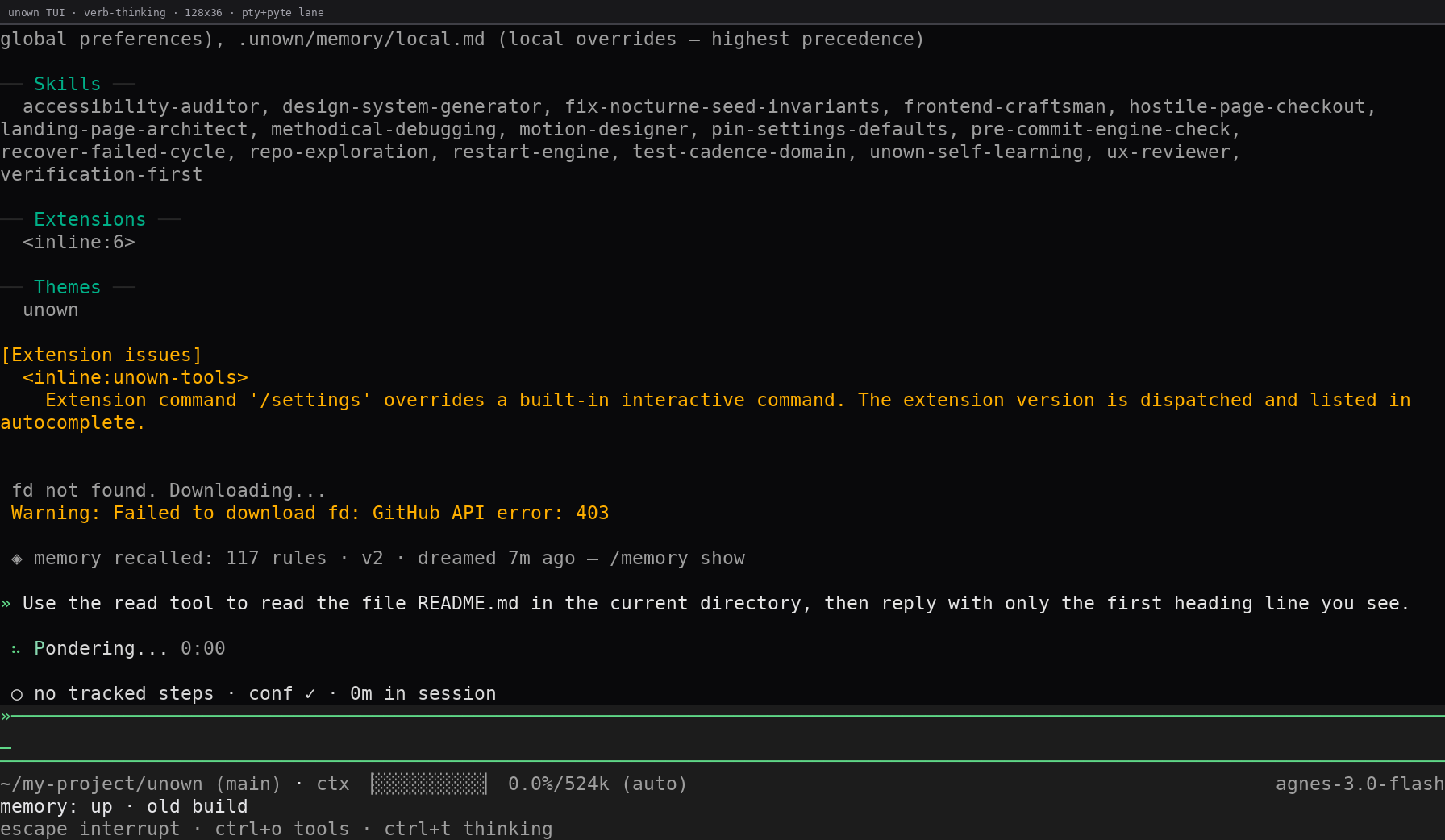
The personality lane (A15–A16). While the model thinks, the working
line now carries a rotating spinner verb — Pondering...,
Percolating..., Vibing... — one verb per three-second window, never
repeating itself, rotating on the elapsed chip's existing timer (no new
timers; that discipline is test-pinned). The moment a tool runs, the
honest label wins: Editing math.ts..., Reading README.md....
Personality never shadows truth.
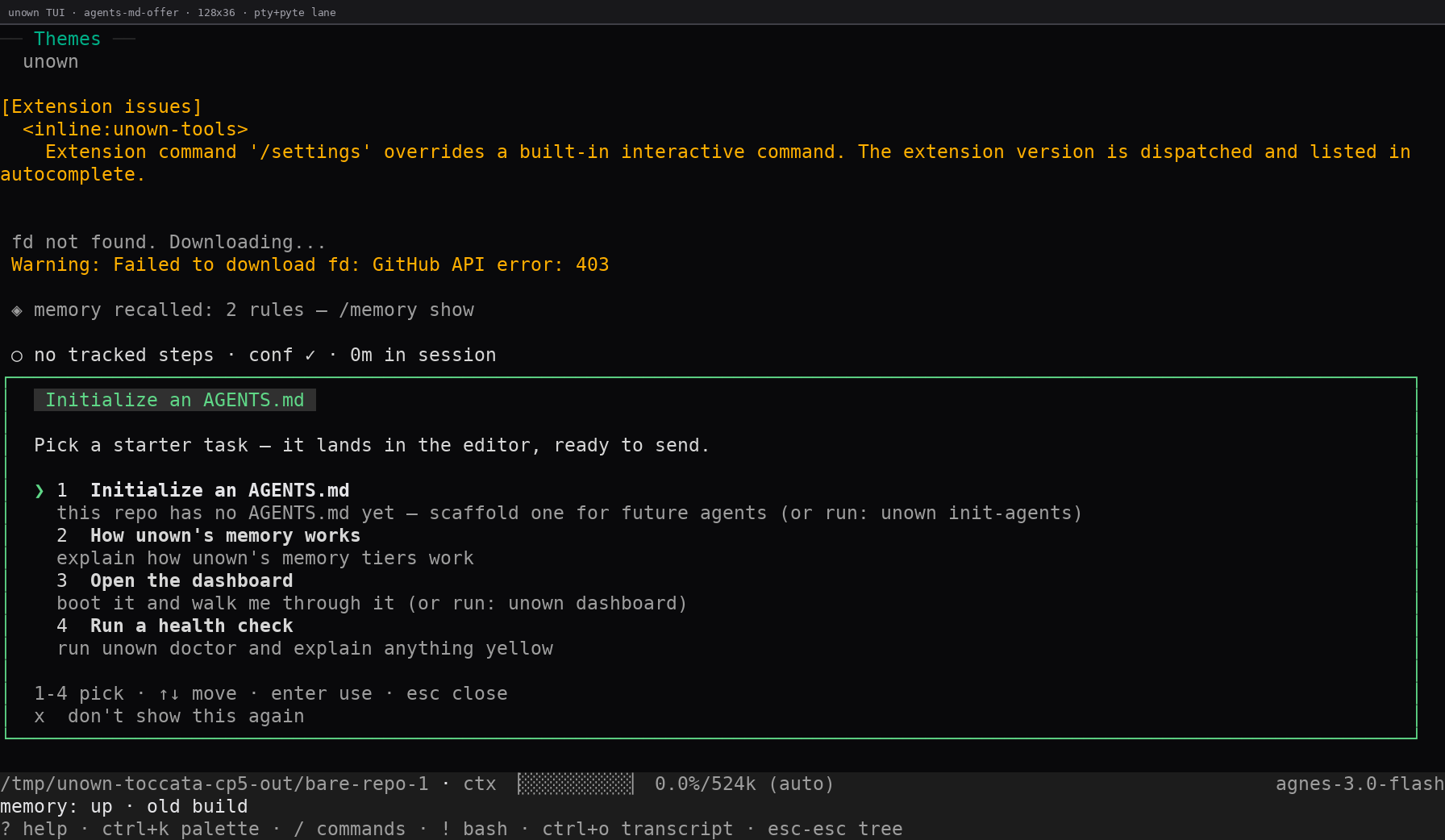
And the onboarding card got repo-aware: open a repo that has no
AGENTS.md and the first flights catalog leads with the one task the
repo state actually asks for — Initialize an AGENTS.md — Claude
Code's /init moment, translated. A returning user still gets that
offer once per repo, recorded in a capped latch so it never nags.
What we refused, on record
The research's most useful output might be the refusals. A full vim editor is a multi-thousand-line surface; shipping a partial one that traps power users is worse than none. Voice input needs microphone access a headless-capable coding agent shouldn't demand. Spell check is a dictionary dependency for prose that is mostly identifiers and paths. Enter-queues — Claude Code's classic model — was rejected because Unown's Enter-steers default is a deliberate differentiator (Amp validated the same call). Ghost-text autocomplete lost to the list-with-argument-hints form: richer for command discovery. Every refusal carries its reason in the decision record, so "why don't we have X" has an answer that isn't "we forgot".
The receipts
Every adoption is pinned by tests — the round's final count: 16 new
unit batteries across the tui, coding-agent and self-learning packages,
the full suites green over their documented baselines, and a new PTY
lane (scripts/tui-capture/verify_toccata_cp5.py, 10/10) that drives
the real TUI against the live stack: a real Agnes turn showing the verb
then the tool-label takeover, and the offer card verified across four
boot shapes (fresh, returning, re-boot, repo-with-file). The lane even
re-proved an old law on the way: its first footer regression run failed
on an honest old build chip because the engine was still booted from
the previous commit — a stale engine is a stale verdict.
The full ledger is the round's session log, docs/toccata-round-session.md, and every keybinding is in the usage reference with its Windows/WSL variants in parentheses.
What ships next
The audit's deferred items are on record in the decision doc — the vim editor as its own round if demand appears, and the focus-view lane — so the next keyboard round starts from a map, not a mystery.
Spotted something wrong or worth adding? The record is the repo — open an issue.