4 min readfeature
The round that made the plan visible
Unown scored the plan, saved it, gated it — and never showed it. Seven competitors later, the plan renders at every moment it matters.
- #planning
- #tui
- #release
The report was one sentence: user cannot see plan mode's created plan by default. It was entirely true, and it was worse than it sounded.
After a planning pass, the plan's full content existed in exactly three
places — the .unown/plans/<slug>.md file on disk, the plan_write tool
result, the exit_plan_mode tool result. The TUI rendered none of them.
plan_write's renderer printed one line (✳ Plan scores 85/100 …) and threw
the objective, the steps, the risks, and the verification on the floor.
exit_plan_mode's showed the first 90 characters of the first line. Both
ignored the expanded render option, so Ctrl+O was a functional no-op. And
the approval dialog — the moment the user is asked to commit to a plan —
was a score summary plus four options. You were approving a plan you had
never been shown. The only glimpse of the plan's body came from picking
"Edit the plan", the option for people who already know what they want to
change.
What the field does
Before touching code, the round asked what everyone else does. Seven
products, every claim sourced to their docs or their source: Claude Code
presents the plan in the conversation and asks how to proceed; Cursor
auto-opens the plan as a virtual file you can read and edit; Cline's
chat is the plan; Copilot shows a Review Plan card with "Open Full
Plan"; Codex renders a ProposedPlanCell — the full plan markdown,
streamed live into the transcript — then asks "Implement this plan?";
Aider prints everything to the stream; Gemini CLI writes the plan as
a Markdown file and presents it in chat for formal approval.
The law is unanimous across all seven: the plan is shown, in full, at the moment it is ready — never hidden by default. Progressive disclosure (compact checklists, preview caps) is applied only after first presentation. Nobody requires an opt-in to see the plan. Unown scored it, saved it, gated it — and hid it.
The corrected workflow
The fix ships as a pure display module (plan-display.ts) plus a shared
renderer, wired into every moment the plan matters:
- When the model writes the plan — the
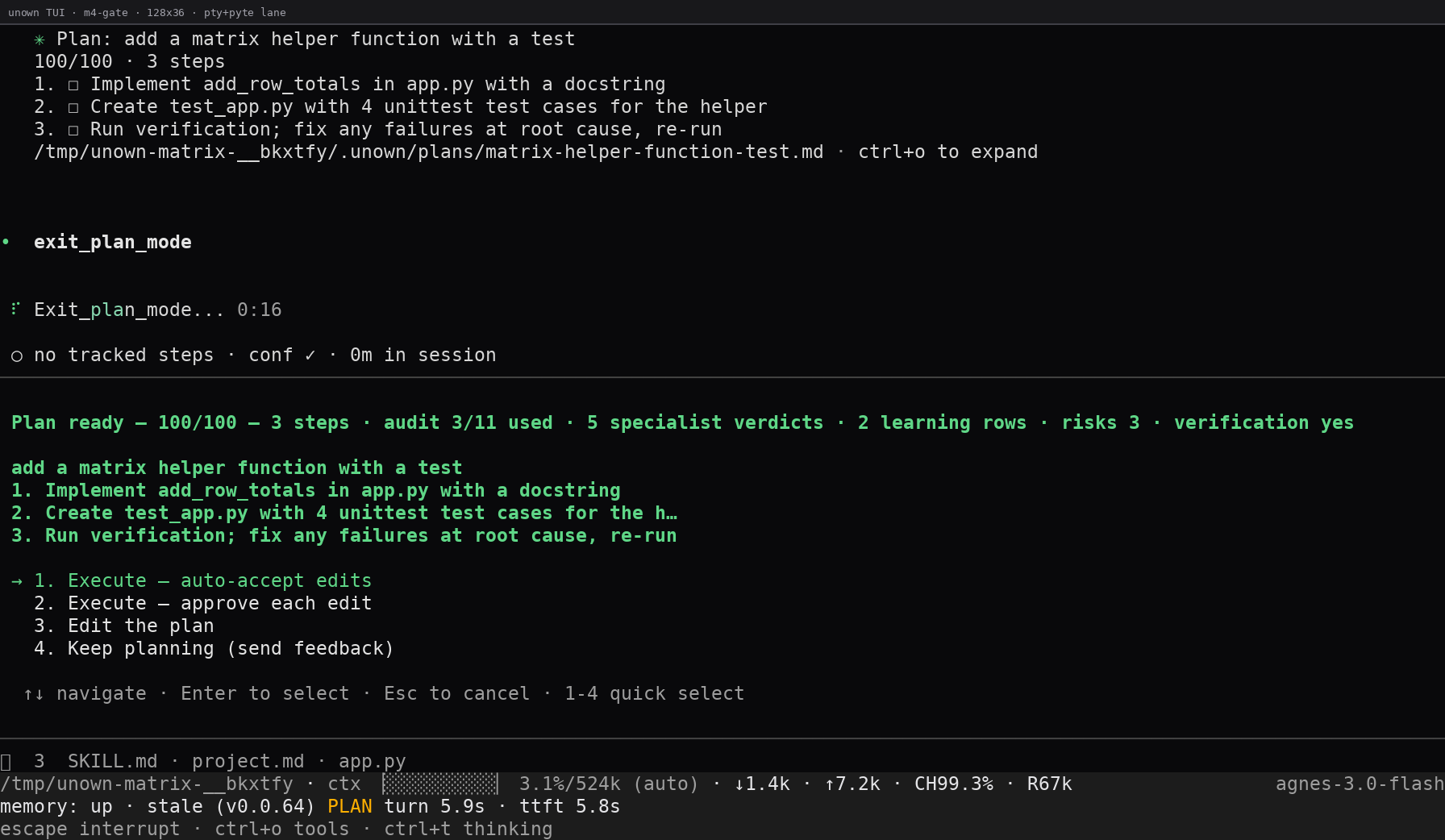
plan_writeblock now renders the objective, the score, and the step checklist (1. ☐ …), capped for narrow terminals with an honest⋯ N more stepstail.Ctrl+Oexpands it to the full markdown. - When the approval dialog opens — the title carries the plan itself
(objective + first steps under the unchanged
Plan ready — <score>headline), with the four options byte-identical to what the keyboard round pinned.Ctrl+Opasses through the open dialog and expands the transcript block behind it. - When the plan is approved or rejected — the result block renders the approval line plus the step checklist, or the rejection plus your feedback, expandable to the full markdown. Legacy transcripts without the new payloads recover the plan from the result text markers — a resumed session never loses its approved plan.
The expand hint renders through the live keybinding machinery
(keyText("app.tools.expand")), so a user who rebinds it sees their key,
and macOS renders option+O — never a hardcoded string.
The verification's own dividend
The first live gate run failed — and the failure was a real bug nobody had
filed: Home, End, PageUp, PageDown, k and j did nothing inside
the docked approval dialog. The fullscreen viewport's scroll bindings
consumed them before the focused component ever saw input. The fix is the
opt-in wantsViewportNav component contract — the selector, input and
editor dialogs declare that they want viewport navigation, and the
fullscreen layer defers. The usage docs' Home/End promise is now
actually true in the live TUI.
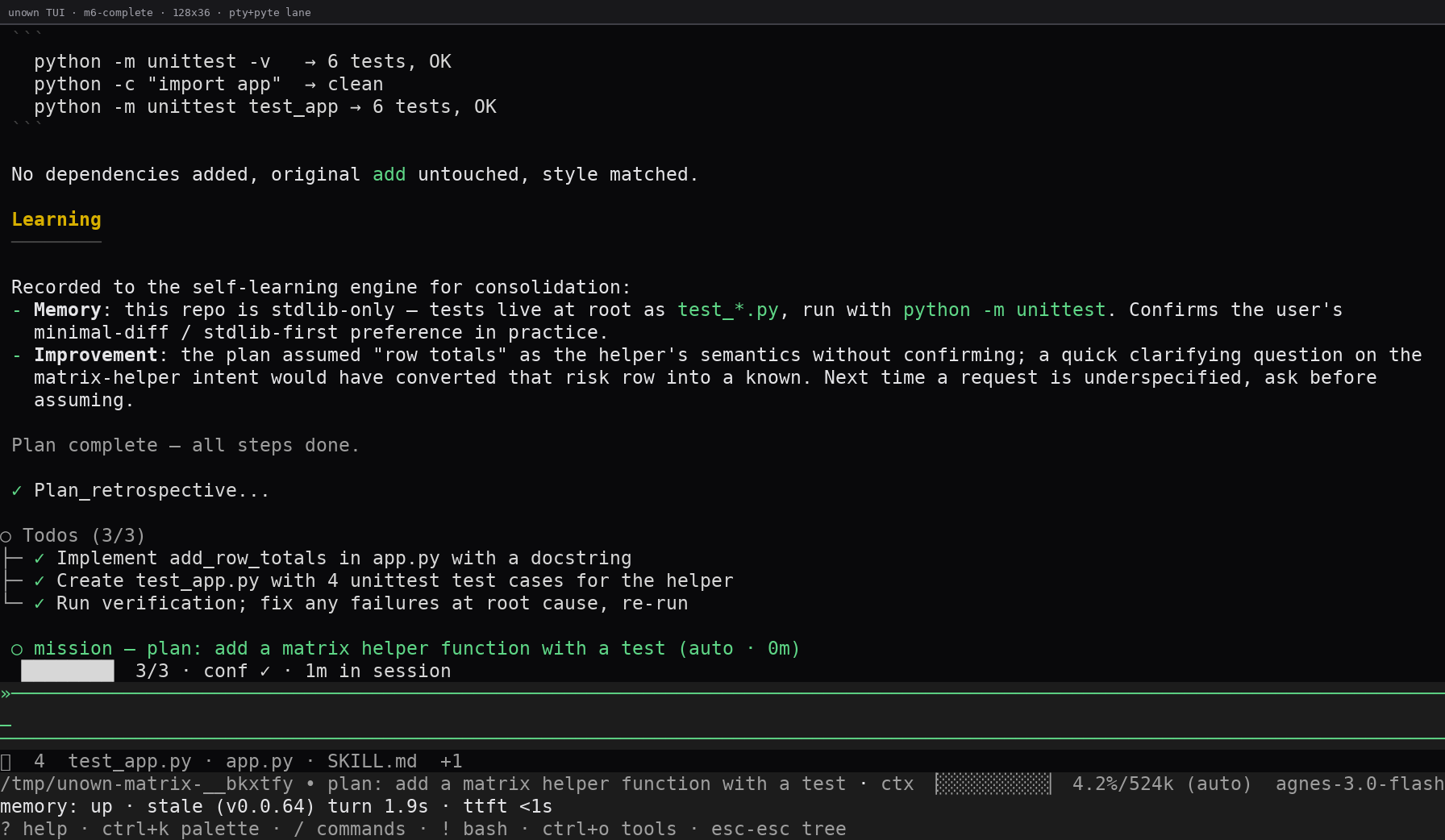
The final verification drove the corrected workflow end to end on a real
terminal against the live model: the PTY matrix 18/18 green — the gate
opens with the plan visible above it, the full navigation matrix works, the
stay-loop holds, approve executes to Plan complete, todo discipline
intact. The captured pane above is that run.
Why it wasn't simple
The obvious fix — echo the plan into the transcript when the dialog opens —
doesn't work: sendCustomMessage during a tool's execution is deferred to
end-of-turn, because providers that validate message order reject a message
wedged between a tool call and its result. The visibility has to live in
the plan_write block (which renders the turn before exit_plan_mode
fires), the dialog itself, and the result block. That's where it now lives.
The round also left the lane pinned: ten display pins in the new
plan-mode-display.test.ts (the display lane was previously unpinned — the
defect's accomplice), plus the pure builders' contracts. And the release
cut itself surfaced three environment-dependent test flakes on the CI
runners that every pre-warmed sandbox had been quietly passing — each
root-caused and cured, with the freshest lesson being that a test
asserting on themed output must pin the theme mode, not inherit whatever
the runner's environment happens to say.
The plan was always there. Now you can see it. That's the whole fix — and it took a seven-product teardown, a pure display module, a viewport navigation contract, ten pins, and an 18/18 live matrix to make it true at every moment it matters.
Spotted something wrong or worth adding? The record is the repo — open an issue.