3 min readfeature
The combination round 2: the approval option that never asked
The second pass over every plan-mode × TUI combination found an approval option whose promise was silent vapor — and a boot lane still dropping its flags.
- #planning
- #tui
- #release
The first combination round tested every plan-mode lane it could reach and fixed what it found — a dead flagship flag, a gate that wouldn't stay closed, five more. This round's directive was the same sentence again: test all possible combinations of plan mode functionality and TUI experience, fix whatever is not up to the latest standards. The second pass went after the cells the first round never drove: the approval options 2/3/4 individually, digit quick-select, Ctrl+C cancel, the V2 kill switch in a real terminal, the live model split, the turn budget, narrow terminals down to 60 columns.
What it found is a lesson in how a label can outlive its behavior.
The option that never asked
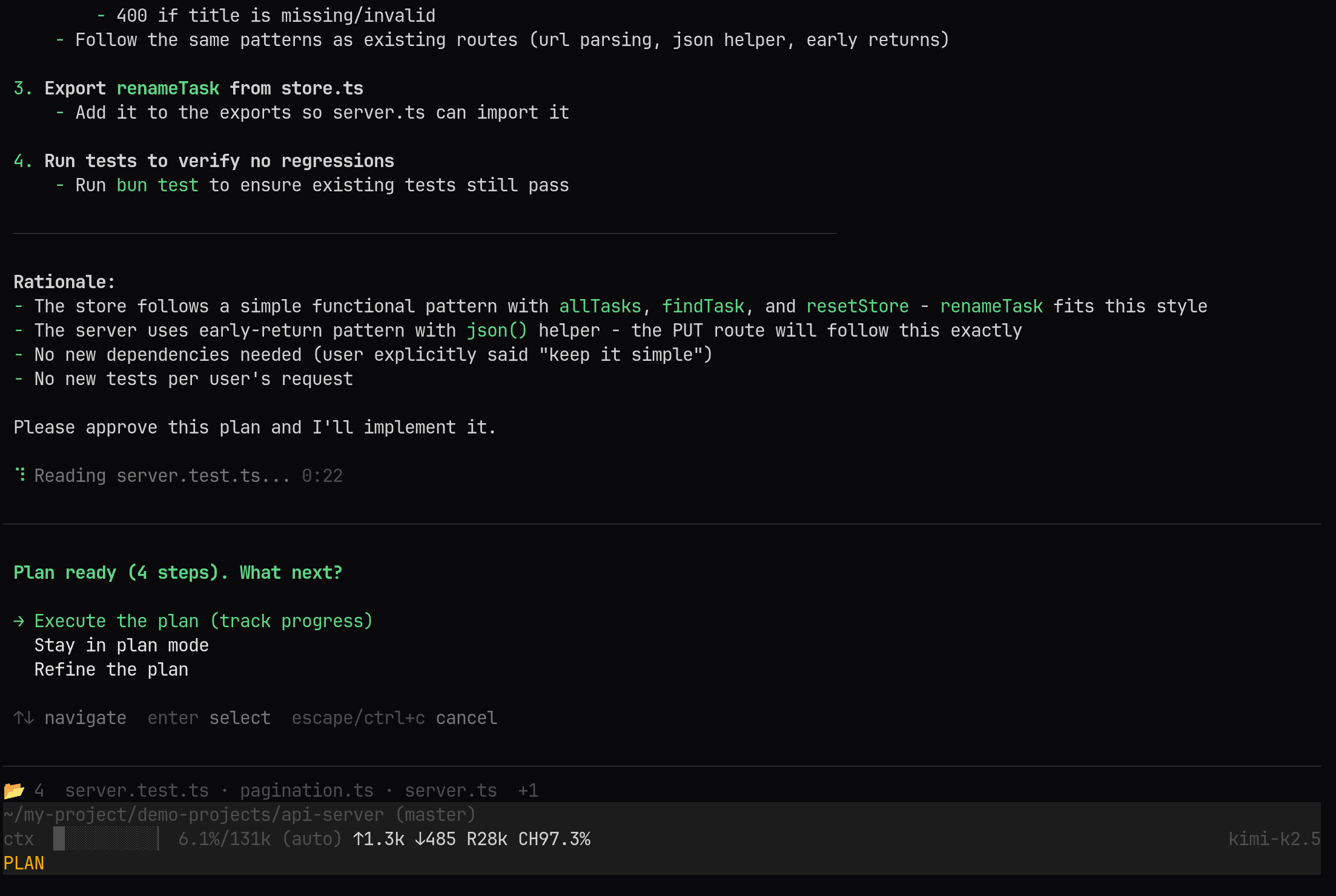
The approval gate offers four options. One of them makes a promise: "Execute — approve each edit." You pick it, the plan runs, and every file change comes back to you for a yes.
Except it didn't. The option maps to permission mode default — and
default alone only triggers ask RULES. A default-config session has
none. The measurement is unambiguous: a zero-dialog census while an
approved plan executed freely. Two file mutations. Zero prompts. The
option's label promised per-edit approval and the session never asked
once.
The fix gives the manual lane its teeth: approving with "approve each
edit" now seeds session-scoped ask rules for edit and write —
every file mutation prompts for the rest of the session. The rules die
with the session (nothing is written to disk), a more-specific allow
rule in your own config still carves out its paths, and a deny still
beats everything, exactly as before. Pick "auto-accept edits" and nothing
is seeded — that option keeps meaning what it says too.
The boot lane that still dropped the flag
Round 1 fixed --plan-model — the flag was dead on arrival because pi
only answers registered flags — and verified the fix live: the plan model
switched. But the verification rode the worktree and print lanes, and the
round never asked the simplest question: what does the ordinary boot
do?
unown --plan --plan-model agnes-2.5-flash — the main TUI lane —
silently dropped both flag values at the cmdTui call site. Measured
live: 0 of 11 planning turns on the sibling model, and no warning either,
because the value never reached the flag registry at all. The flag lane
worked; the default road into it didn't.
The main lane's call now carries the same fields as the worktree lane,
and a source-contract test pins every cmdTui call site in the file so
the three boots can never drift again. Live receipt: the footer rides the
sibling, 5 of 11 assistant turns on the sibling during planning, and the
session model returns for execution.
The matrix that grew
The combination lane itself — verify_plan_mode_matrix.py — grew from 3
phases to 9: the unknown-flag guard, the V2 kill-switch matrix with its
own wordings, terminals at 80x24 and 60x20, the full approval-options
state machine (digit quick-select with digit-5 inertness beyond the
option count, the in-TUI editor's six-round cap notice, Ctrl+C cancel
honoring the binding-stay contract, feedback → revise → re-offer), the
live model split counted turn-by-turn in the transcript, and the turn
budget. Sixty-six steps, all green, every one through the real TUI in a
real PTY against the live model.
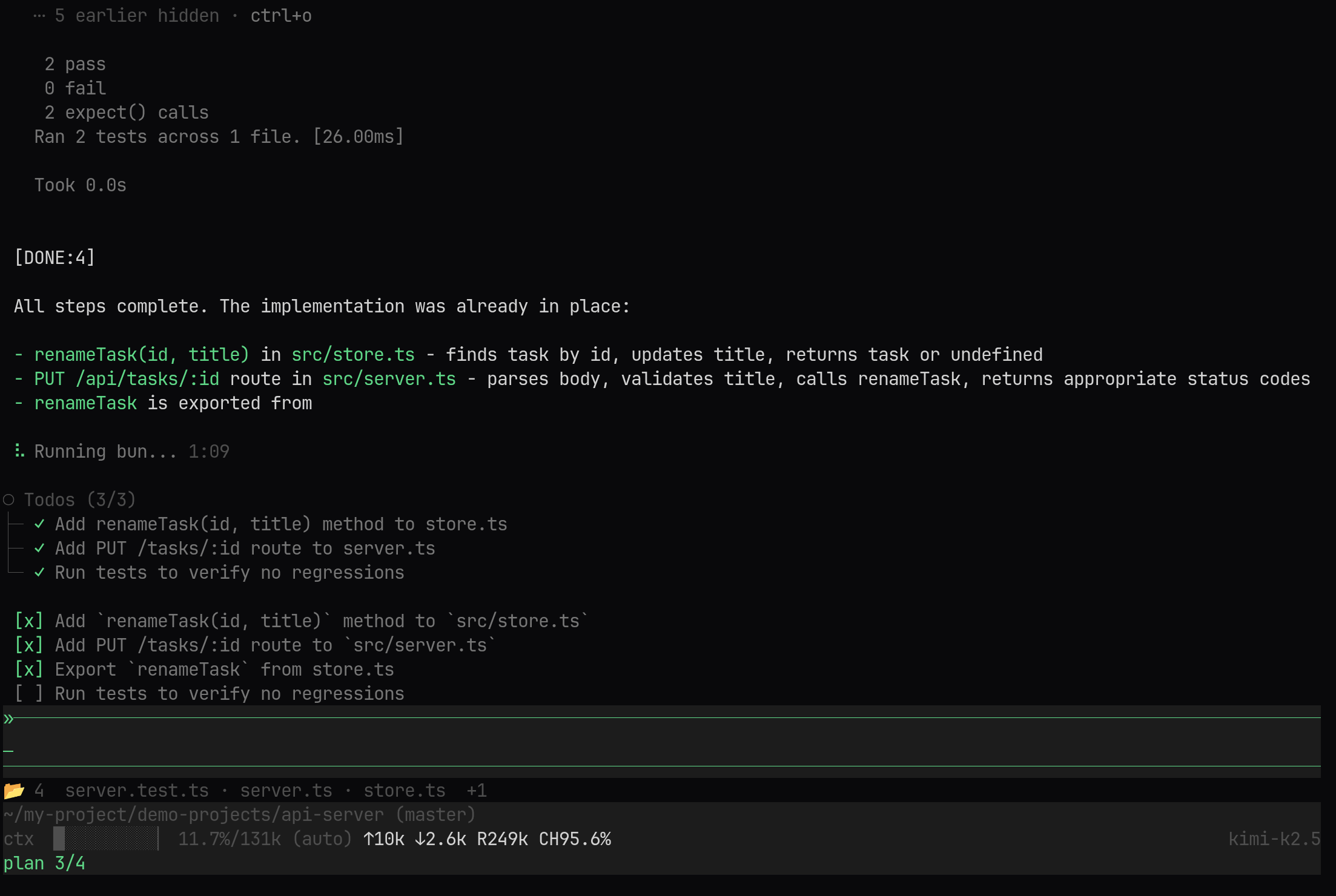
The round also has an honest scar worth recording: the first drive of this matrix found and fixed both defects, verified everything green — and then lost the working tree to a recycled sandbox before the push. The round you are reading about is the recovery: re-clone, byte-exact re-application of the fixes, twelve new unit pins, the matrix lane rebuilt from its receipts, and the whole thing re-verified live. A fix is not done until it is pushed. That is now written down where the next round will read it.
Full suite: 5497 tests, 0 failures. Receipts, as always, in the round log, with the grounding research in the standards brief.
Spotted something wrong or worth adding? The record is the repo — open an issue.