3 min readfeature
Ostinato: the round where the hardening came first
The repo's second user product - a keyboard-first, offline-first spaced-repetition PWA shipped under a harden-first programme, with receipts.
- #pwa
- #keyboard
- #hardening
- #agent-driven
Ostinato is the second user product this repo has ever shipped, after Coda: a keyboard-first, offline-first spaced-repetition flashcard PWA at apps/ostinato/ — markdown decks, SM-2 scheduling, a 17-command palette, crash-safe mid-review resume, and zero package dependencies. But the round that built it is the more interesting story. It ran the A1 engagement's harden-and-prove programme: hardening first, before feature velocity — the reliability lanes were exercised, and their defects harvested, before the app was allowed to grow.
What v1 actually is
- markdown decks — cards are front/back markdown, rendered in-app, round-tripping losslessly through byte-stable JSON import and export;
- SM-2 scheduling — the Wozniak 1990 algorithm, pinned as the oracle by test receipts and cited, not re-derived;
- the keyboard surface — j/k navigation, 1-4 grading,
/search, Ctrl+K for the 17-command palette, all exercised with zero pointer events; - crash-safe resume — every transition persists to localStorage with atomic writes, so a reload mid-review restores the exact phase;
- honest scope — verification is Chromium-desktop only. Firefox, Safari and mobile are untested and recorded as deferred.
How a round like this runs
The round was planned against a PRD and an eleven-lane reliability matrix, then executed through budgeted agent tickets O-1 through O-6, each green on its own gate before the next started. Before any app code was written, three calibration canaries (C1-C3) ran to baseline the operator lane. The live-execution diagnosis lanes then did the heavy lifting: four rounds of the e2e battery against the real app harvested nine defects the unit lanes could not see (B-3 through B-11 — the receipted-but-unwired persist rule, overlays that painted only on the review path, aria attributes dropped on the floor, a stale done session restored over fresh imports, a synchronous blob revoke that killed its own download, a nameless listbox, dimmed contrast, focus destruction by full rerenders, and a grid min-width overflow). Each was root-caused with live probes and fixed with byte-exact briefs. No operator wrote app code; the tickets carried the receipts.
The hardening receipts
The figures in this post are the ones with receipts, from the closeout re-run (benchmarks/ostinato/receipts/run-20261104T181704Z/):
- the e2e battery — 12 specs across five lanes, 12/12, 8.5 s first run / 7.2 s re-run, headless Chromium, verified by an external Playwright suite rather than the app's own tests: keyboard-only flow with byte-verified export/import, axe
wcag2a/wcag2aain light and dark with zero violations, offline boot from the service worker with the loop completing offline, crash-resume and 375/1280 resize discipline; - the precache derivation proof — 18 URLs, 0 missing, PASS, the three-way disk ladder that no hand-maintained cache list can offer.
The unit lanes ran 93/0 in both their DOM-free and compatibility forms; the app's package.json carries no dependency fields at all, and the dedicated CI job asserts that stays true on every build.
The engineering spine
Four load-bearing choices, each pinned by a gate:
- a DOM-free domain core with a boundary-test pair —
src/domain/imports nothing outside itself, enforced by a boundary test plus a scoped no-DOM-globals rule, not grep, which is bypassable; - every-transition persistence — the crash-resume claim is true by construction, because every render path rewrites both storage lanes; the one wire that was missing (B-3) is exactly what the crash-resume lane exists to catch;
- atomic localStorage writes — write the temp key, then commit-swap, so a crash mid-write never leaves a torn document;
- the audited capture lane — the stills on this page and the landing band came from
apps/ostinato/scripts/capture-usage.mjs, a keyboard-only Playwright lane whose PROVENANCE.md is the receipt for every frame.
The landing page carries the identity pair — the palette and the revealed markdown back — while the four stills below ride here.
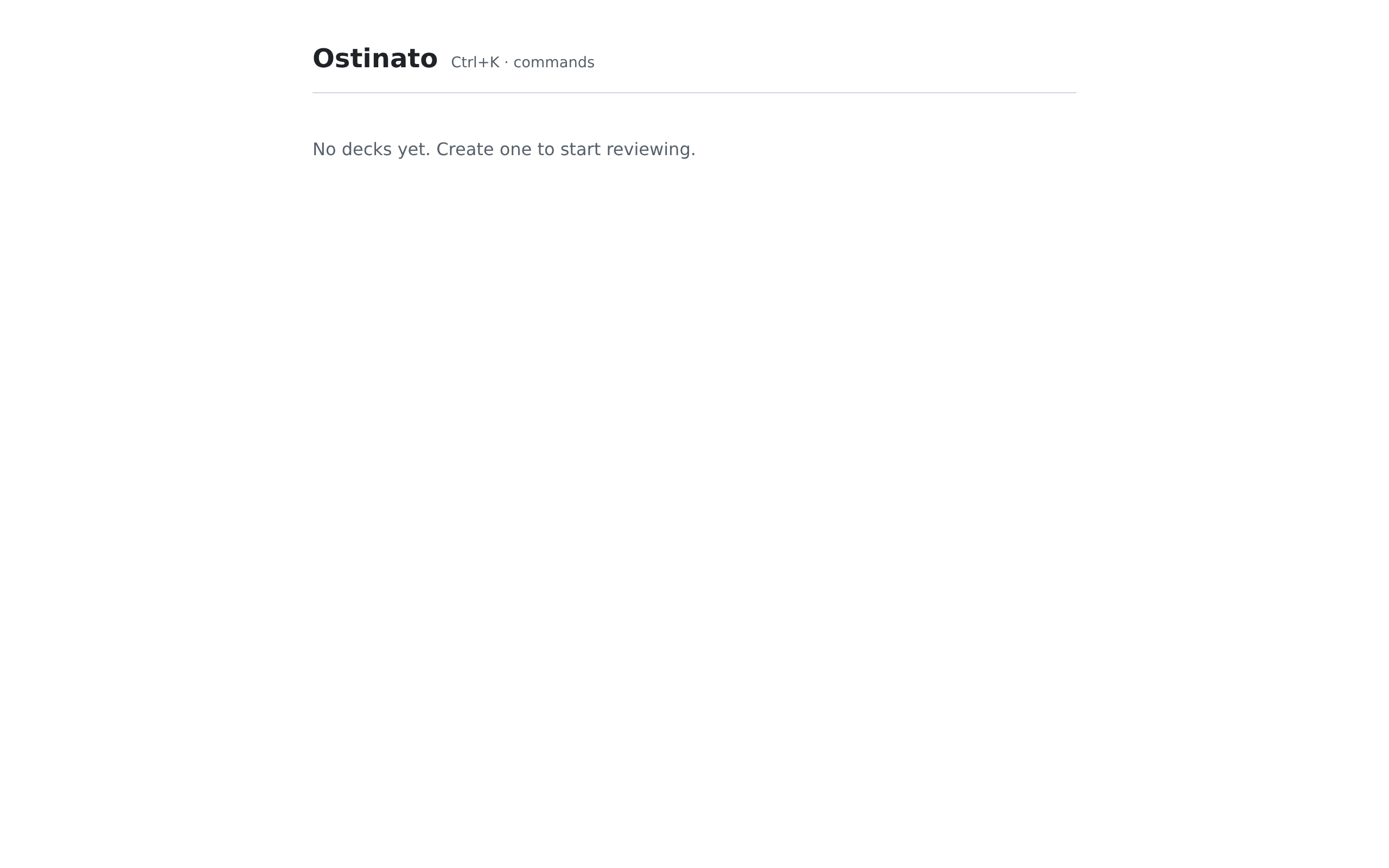 Fresh boot: the honest empty state, "No decks yet."
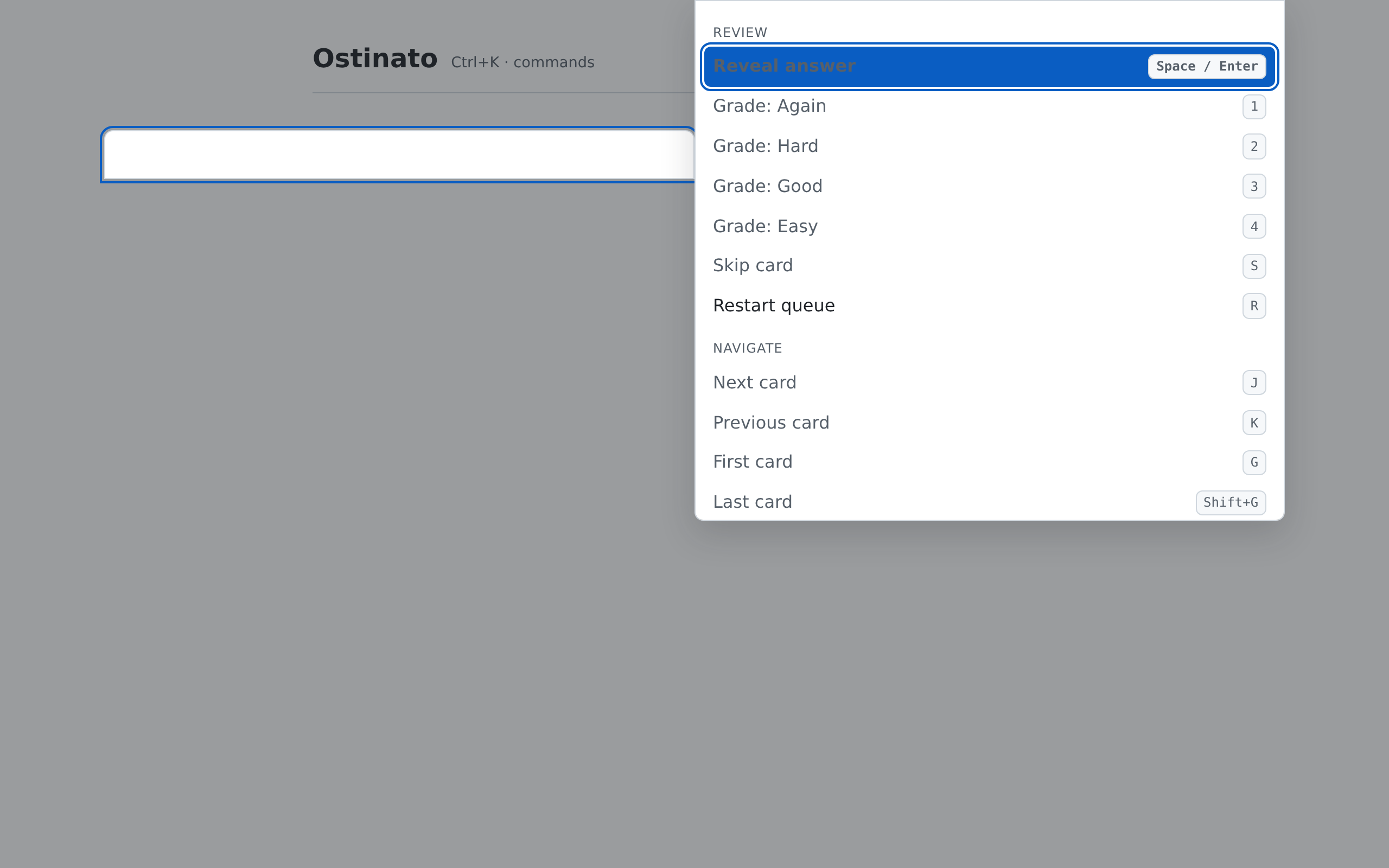 The 17-command palette — the keyboard-first identity shot.
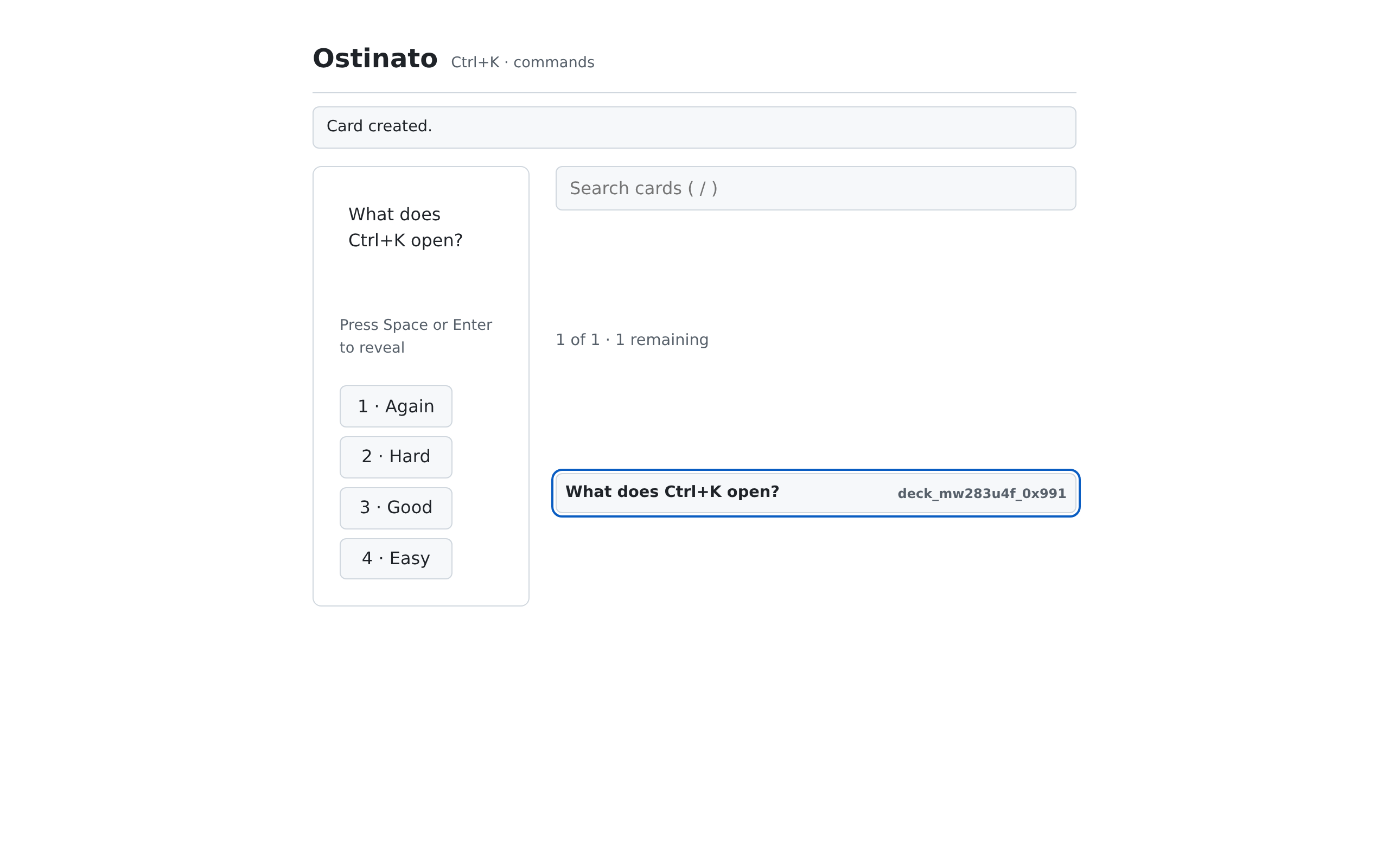 Review: the deck's card front with progress, "1 of 1."
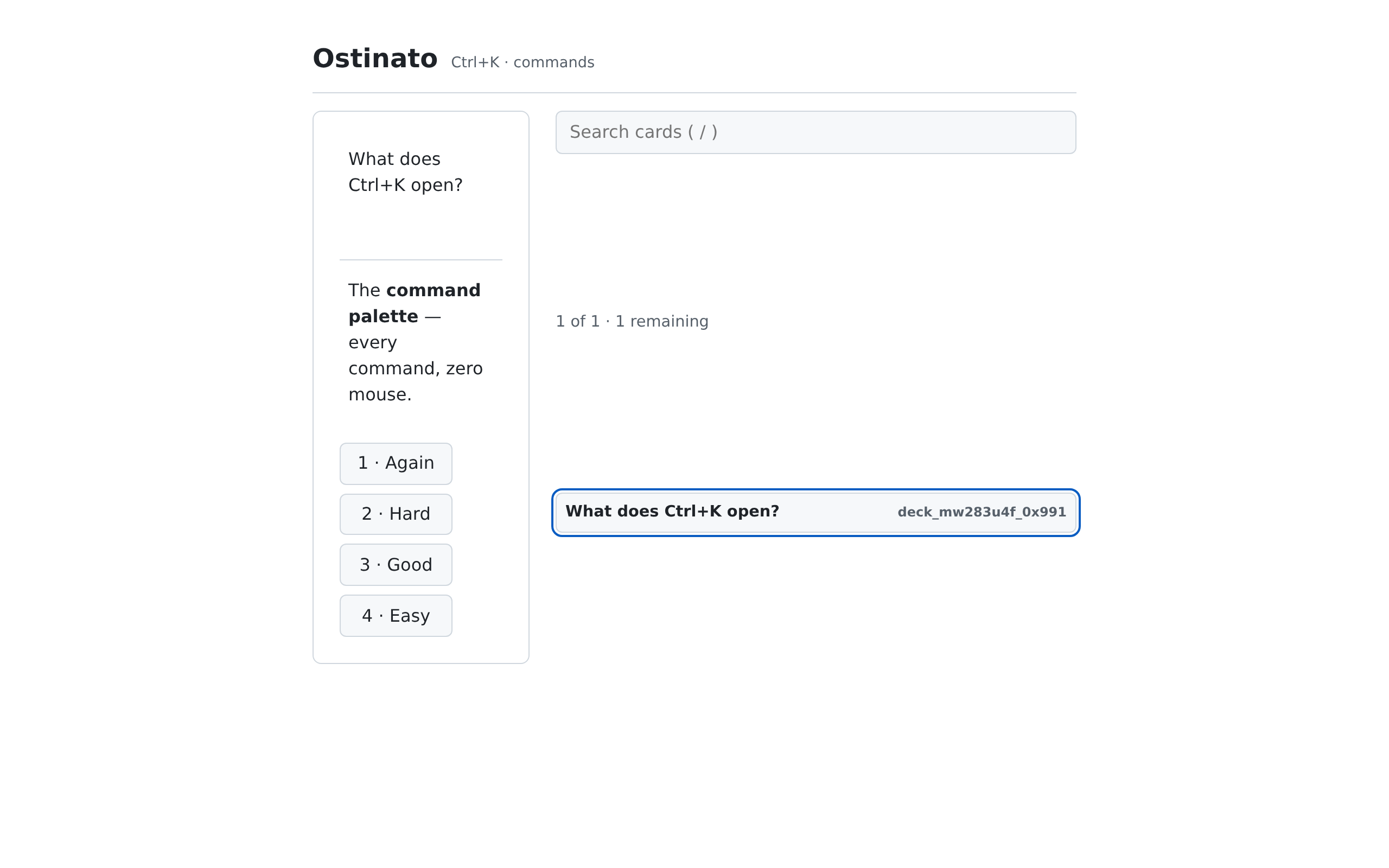 The back revealed with Space — the markdown bold rendered, left ungraded on purpose.
Try it
bun run ostinato:dev boots Ostinato at http://127.0.0.1:4013 through a transpiling static server — no build step, no bundler. The full developer and user story is in docs/ostinato.md: running it, testing it, the keyboard-first story, and the PWA/offline story.
Spotted something wrong or worth adding? The record is the repo — open an issue.