5 min readrelease
The release that never was: re-cutting v0.0.53 from a red tag
The tag shipped while CI was red on all three OSes, so the release never published. The story of the one-way latch that caused it — and the fix.
- #release
- #verification
- #testing
The changelog said v0.0.53 was out. The GitHub releases page said otherwise: latest was still v0.0.52. No assets, no feed entry, no installs — the tag existed, pointed at the release commit, and nothing had shipped. This is the story of how a release can silently fail, what the red CI was actually saying, and the one-line architectural assumption that connected a flaky test to a real production defect.
What the release workflow did right
The repo's release pipeline has a rule we wrote ourselves: a tag on a red
SHA can never release. The ci-green job resolves the CI run for the
tagged commit and polls it; if CI did not conclude success, every
downstream job — the 3-OS verify matrix, the artifact build, the SBOM, the
binary smoke legs, publish, feed verification, installer smoke — is skipped.
That gate fired. The tag went up while CI on the same SHA was failing, and
the gate quietly refused to ship a broken release. The failure mode we
designed for on paper worked exactly as intended; what we had missed was on
the human side — nobody watched the workflow after pushing the tag, so the
release sat unpublished for a day. The lesson that landed: the cut is not
git tag && git push. The cut is watching the workflow finish.
The red CI, decoded
The failing job was Build + test — the same failure on ubuntu, macOS and
Windows, which is always a hint: not a platform flake, but something
deterministic that only shows up in the full-suite file order.
The failing test was one we had just written: the todo unification round's own M1 fallback pin —
with the todo addon disabled, the legacy plan-steps widget is the execution surface —
expect(legacy.length).toBeGreaterThanOrEqual(1)→ Received: 0.
Ten of the file's eleven tests passed. The file, run alone, passed 11/11. Run
after goal.test.ts, it failed. That is the whole diagnosis in one sentence:
bun test runs every file in one process, and module state survives
between files. goal.test.ts (earlier in the enumeration) calls
registerTodoAddon, which sets module-level bridges — functions in module
scope that nothing ever resets. By the time the unification file's fallback
test ran, isTodoOverlayAvailable() answered true for an addon that test
never registered. The legacy widget — the exact thing under test — never
mounted.
The round's local verification had passed the same suite because bun's file
order varies by platform and runner (a fact our own test/_env.ts documents
after three prior CI incidents). The local order was friendly. CI's was not,
on any of the three OSes. A test that passes alone and fails in the suite is
not a flaky test; it is an order-dependent test, and order-dependence is
always a shared-state leak wearing a disguise.
The same bug, in production
Here is why the failing test deserved to fail. The one-way latch it tripped over is not just a test-infrastructure annoyance — the same mechanism had a production shape:
/reloadre-runs every extension factory in the same process.- The
/addonstoggle for the todo addon says "disable (until /reload)". - Disable it, reload, and the module-level bridges set by the previous
factory cycle are still there.
isTodoOverlayAvailable()still answerstrue— for an overlay that can never mount again, because the addon that owns it is no longer registered. - tools.ts, believing the overlay is live, keeps the legacy plan-steps fallback retired.
Result: no progress surface at all until a full process restart. The test was asserting the right contract (the fallback must exist when the addon is off) through the wrong lens (it assumed a pristine process). The one-way latch was correct only under an assumption the architecture doesn't make: a process registers exactly once.
The fix: a contract, not a latch
The repair is small because the diagnosis was exact — the best trades are always like that:
resetTodoAddonBridges()restores the five todo-owned module bridges to their unregistered defaults. The tools-owned pair (the plan-sync reader and the completed listener) is deliberately untouched: the tools extension registers before the addons extension in every cycle and re-arms its own.- The addons extension's factory calls the reset at the top of every
(re)registration cycle. Boot and
/reloadboth converge to the same invariant: bridge state mirrors the currentaddons.json. Enabled cycles re-register immediately, so the reset is invisible to them. - The unification test file now starts every test from the unregistered state — order-proof by construction — and a new RELOAD pin drives two real factory cycles (enabled → disabled) through the actual addons extension, then approves a plan and asserts the legacy widget returns. Run against the unfixed source, that pin fails; against the fixed source, both file orders pass.
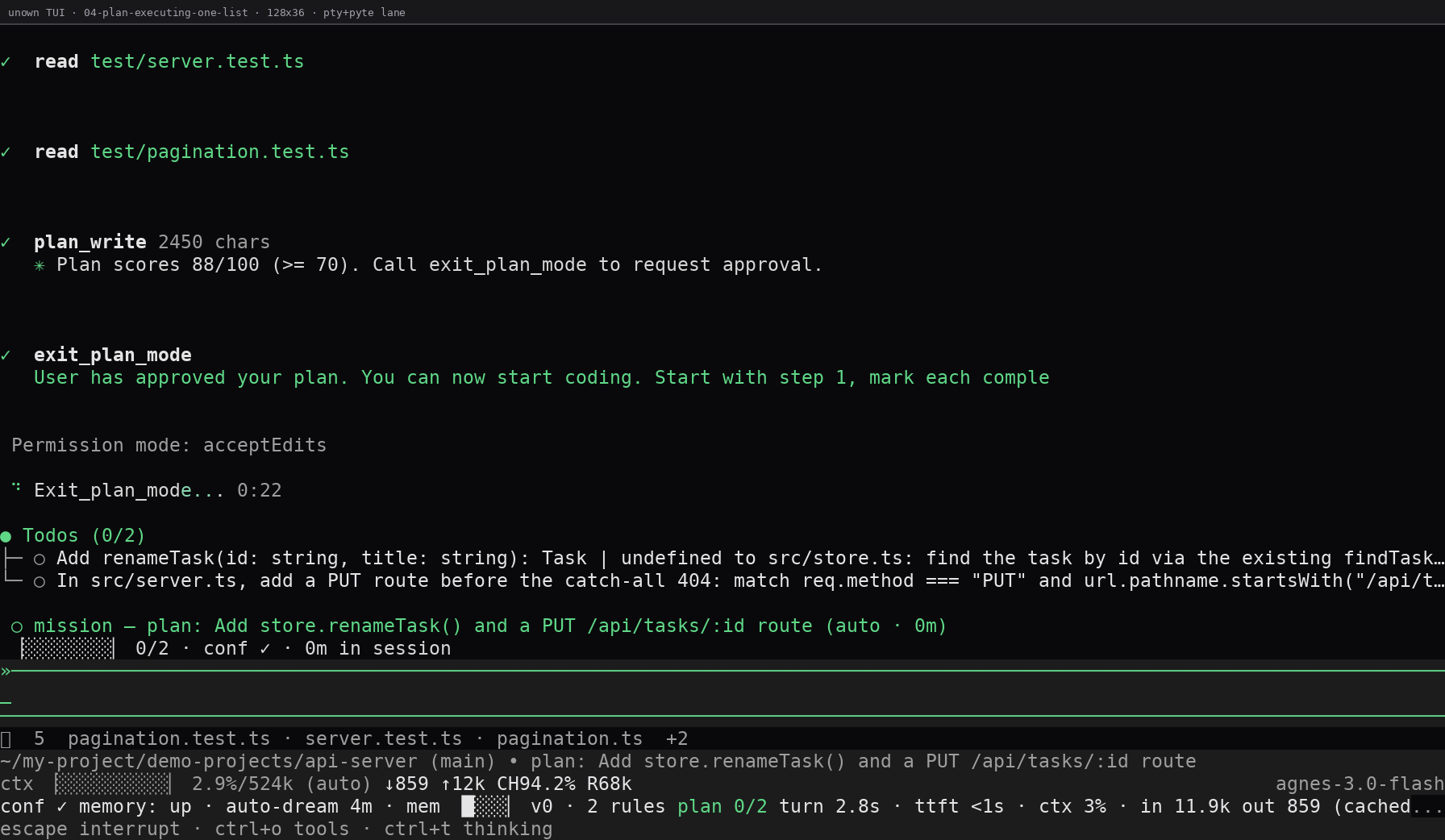
Verified like a real user, again
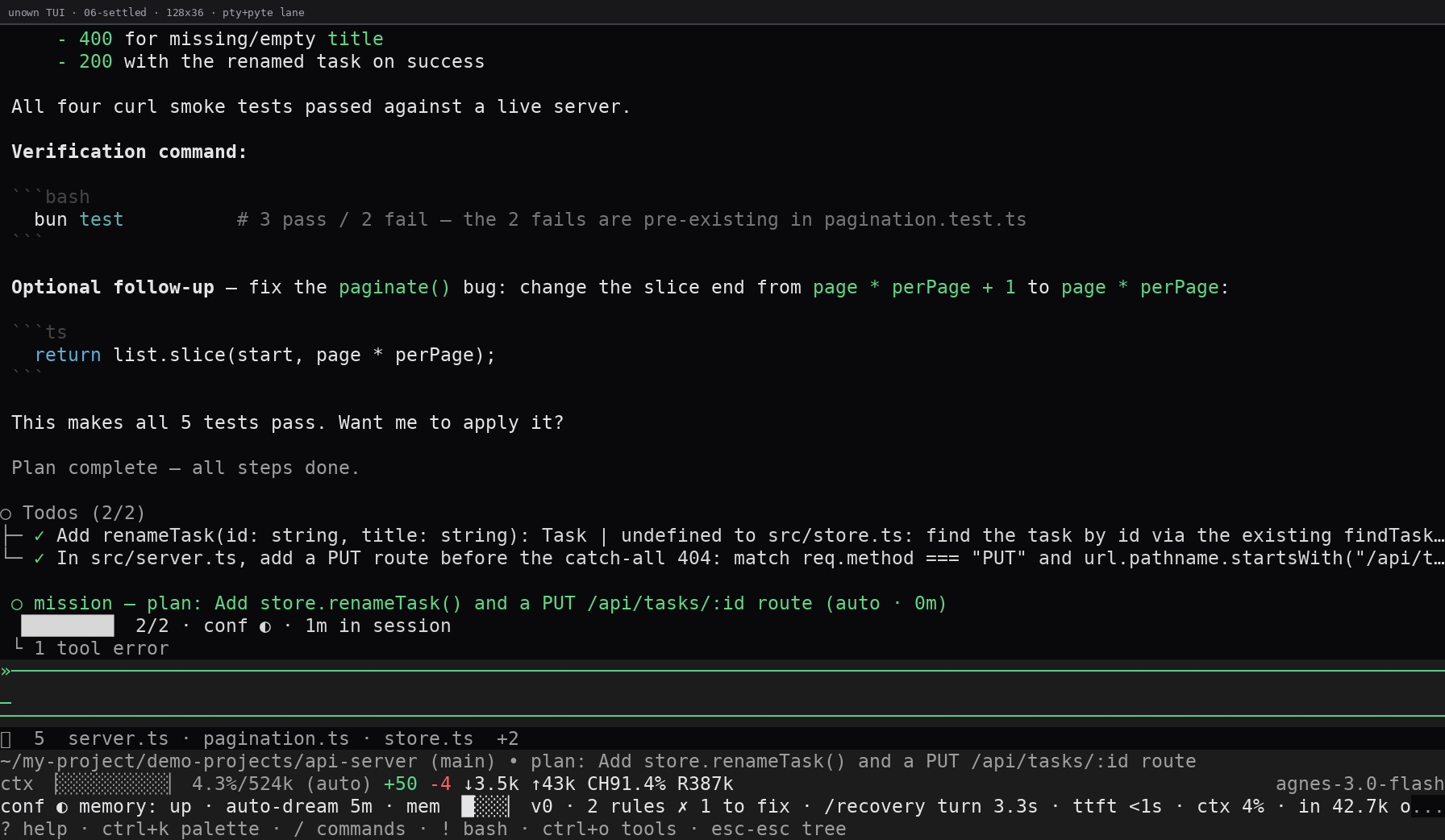
Because the fix touches the boot-time wiring, the round re-ran the whole verification matrix, not just the unit that changed:
- the full self-learning suite 5326/0 in the exact local order that had reproduced the failure (a stricter order than any CI leg);
- integration 13/0, bridge 248/0, e2e 15/15, the landing gates, the production build, the artifact-builder suites;
- the real-user PTY lanes against the live model: the todo unification lane's 14 checks (planning suspension, single checklist at approval, the session-file lockstep — one seed entry, ids restarting at 1, final todo/plan agreement) and the footer lane's 9 — both green on the repaired tree.
The re-cut
With main green, the tag moved. Moving a tag is normally taboo — but this one had never been a release: no release object, no assets, no feed entry, no install ever referenced it. The alternative was cutting v0.0.54 and leaving the changelog documenting a v0.0.53 that never existed. The honest option was the tag move, a corrected release date in the changelog, and this record.
The 0.0.54 queue is already written down — the settings ledger's spend meter and memory-health card, each with a benchmark waiting to flip. But that is the next round's story. This one ends the way every release should: watched, green, and actually published.
Spotted something wrong or worth adding? The record is the repo — open an issue.