4 min readfeature
The todo unification round: why you saw two to-do lists in plan mode
The plan-steps widget and the seeded Todos panel both mounted after approval. This round made them one list — verified live, with receipts.
- #planning
- #tui
- #verification
The bug report was one sentence: "why am i seeing two to-do lists in the plan mode?" The honest answer took a root-cause pass to write — because both lists were real, both were ours, and each had been shipped by a different round without knowing the other existed.
What you were seeing
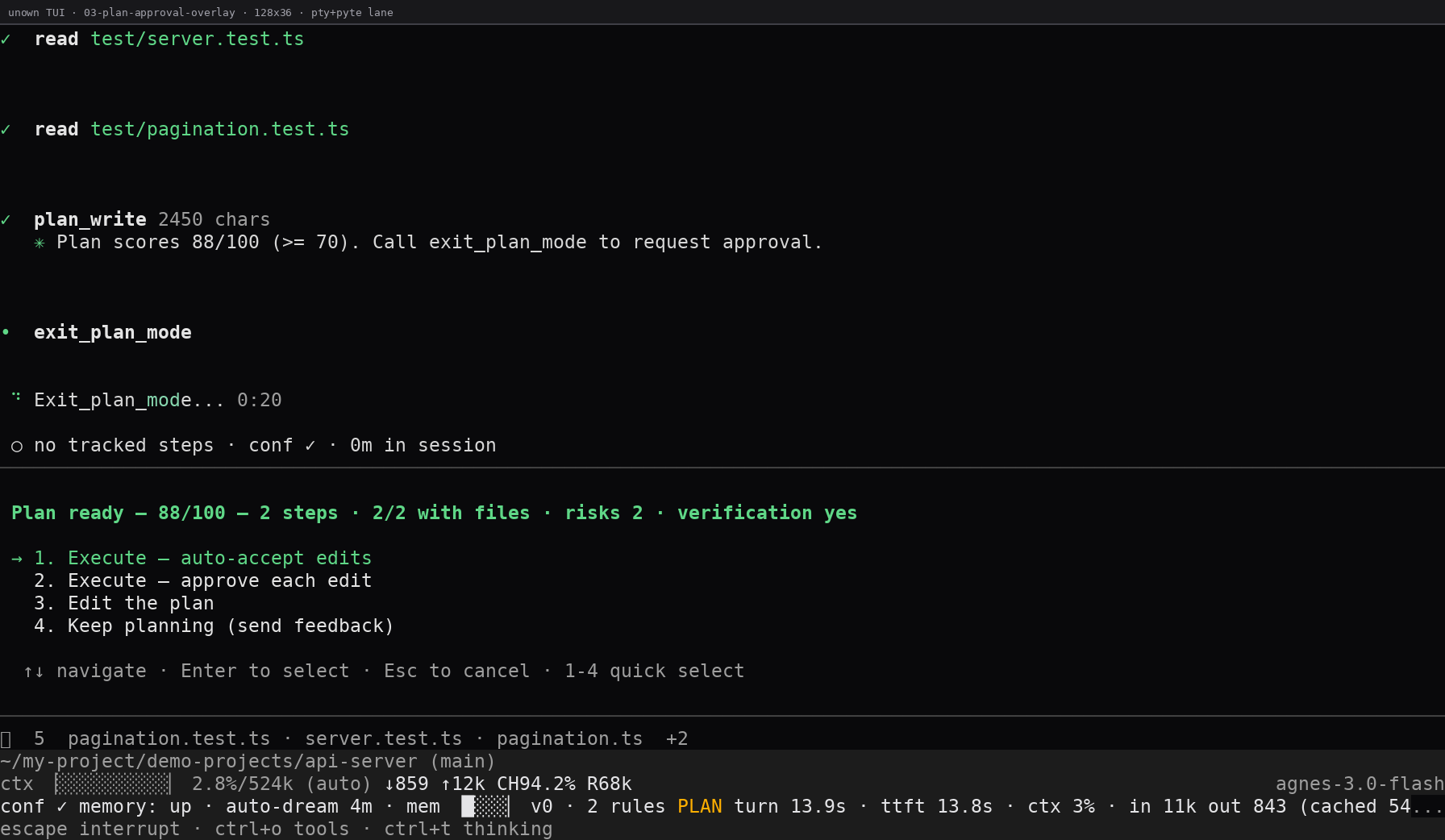
Plan Mode V2 (the planning round) ends in an approval dialog. On approval,
the approved steps were rendered as a legacy plan-steps widget above the
editor — [ ] step lines advanced by [DONE:n] tags. But gap P-06 had
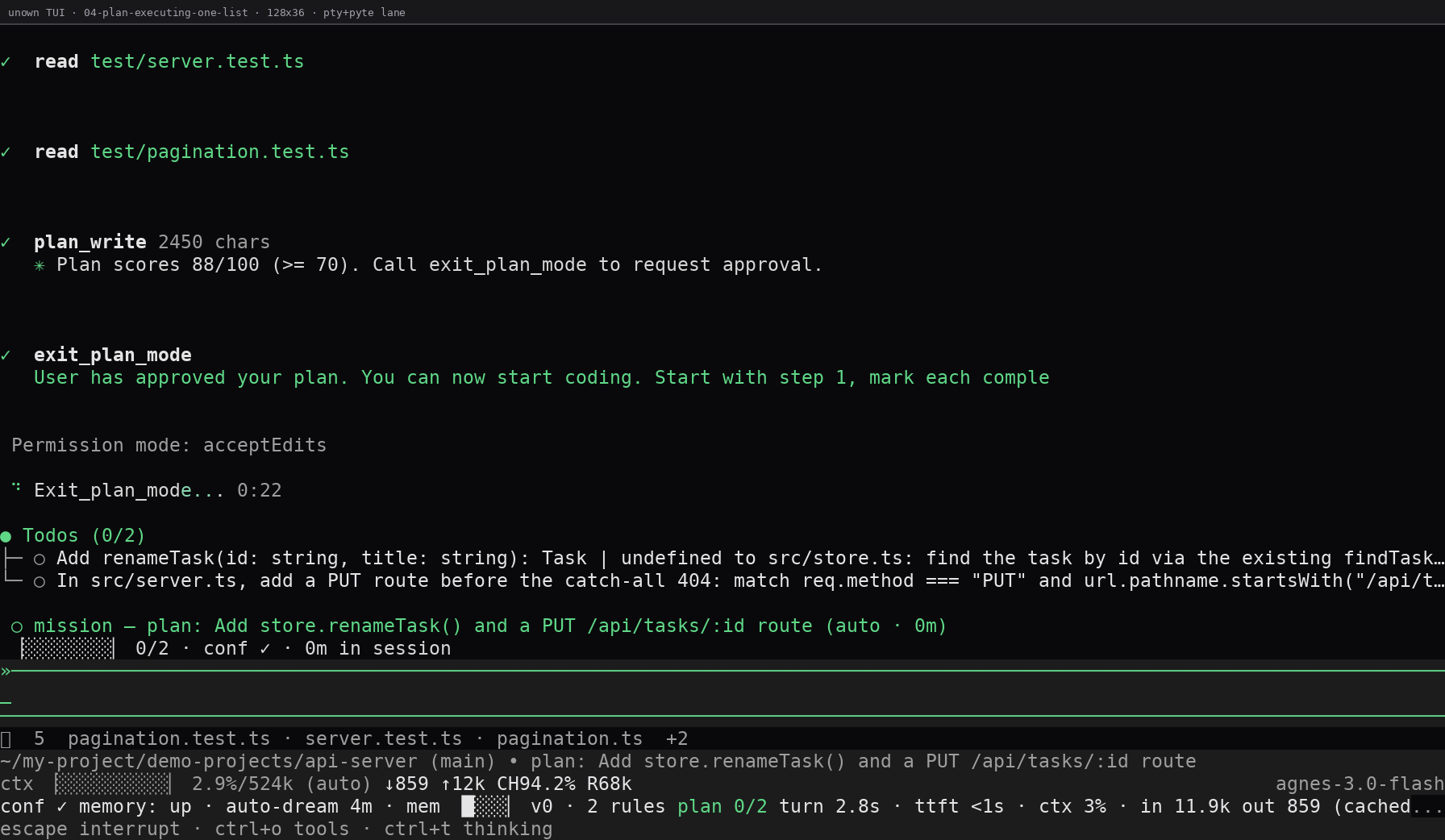
also shipped a plan→todo bridge: approval seeded the V2 todo overlay with
the same steps. Two widgets, two keys, both aboveEditor, stacked. The
seed hook shipped without retiring the old widget.
Three more defects rode along: the todo tool was still available while
planning (nudging the model to build a second list mid-plan — Codex
rejects update_plan in plan mode with an explicit error for exactly this
reason); seeding appended instead of replacing, so approving plan B
stacked it on plan A inside one panel; and the seeded panel only mounted
after the model's first todo call — popping in late, next to the list it
duplicated. [DONE:n] tags and todo flips never synced, so the footer chip
could disagree with the visible list.
The rule the fix enforces
We checked what every serious agent does before writing a line: OpenAI
Codex rejects the todo tool in plan mode at the tool layer; Gemini CLI's
plan-mode allowlist excludes write_todos; Claude Code keeps the task list
one live surface and never renders the plan as a second checklist. The
consensus is one sentence: the plan is a user-approved proposal artifact,
the todo list is live execution state — exactly one progress surface may be
visible at a time, and the handoff happens once, atomically, at approval.
So now:
- The seeded Todos panel is the ONE checklist above the editor. The
legacy
plan-stepswidget is retired — it survives only as the fallback for a todo addon disabled via/addons, and the two can never be mounted in one process. - Approval replaces the foreground list: ids rewind, one replayable
seed entry lands, and approving a second plan never stacks it on the
first. The panel mounts at the approval moment, not after the model's
first
todocall. - The
todotool is off the plan-mode toolset while planning, and the overlay suspends while the PLAN chip is on — a leftover list never sits next to the plan's checklist. Your data is kept; approval or leaving plan mode brings it back. - Progress has two input paths that are the same list: a
[DONE:n]tag flips the matching seeded todo; a hand-driven todo flip completes the matching plan step. The footer chip, the mission panel and the panel always agree — and/resumereconciles both directions before the first paint.
Verified like a user
Eleven new tests pin the contract through widget-capture assertions (the
plan-steps widget never mounts while the addon is live; approval mounts
the seeded unown-todos; re-approval replaces; tags flip todos; todo
flips complete steps; resume reconciles both directions). But the headline
got more than that: a live PTY session drove the real TUI against the real
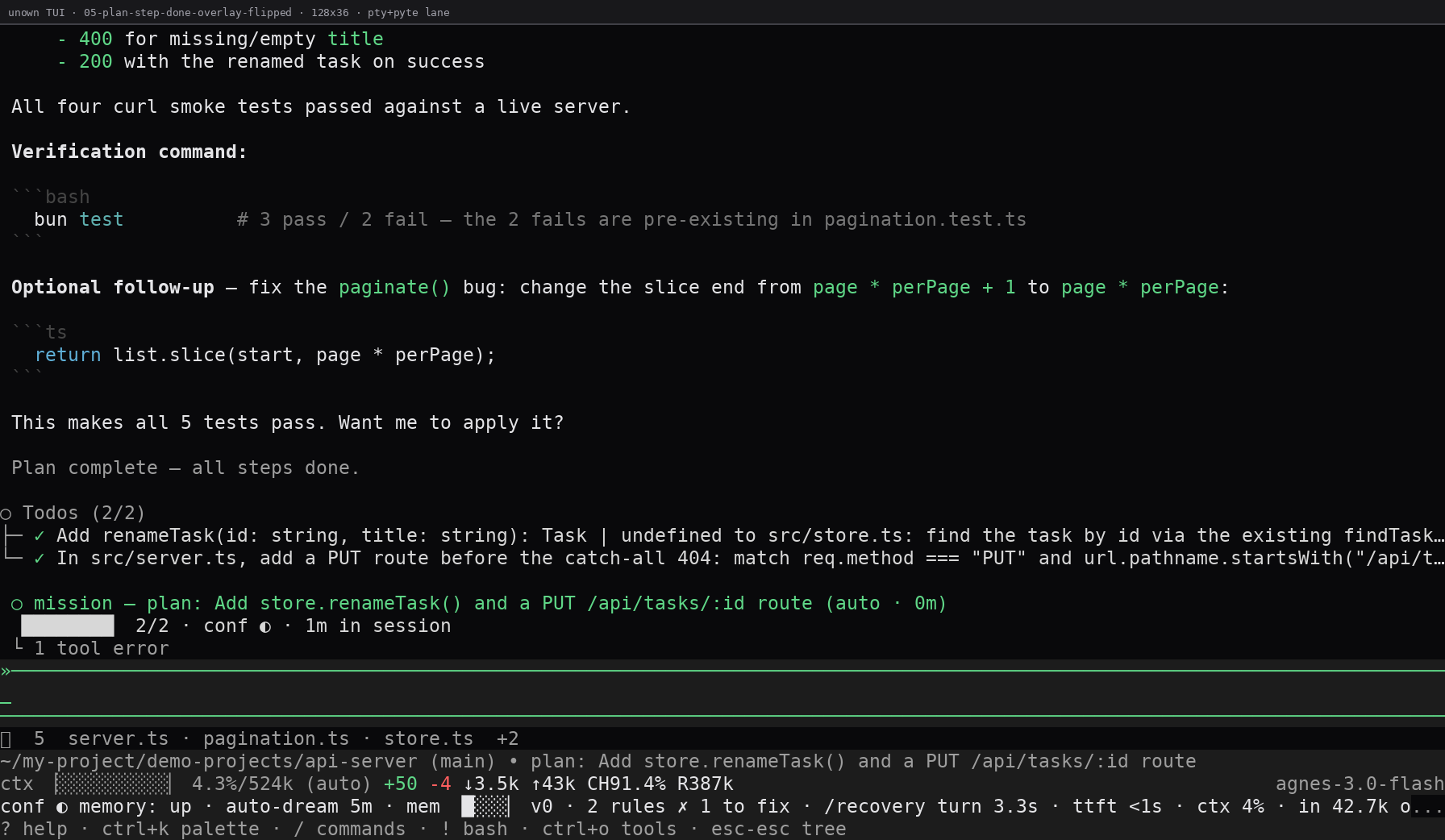
model — /plan on, a real task, the approval dialog, execution, settle —
and checked the literal pane text at every step. Then it checked the
session file, because panes are timing-dependent and truth isn't: the seed
entry count, the rewound ids, and the final agreement between the plan
state and the todo state on every matching step. Fifteen checks, all
green — including the one that matters most: no [ ] plan-steps row
ever appears.
The lockstep evidence is the part we're proudest of. In the live run the
model used both input paths — [DONE:1], then [DONE:2] [DONE:3], plus
its own todo updates — and the plan state and the todo state advanced in
perfect lockstep, entry for entry, ending in the completion gate firing
with all steps done.
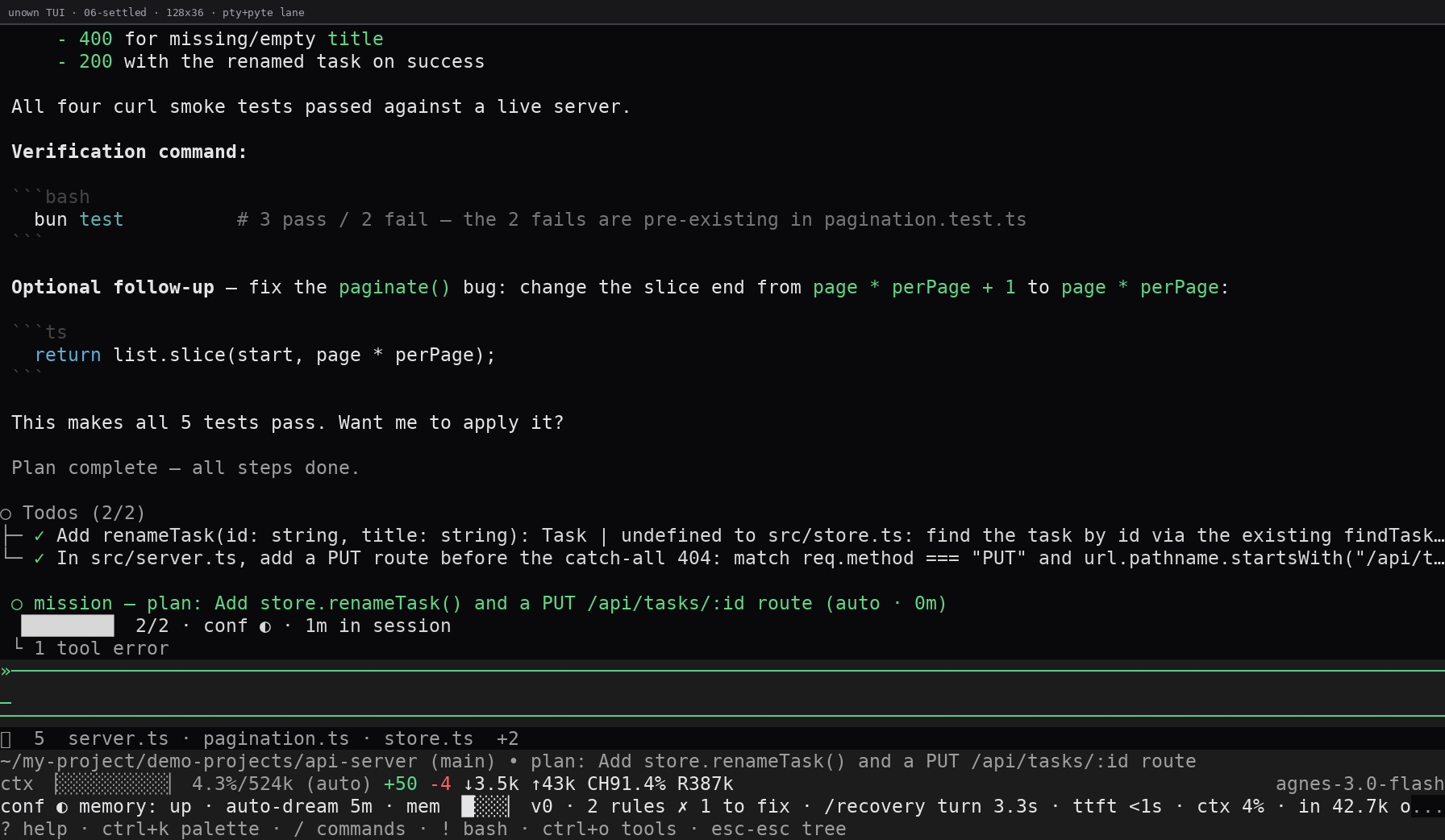
One honest note from the verification runs: the model is allowed to add tasks mid-execution (the todo list is live state, not a prison), so the overlay can legitimately show a task the footer chip doesn't count — the chip tracks the approved plan's steps. That's not a desync; that's the difference between an artifact and a workspace.
The receipts — findings F1–F6, milestones M1–M7, and the resumable session
log — live in
the session doc;
the regression lane is
scripts/tui-capture/verify_todo_unification.py.
Spotted something wrong or worth adding? The record is the repo — open an issue.