3 min readfeature
The sessions round: abort and resume, made consistent
One abort matrix behind Esc, /abort and every protocol; both session stores behind every picker; resume in both grammars the field ships.
- #sessions
- #cli
Every coding agent has the same two moments: the user wants the running turn to stop, and the user wants yesterday's conversation back. The agents that feel good at those moments are not the ones with the most features — they are the ones where the same intent always meets the same behavior, no matter which surface you used.
That is the whole of the sessions round: unown's session abort and resume were correct in every piece but inconsistent as a product. This round made them consistent, then verified the result like a user runs it.
The audit: one behavior, five vocabularies
The code said abort; the keybinding table said interrupt; ACP said
cancel; the fleet said stop. The Esc key could stop a turn, a bash
command, compaction, and a retry wait — but only through four separate
code paths chained onto the escape handler. There was no /abort
command at all, although every other session lifecycle operation ships
one (/new, /resume, /fork, /tree). And the extension API's
ctx.abort() could only reach the agent turn, so a command surface could
never be complete.
Resume had its own drift. The launch picker, --continue, --resume <query>, sessions list, and /sessions list all union the two session
stores (the user lane at ~/.unown/agent/sessions and the project import
lane at <cwd>/.unown/sessions). The in-session /resume picker
listed only the primary store — so a session imported from Claude Code or
Codex was visible at launch and invisible a minute later, inside the
session. And if your muscle memory came from Codex, codex resume had
taught you a noun-verb grammar that unown sessions … did not answer.
One abort matrix
The fix in the engine is one method: abortActiveOperation() — abort
whatever is running (turn, bash, compaction, retry) and tell the caller
truthfully whether anything was. Esc, the new /abort command, the
extension API, and every abort lane ride that one path. A surface can no
longer drift, because there is nothing to drift from.
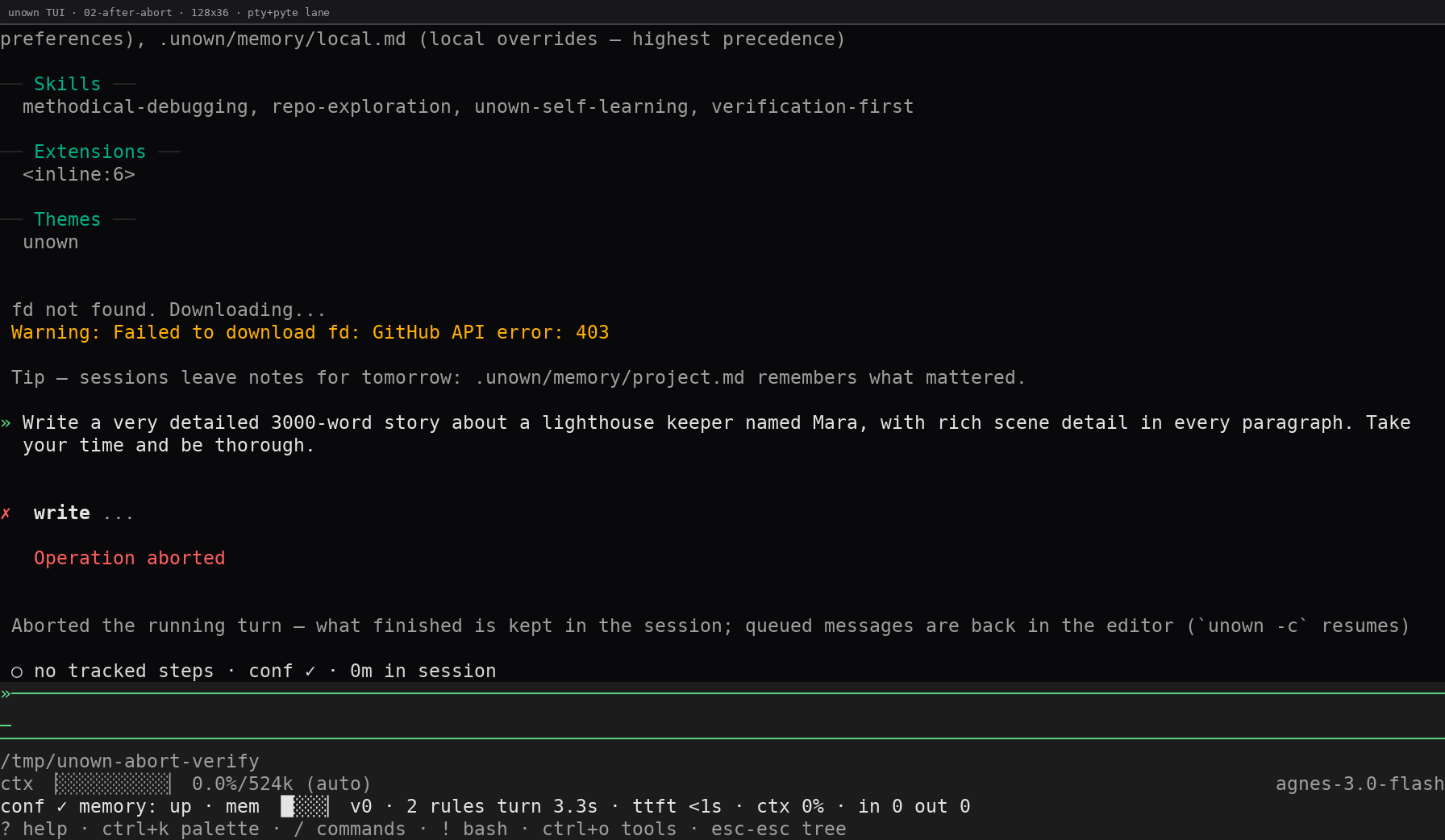
/abort when nothing is running says exactly that — "Nothing to abort" —
rather than pretending. When a turn is running, the partial answer is
kept in the session file with stopReason: "aborted", queued messages
return to the editor, and the notice names the resume command. Aborts
stay cooperative: no process kills, no lost work, nothing re-executed on
resume.
Both stores, everywhere
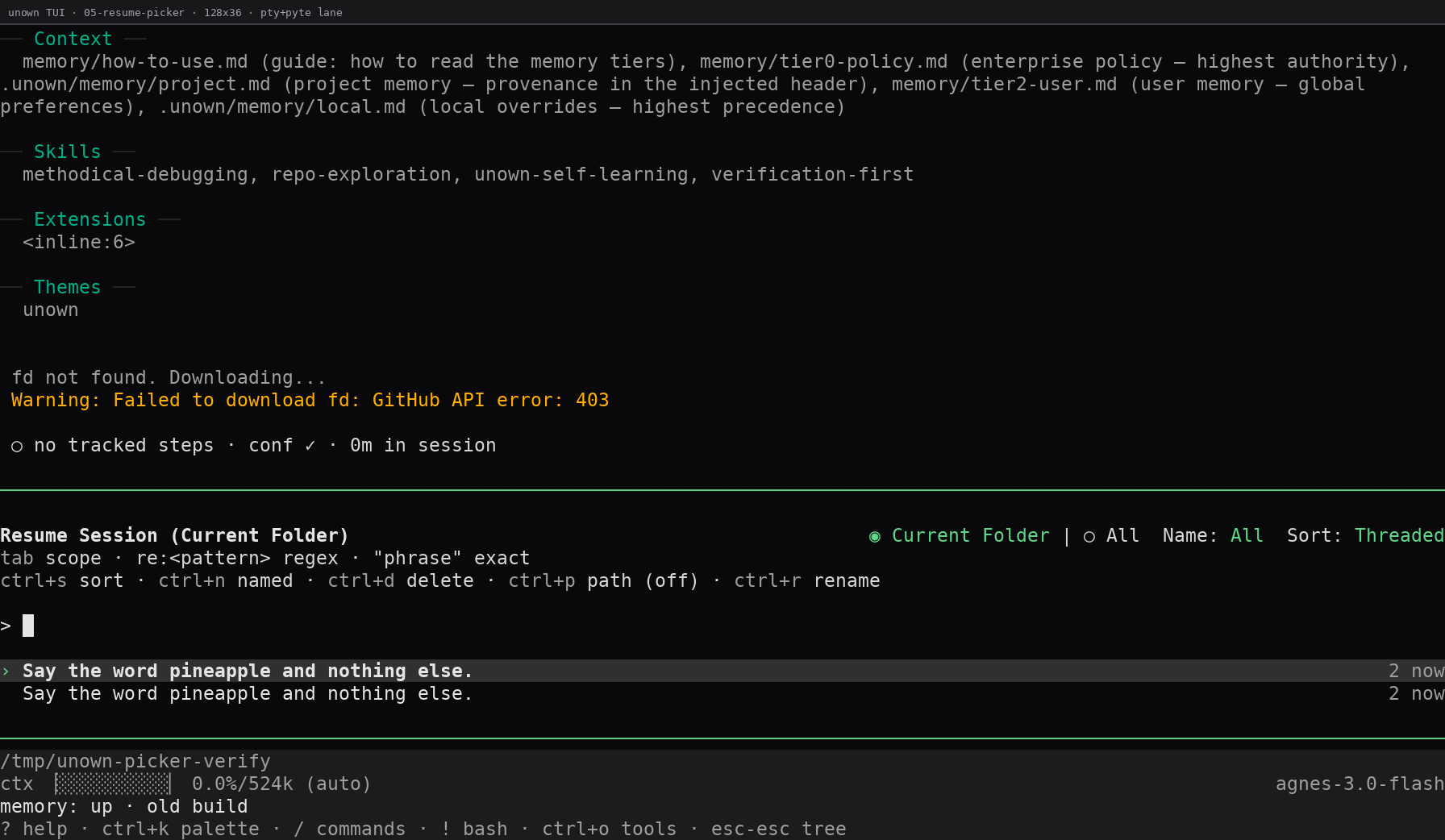
The in-session picker now unions the stores through a wrapper seam in the
vendored pi base (PI_EXTRA_SESSION_DIRS) instead of a unown-only patch
— any wrapper embedding pi can use it. The launch picker's private merge
copy was deleted: both pickers derive from the same mechanism.
Resume in both grammars
Claude Code ships flags (claude --resume); Codex ships a subcommand
(codex resume). Unown now honors both: unown --resume <query> and
unown sessions resume <query> are the same resolution walking the same
ladder (path → id → name, both stores), and everything after the
subcommand flows exactly as it would after the flag — bare is the picker,
-p "…" resumes and runs. One grammar, two spellings, zero divergence.
Verified like a user, not like a test suite
The round's verification booted the real TUI in a real PTY: a long prompt
streamed from the live model, /abort stopped it mid-turn, the session
file was checked for the persisted stopReason: "aborted", unown -c
resumed the same file, and a follow-up question was answered on the
resumed session. A second pass created a session, exported and imported
it through the real CLI, and asserted the in-session picker lists both.
Ten unit tests pin the subcommand rewrite; fifteen pin the abort matrix
and the seam; the suites around them (116 unown + 49 pi tests) stayed
green.
The single page documenting all of it — the format, the matrix, every spelling, crash recovery, exit codes — is docs/session-lifecycle.md.
Spotted something wrong or worth adding? The record is the repo — open an issue.