4 min readfeature
The observability round: can you read your agent's state in 60 seconds?
A mission panel, a 60-second brief, a recovery card, receipts-only confidence and an ambient learning feed — the round the terminal learned to explain itself.
- #observability
- #tui
The mission was one sentence: a developer should be able to leave the terminal for 30 minutes, return, and understand what happened, why it happened, what decisions were made, what was learned and what remains — within 60 seconds. Everything unown already had — the turn meter, the engine state machine, the receipts ledger, an eleven-screen dashboard — was machinery. What the round found, auditing every surface against the seven questions (objective, task, progress, blockers, risks, confidence, next action), was that the machinery was strong and the narrative was missing: nothing pinned the objective on screen, ordinary turns had no progress signal, failures scrolled away, and learning lived behind the dashboard door. The full audit — 22 flagged ambiguities, eight benchmark tasks, a nine-level information architecture — is committed as the TUI observability audit; the field research behind it compared nine systems from Claude Code to OpenHands.
The mission panel
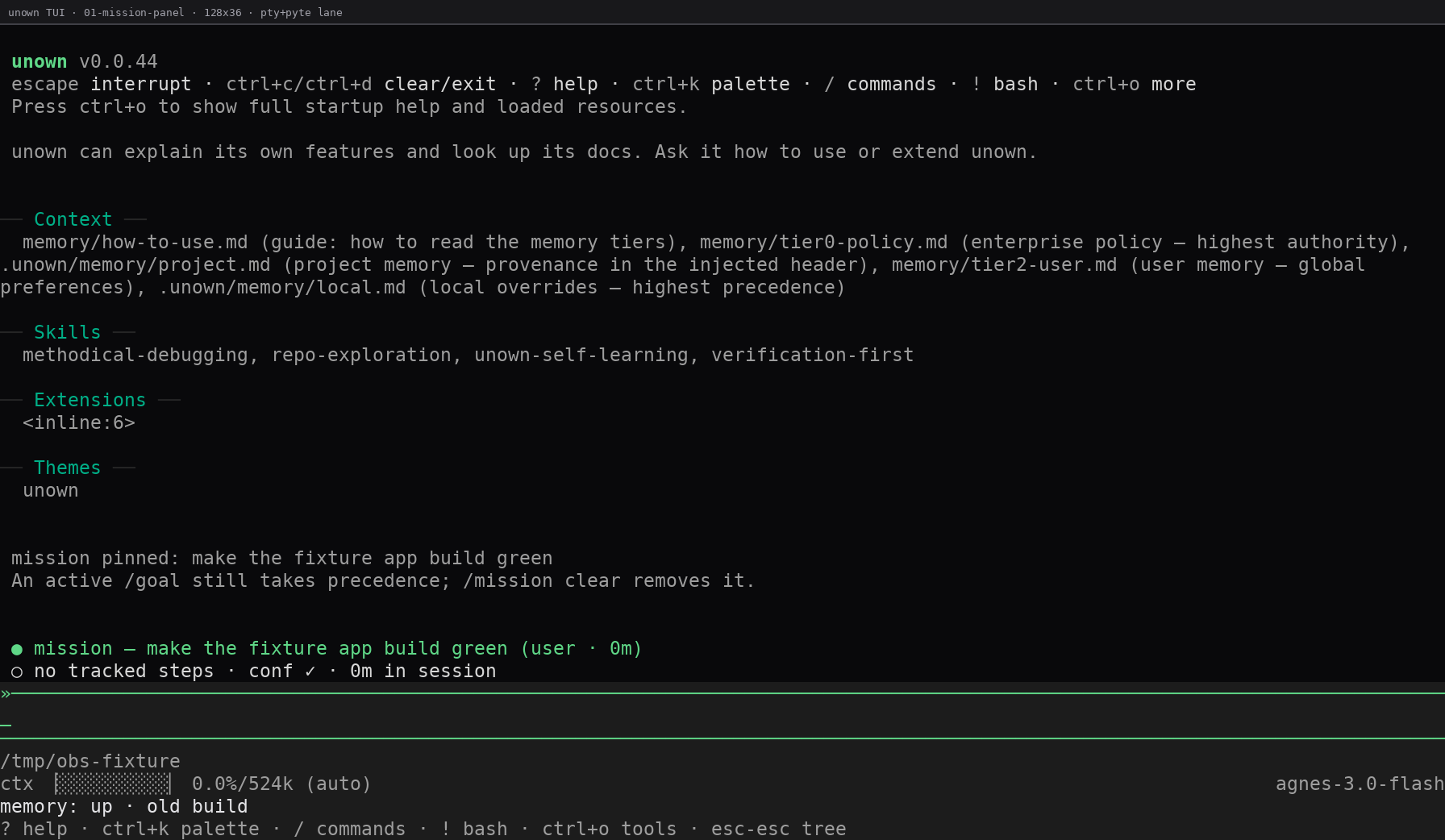
A compact panel above the editor now pins the session's objective — an active /goal wins, else the /mission pin, else the session's own auto-title (the first prompt finally echoes as the mission it becomes). Below it, one status row: the derived progress meter (plan steps while executing a plan, else todo completion, else an honest ○ no tracked steps — never a fabricated percentage), the confidence chip, and the session cost/time rollup. Fresh learning events and composed risks get their own rows only when they exist.
The 60-second brief
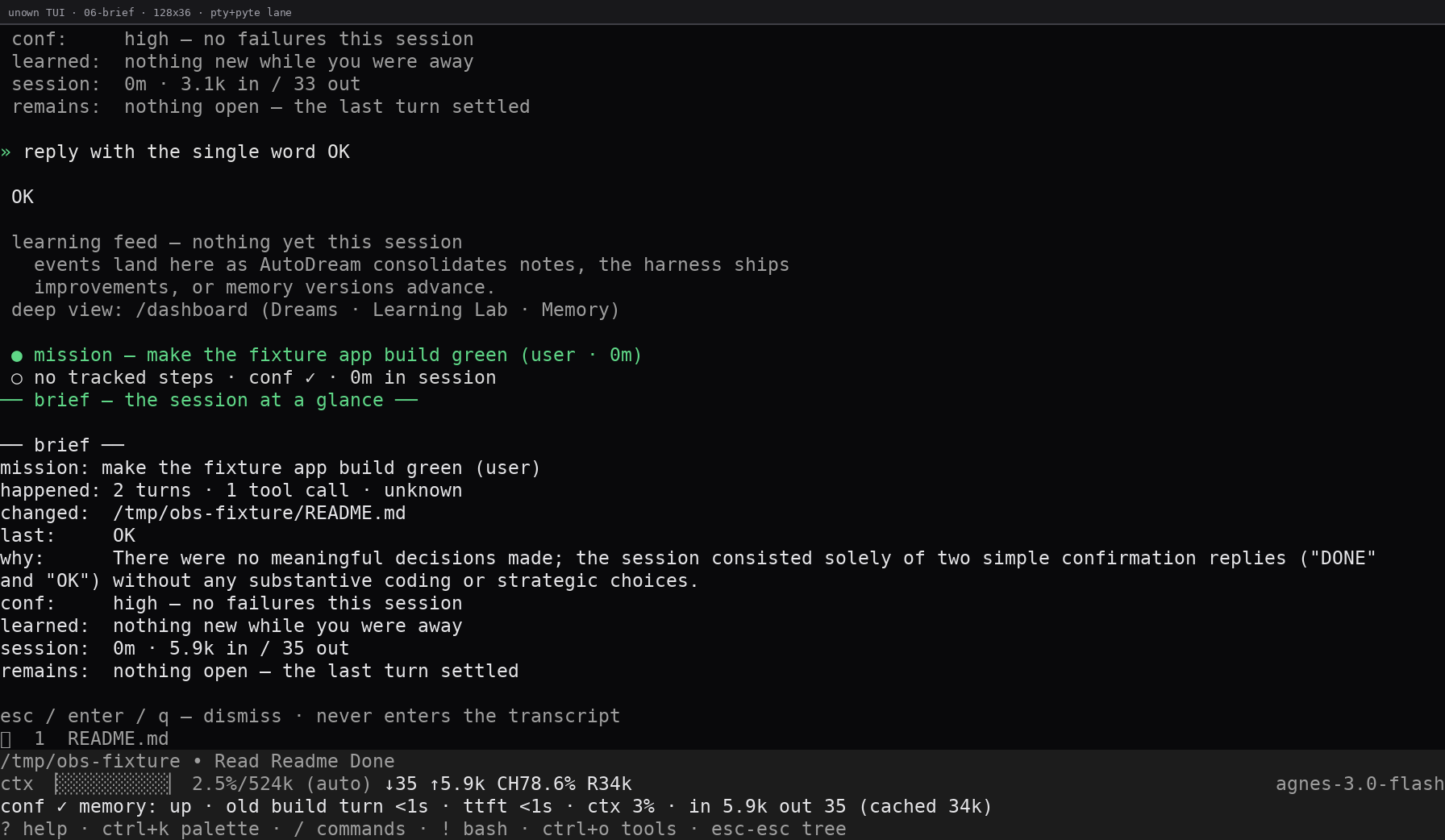
The old auto-recap was activity-shaped: "3 turns, 14 tool calls." The new brief is state-shaped. Return after an idle gap and the next prompt gets eleven lines that answer everything: mission / happened / changed / last / why / conf / risks / learned / session / remains — deterministic, no LLM on the prompt path. /brief renders it on demand and adds the decision miner: one pass through the side-question lane that names what the agent decided and why, never entering the transcript, receipts or AutoDream's mining.
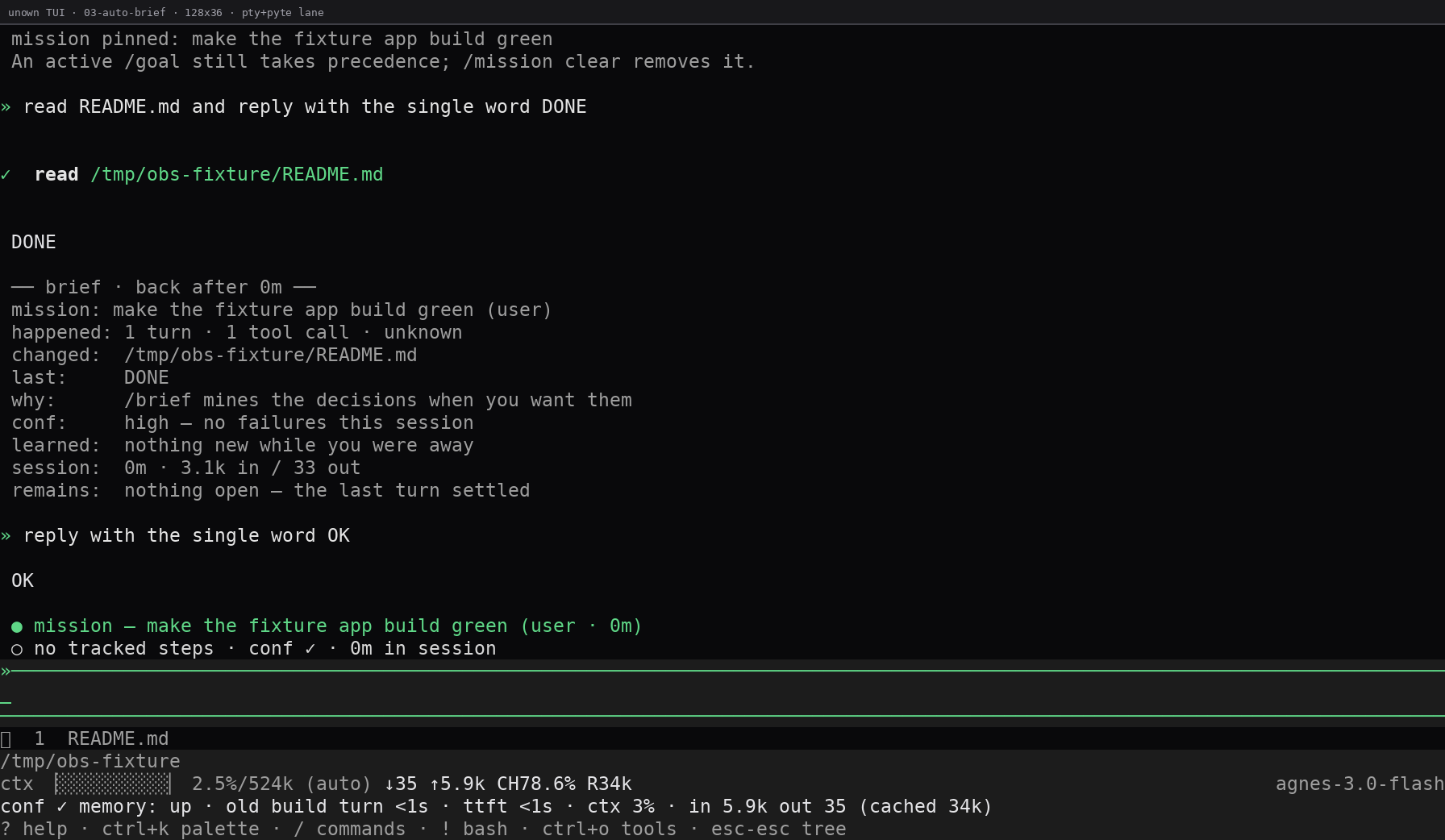
The trust test measured the headline claim honestly: after an 11-minute real idle window, the returning pane answers all five questions in one screenful — and the learned: line reported a dream that actually happened while away (project memory advanced v4 → v5), because the engine kept learning with nobody watching. The receipts are committed as pane dumps — the pane is truth.
/recovery: failures with their fixes
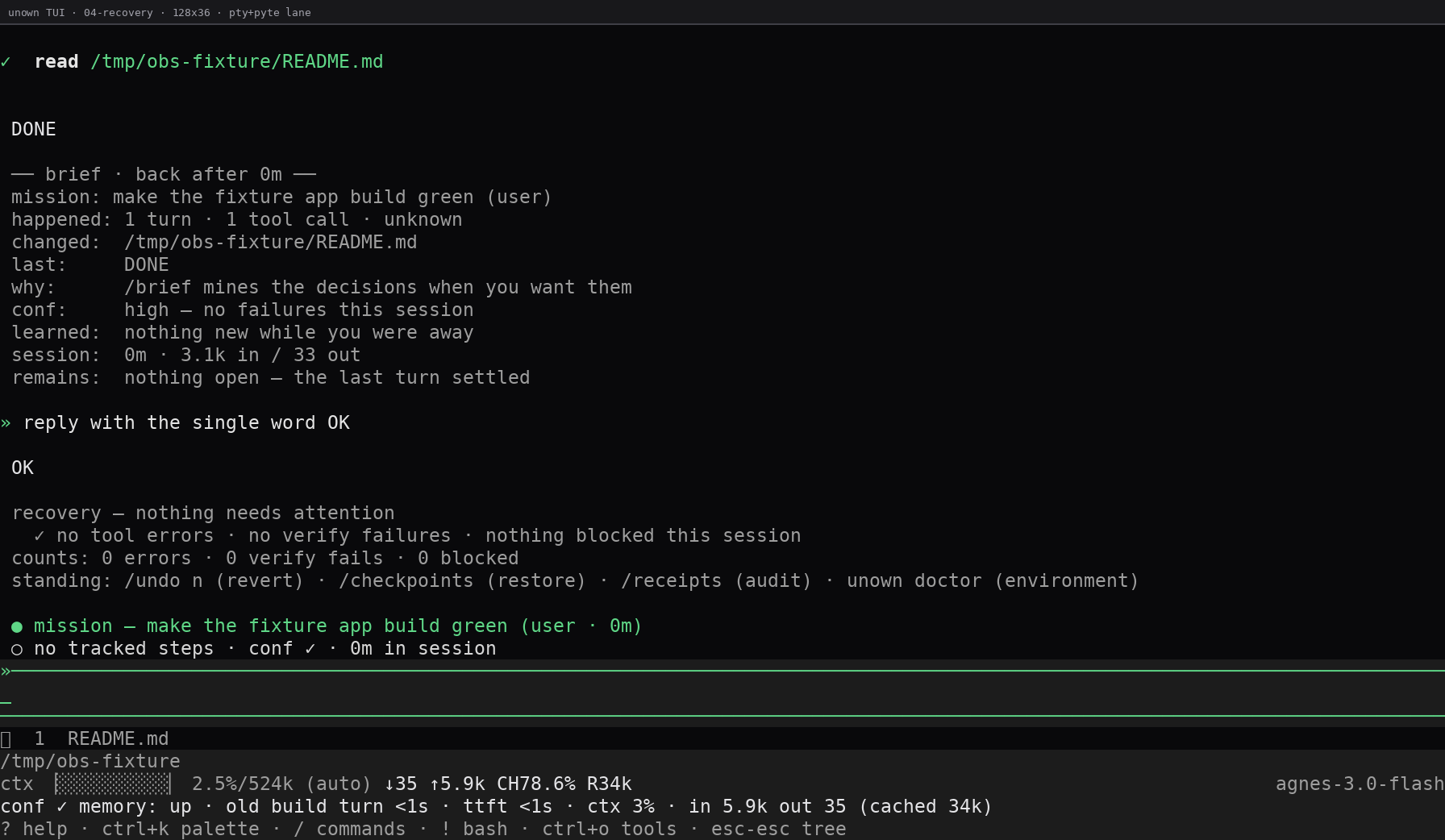
Every ended tool call is classified once — tool error, verify failure, permission denial — from the producers' own markers. /recovery composes them worst-first with the engine state and dead letters, each row carrying its repair path (/undo n, /engine, the dead-letter directory), and the footer shows ✗ N to fix · /recovery whenever anything needs attention. A clean session gets the clean bill — the card is also where you check that nothing broke. The dashboard gained the same answer at mission-control scale: a twelfth screen, Recovery, composing failed jobs, failed runs and recent denials from the existing screens' own data.
Confidence is receipts-only
conf ✓ / ◐ / ✗ is computed from the session's own ledger — tool errors, verify failures, denials — never from the model grading itself. Any verify failure reads low; 1–2 errors or a blocked action reads medium with the drivers named next to the chip. The rules are pinned by tests, and the OB-8 lane verified live that a real [auto-verify] failure flips the chip within the same screen.
The learning feed, ambient
Dreams shipped, memory versions, harness improvements and consolidated notes now land in-session: a ✦ chip counts unseen events, the panel carries the freshest, /feed shows the session's learning history with ages, and the brief reports what was learned inside the away window. The sources are the engine-status probe's existing dream-news gate plus a five-minute overview diff — zero new engine load. And the round's own benchmark caught the honest bug here: events landed in the ring but the chip only painted at the next turn — an idle session learned in silence. The fix (a push-listener that repaints the moment an event lands) is pinned and verified painting itself, live, in the OB-1 receipts.
The dogfood ledger
The round used unown to improve unown, and three real defects fell out, each root-caused, pinned and fixed in-round: the persisted-digest unknown tools (stored entries carry name, the digest read toolName); the silent idle feed above; and the overview diff reading flat keys the engine nests under kpis. A fourth finding corrected the benchmark itself — kill the engine and the supervisor's gated auto-start heals it, narrating memory engine online — learning resumed; the contract is narration, never silence.
What ships in it
The mission panel, /mission, the auto-brief, /brief, /recovery + the health chip, /feed + the feed chip, receipts-only confidence, the telemetry rollups, the dashboard's Recovery screen, 56 pinning tests, the PTY capture/benchmark/trust lanes, and the round's records — the audit, the competitor scorecard, the five user journeys, the trust & transparency report and the UX principles card. One lane is deferred honestly: fleet outcomes in the brief needs the FleetManager bridge, recorded as the next build.
Spotted something wrong or worth adding? The record is the repo — open an issue.