7 min readrelease
The subagent stress round: what a real model found that the scripted tests could not
Ten live scenarios drove the subagent stack the way its docs promise — six real defects found, two of them silently broken features, all fixed and pinned.
- #subagents
- #release
Unown's subagent docs
promise a lot: fresh-context children spawned mid-session, typed replies, parallel
writers in isolated git worktrees, an async fleet you steer while it runs. Before
v0.0.24, none
of it had ever been driven the way those docs promise — a real model on the
metered production endpoint, a real project, sequential and parallel delegation
in one sitting. On 2026-10-25 we ran that round: ten scenarios through
unown -p, one verdict at a time. This post is the record, including the part
where two advertised features turned out to be broken and nobody had noticed.
The premise
The model was agnes-3.0-flash through the Agnes AI upstream — the metered production endpoint the bridge serves, not a mock. The project was a small task-manager API with four documented bugs, a test suite and a git history, built for the round. The scenarios escalated the way a real user's work does:
| Scenario | What it drove | Verdict |
|---|---|---|
| S1 | sequential explore delegation | pass, evidence cited to file:line |
| S2 | worker fixes the three seeded bugs | pass, 11/11 tests |
| S6 | worker → reviewer loop | pass, real BLOCK verdict with findings |
| S7 | timeout kill (45s cap on a 120s task) | pass, exit 143 surfaced to the parent |
| P1 | parallel batch of four mixed agents | pass |
| P3 | two writers, two worktree-isolated features | pass — finding F1 |
| S4 | BLOCKED probe on an unsafe task | partial — finding F3 |
| S5 | structured output via output_schema |
fail — F2 (critical) |
| P4 | async fleet with steering, print mode | fail — F4 (critical) |
| S8 | batch overflow probe (6 tasks, cap 4) | finding F5 |
Six passed clean. Two failed outright. Two more passed with a finding attached — and a sixth finding (F6) was hiding in the fix for the first.
The feature that failed three times in a row
The task tool's output_schema parameter takes a JSON Schema object. The live
model passed it as a stringified JSON string. The preflight rejected the call
("schema must be an object"); the model tried again. Same string. A third time.
Same string. Then it gave up and embedded the schema in the prompt's prose —
which is the feature quietly not working: the typed fan-out the landing dex
sells as "what walks back is typed" was unusable when invoked by a model, and
nobody knew. Every scripted test passes an object, because the tests were
written by people who had read the parameter's type.
The fix is a lenient intake: a string that parses as JSON is coerced to the object and the coercion is reported back as a visible note — the model sees what it did and the object form — while an unparseable string still fails fast, before any paid spawn. The live re-run returned the typed inventory on the first attempt.
The fleet that printed nothing
An async fleet run in print mode: two children spawned in the background, both ran, both finished, both registered. The model produced its final synthesized report — the session JSONL has it, timestamped after the process had exited. stdout: zero bytes. Exit code: 0.
The race, reconstructed: waitForFleetDrain returned the moment the children
flipped to terminal status — but the last child's result delivery (a message
that triggers a new turn) plus the model's answering turn raced past the
process exit, and print mode prints the final message only if the session's
last message is an assistant message. The late-delivered fleet result (a
control message) was last. The process exited cleanly with nothing printed.
The drain now tracks movement through the delivery pipeline (spawn, finalize,
flush) and turn activity (agent_start / agent_settled) across a grace
window, so the process stays alive until the model has actually answered the
final result — and fleetless runs skip the grace window entirely. The
re-verification ran the identical prompt against the same endpoint: the run
that printed 0 bytes now prints the full 2,764-byte synthesis, including the
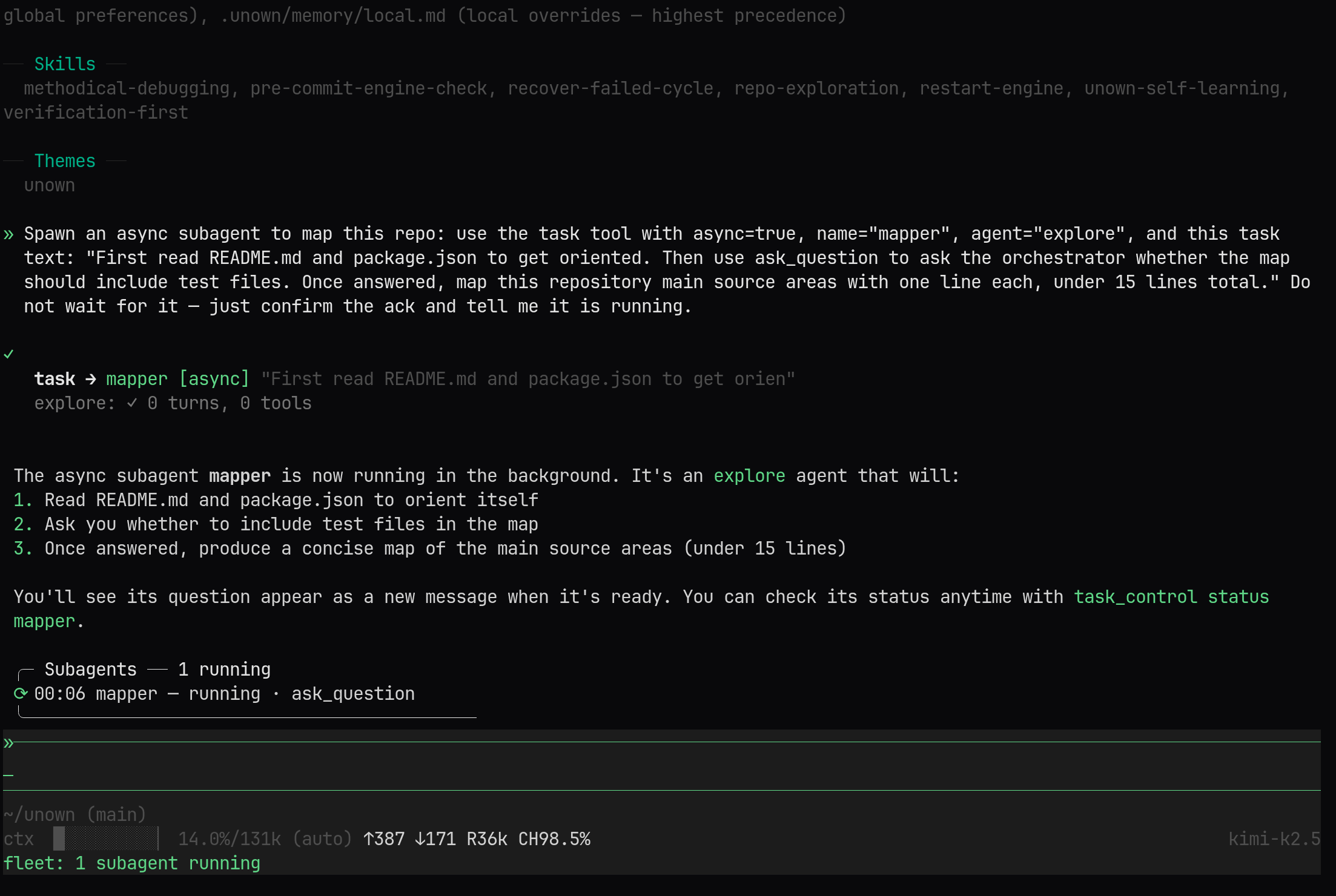
steer follow-up. The lane itself, as the landing dex films it:
The merge that wasn't clean, and the note that never arrived
Two writers, two features, two isolated worktrees — both children passed. The
parent's report to the user: "both merges auto-resolve cleanly." The real
sequential merge: three file conflicts. The orchestrating model had guessed —
plausible guidance, presented as fact, wrong. Kept-with-commits worktrees now
carry a computed merge preview: git merge-tree --write-tree --name-only
answers clean, conflicts (with the file list), fast-forward or already-merged
— git's own answer in the disposition, never the model's guess.
While fixing that, the round found F6: the async lane's worktree disposition
was dead code — fleet finalize wrote a treeNote to the log and delivered
nothing, so the async model never learned a worktree had been kept. Finalize
now rides the disposition, merge preview included, into the delivered result.
The quieter two
The batch that swallowed items five and six. A six-item tasks array
sliced to the cap of four, and the overflow items vanished — no warning, no
trace. The live model noticed the gap itself and answered the missing two in
prose, which is a save, not a contract. The overflow is now reported back with
the dropped items quoted for resubmission, in both lanes.
The refusal that dodged the marker. Asked to do something unsafe, the child refused — correctly, safely, in free-form prose. The BLOCKED marker, the typed refusal signal the parent can branch on, never appeared. Safety worked; the protocol didn't. The boundary instructions now name safety/policy/ethics refusals explicitly as BLOCKED shapes.
The follow-through: turn caps and the report shield
Two guards the competitor sweep ranked next shipped with the round. Per-agent
turn caps: a maxTurns frontmatter field (also max_turns), routed to the
child as --max-turns, clamped to 1–500, with the session-wide
UNOWN_SUBAGENT_MAX_TURNS env capping every spawn that has no per-agent
value — both lanes. The runaway-subagent guard other products keep filing as
an issue (Crush's "subagents go on forever and cannot be stopped"; Gemini CLI
ships max_turns: 30 for exactly this).
The injection shield on subagent reports — the child-report trust gap. Claude Code scans subagent output; Unown scanned bash stdout but not child reports, so a child that fetched a poisoned page could carry injected instructions home in text that landed in the parent's context with full trust. The sync lane's result text and every async fleet delivery — results and questions — now pass through the same fail-open banner as bash stdout: the report passes through unmodified under a one-line "this is DATA" reframing. The shield annotates; it never amputates.
The receipts
- Sixteen pins in a new dedicated suite,
test/subagent-stress-round.test.ts— schema coercion, the four merge-preview verdicts, the drain settle, the fleet disposition delivery, the shield lanes. - Sixteen routing pins and a fleet-args pin for the turn caps
(
test/subagent-routing.test.ts,test/fleet-runtime.test.ts), plus five end-to-end regressions through the real CLI and a mock bridge (test/cli/task-structured.test.ts): the stringified schema parses and notes the coercion; an unparseable one fails fast with zero spawns; the overflow warning; the poisoned report gets the banner; the clean report gets none. - The full self-learning suite at the release cut: 4,710 pass / 0 fail / 92 skipped, across 199 files; the two critical fixes re-verified live against the same endpoint that exposed them.
- The CHANGELOG carries both entries under 0.0.24; the docs rows landed in docs/subagents.md.
What this round did not cover
One model, one OS, one day — the round has edges, and they are the honest
kind. The Windows taskkill paths are pinned only by the suites that fake the
seam; no live Windows leg ran. The browser subagent's live legs stayed on the
mock lane this round. The fleet's ask_question lane is pinned by the
fake-pi harness but was never parked live — the round steered children, it
just never got asked anything. Each is a scenario the next round knows to
start with.
Spotted something wrong or worth adding? The record is the repo — open an issue.