5 min readrelease
The hardening round: the verdict on the detached engine
We re-litigated the core USP's architecture against ten competitor repos and 54 sources. The detached engine stays; six honest-failure lanes ship in v0.0.28.
- #engine
- #release
The memory system is Unown's core promise, and it lives in a detached daemon:
the self-learning engine on :3030, running harness cycles, AutoDream
consolidation and the job router while your terminal sessions come and go.
This round put that architecture itself on trial — is the detached process
approach stable, viable and scalable, or should the memory system move into
the agent process? The trial had teeth: a ~54-source landscape survey, a
source-level reverse engineering of ten competitor repos at pinned SHAs, and
a full codebase walk of the live supervision stack. The verdict and the six
lanes it shipped are v0.0.28.
The verdict: retain — and the evidence that decided it
The question was not "is our engine good" but "is the shape right". So the research read the shape everywhere it exists in the wild (the survey, the source deep-dive):
- Interactive coding agents (Claude Code, Gemini CLI, Cursor, opencode, Aider) run files + in-process memory, zero daemons — but none of them consolidate memory in the background. Their memory is static between sessions.
- Every system with continuous consolidation runs a detached process. Letta's sleep-time compute is a second agent on the server. Cognee anchors pipeline tasks in a registry and drains it at shutdown. MemOS's local plugin is a per-agent TypeScript daemon over better-sqlite3 with a KeepAlive supervisor — the closest thing in the industry to our engine.
- The killer precedent: OpenAI ships
codex-app-server-daemon. A detached, pidfile + file-lock managed local daemon with a lifecycle CLI,shutdownGraceSeconds, and an embedded fallback. OpenAI converged on the hybrid we already run, almost feature-for-feature. - The embedded alternative is worse on the axes that matter. Bun issue
#40659 —
BEGIN IMMEDIATEdoes not exclude across processes on Windows, closed as not planned — makes the single-writer daemon the only durable SQLite shape. And embedding puts twenty-minute watchdog'd jobs inside the interactive process: a wedged dream would wedge your terminal.
The full decision record, with every claim tiered [V]/[C]/[U], is
docs/detached-engine-hardening.md.
The six lanes that shipped
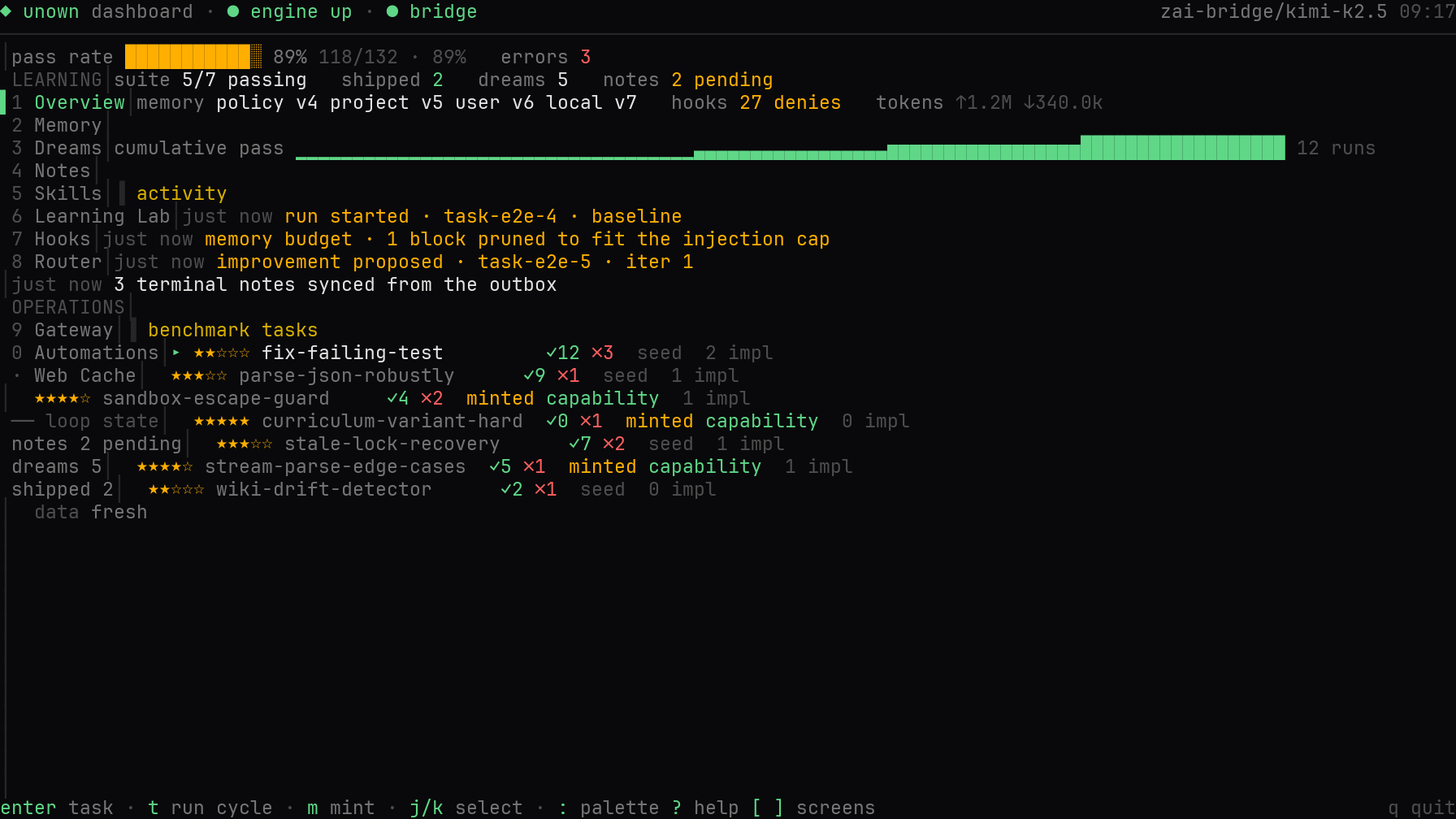
The sweep confirmed the architecture was sound; what it exposed were honest-failure lanes — places where the engine failed silently instead of leaving a record. Six landed, each mapped to a published precedent:
H1 — the outbox dead-letter lane. A note queued while the engine was down
used to be retried every drain pass forever, silently if its ingest kept
failing. Now it gets five attempts (tracked per-file with the last error),
then moves to notes/dead/ with a .reason.txt sidecar — never deleted,
mv it back to retry. The dead count surfaces in /engine, unown doctor
and engine status. The precedents: MemOS's dead-letter quarantine and
Graphiti's acknowledged-then-dropped queue loss.
H2 — delivery retry-before-outbox. A note whose POST fails on the network gets one bounded ~600 ms retry before the durable fallback — a note landing inside the engine-restart window delivers directly instead of waiting for the five-minute sync drain. HTTP error statuses never retry: an answering engine is a deliberate response.
H3 — /api/health with lifecycle phases. A cheap probe answering
{phase: warming | ready | draining, pid, drainBudgetMs, version} — no
500-run scan. The phase flips to draining the moment shutdown begins, so a
stopper can wait out the drain instead of racing it. The codex daemon
contract.
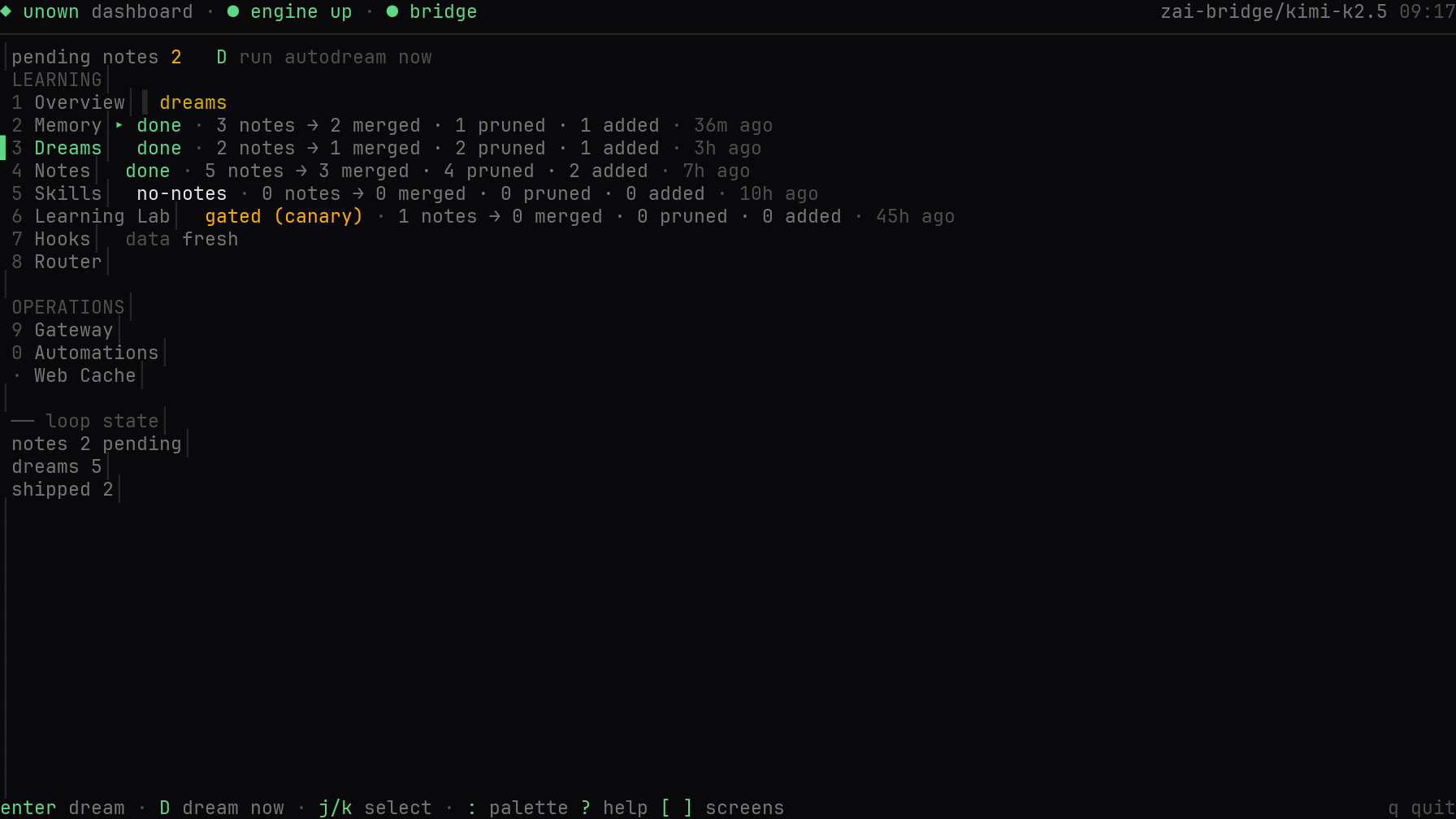
H4 — the in-flight job drain registry. A SIGTERM under a live dream used
to close the store under it — the dream row stayed running until the next
boot's orphan recovery healed it, and the half-finished work was lost.
Shutdown now refuses new jobs (a 409-class conflict) and waits for the
in-flight job, bounded by UNOWN_ENGINE_DRAIN_BUDGET_MS (10 s default), then
closes honestly under anything that overruns. Cognee's background-task
registry is the precedent.
H5 — Windows pidfile recovery. The cmd /c start /b escape hatch
(bun#31603) never learned the engine's pid — cmd.exe exits right after
start — so the pidfile was never written on that lane and engine status/engine stop were Windows-blind. The supervisor now polls the engine
post-spawn (bounded, foreign-port-aware) and writes the pidfile from the
health probe's own pid.
H6 — cross-install token discovery. A binary install probing a
source-repo engine used to get 401 forever — each install shape reads its
own data dir's token. The engine now mirrors its per-boot token to
$UNOWN_HOME/engine.token — the one tree every install shape resolves
identically — and clients resolve own-first/shared-second, re-presenting the
other side on a 401. The split heals on the first request.
What was deliberately not done
The record also names what we chose not to ship, and why: an embedded fallback mode (our gated spawn + outbox already cover it, and it would fight the single-writer rule); an embedder child-process worker (the ONNX lane already degrades to the lexical embedder at load time, and dream idempotence makes a mid-extraction crash lossless); and always-on OS services for compiled binaries — genuinely the biggest remaining reach gap, and deliberately out of this round's scope with the design work named.
Receipts
- The verdict record: docs/detached-engine-hardening.md
- The survey and the deep-dive: detached-vs-embedded · competitor source deep-dive
- The changelog stop: 0.0.28
- The knobs:
UNOWN_OUTBOX_MAX_ATTEMPTS,UNOWN_ENGINE_DRAIN_BUDGET_MS— docs/configuration.md - The suite at the cut: 4,924 pass / 0 fail across 208 files (44 new tests in
five new files), plus live receipts — a SIGTERM under a live
auto-dreamlogging the bounded drain wait, both token files removed at drain, a clean re-boot toready.
What ships next is named in the record's not-done list — the binary install's always-on engine is the standing candidate, with the design work it needs already written down where the next round will find it.
Spotted something wrong or worth adding? The record is the repo — open an issue.